
Ballots Over Bullets: An Initiative to Promote Peaceful Elections in Côte d’Ivoire
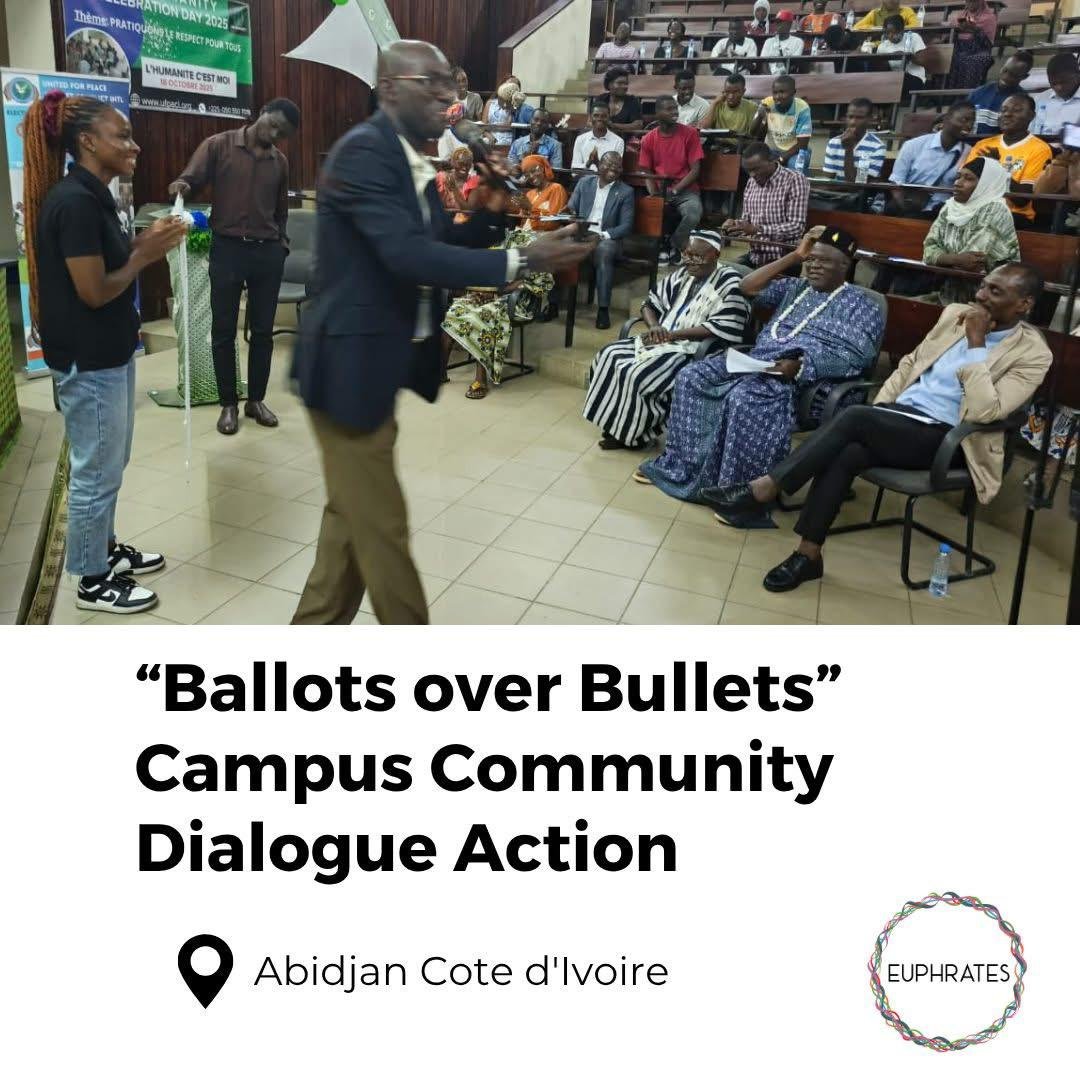
At Université Nangui Abrogoua in Côte d’Ivoire, a message echoed across the University campus: the future of democracy lies not in violence, but in conscious civic engagement.
Under the theme “Ballots over Bullets: Elections Beyond Wars,” a seasoned peacebuilder, James Offuh, convened an interactive campus dialogue, bringing together a diverse group of stakeholders, including young people and community leaders, to reflect on their role in promoting peaceful elections.
The dialogue served as a timely reminder that peace begins with individuals, in how we vote, how we engage, and how we speak about one another.
Why “Ballots over Bullets”?
Côte d’Ivoire continues to navigate a post-electoral crisis between 2010 and 2011, a period that claimed over 3,000 lives and left deep scars across the country. Beyond the immediate human cost, the crisis fractured social cohesion, fueling fear, xenophobia, tribal divisions, and religious tensions.
Student groups such as the General Association of Pupils and Students of Côte d’Ivoire and the Student and School Federation of Côte d’Ivoire have, at times, been drawn into political rivalries, leading to recurrent clashes on campuses. These tensions often spill over into surrounding communities, igniting cycles of division and mistrust.
It is within this context that the ‘Ballots over Bullets’ initiative was introduced by James Offuh to not only be a response to past violence but also as a preventive intervention ahead of the October 2025 presidential elections. At the heart of the “Ballots over Bullets” dialogue was a critical issue: electoral dehumanization. The tendency to view political opponents as enemies rather than fellow citizens. This mindset often fuels hate speech, which can quickly escalate into physical violence within campuses and wider communities.
The response from students was overwhelming. While organizers anticipated 100 participants, over 150 young people actively engaged in the discussions. Many described the theme as both timely and necessary, reflecting a shared recognition of the urgent need to rethink how politics is practiced and experienced at the grassroots level.
Participants engaged deeply, sharing personal experiences, challenging assumptions, and collectively exploring ways to replace hostility with understanding.
Through the facilitation of safe spaces for dialogue, the initiative aimed to reduce tensions and equip young people with the social skills necessary for peaceful civic engagement. The initiative has since gained attention through radio and television platforms.
To ensure continuity, a Campus Sustained Dialogue Action Network (CSDAN) has been established as a student-led network dedicated to promoting peaceful coexistence and nonviolence within the university community. The Campus Sustained Dialogue Action Network (CSDAN) will also serve as a safe space for ongoing dialogue and healing.