
Power, Peace and Diplomacy: A conversation with John Negroponte
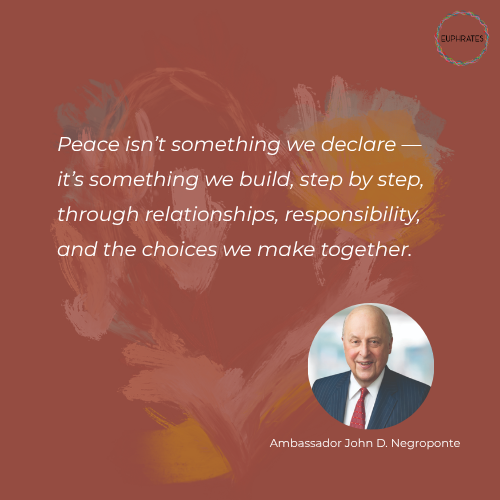
We are experiencing rising global tension, shifting power dynamics, and deep uncertainty. April’s Global Connections conversation offers a window into how seasoned leadership makes sense of it all. Ambassador John Negroponte joined Janessa Wilder in a candid and wide-ranging dialogue shaped by more than four decades of global service. From his roles as U.S. Ambassador to the United Nations, Iraq, and Mexico to serving as the first Director of National Intelligence and Deputy Secretary of State, Negroponte brings both historical perspective and lived experience to today’s challenges.
Together with voices from around the world, the conversation explores the limits of force, the importance of relationships and governance, and the quiet, persistent work of building peace from the ground up. As Negroponte reflects, “You’re not going to change things without effective political action,” reminding us that meaningful change requires both courage and participation from leaders and citizens alike.
We invite you to read the full transcript below and / or Click here to watch the call recording.
Call Nuggets
Force has limits and often raises more questions than answers. Ambassador Negroponte underscores that while force has historically been used at scale, its effectiveness and legitimacy are never guaranteed.
Peace is built through systems - governance, economics, and relationships. Ambassador Negroponte He emphasizes that stable governance and economic interdependence are foundational to peace. “Economic relations are an essential part of international relations… it can really contribute significantly to an atmosphere of normality and tranquility between countries.”
Civil society matters, but political action drives change. Grassroots efforts are essential, but lasting change ultimately requires engagement with formal political systems. Negroponte suggests, “You’re not going to change things without effective political action.”
Progress is possible even in divided systems. Despite dysfunction, there are real examples (like the Montreal Protocol) where persistence and collaboration led to global impact.
Janessa Wilder: The news unfolds… intensity every hour, it seems, and I just want to start with the elephant in the room, and that is Iran. And the question I want to ask about that, obviously we don't need to get into the nitty-gritty, but it's really that we're seeing force—this is a peace organization—we're seeing force used in such a major way, and now even threats of force, perhaps even to civilian infrastructure, being issued. And so, in your experience as a diplomat and also on the intelligence side, when have you seen military action bringing about a real solution? And when have you, perhaps, seen it deepen the crisis, and… where do you think we are now?
John Negroponte: Great questions. Thank you to the Euphrates Organization for having me. I just want to say, first and foremost, because Janessa and I worked in Baghdad at the same time, that she was a real star at the embassy, and I, for one, regret that she left the government. I think we should keep good people in government service, and Janessa was one of them. We need good people in our government, no matter the time, no matter what you think of your president. We need people who are willing to carry out honest government service. So, that's my sales pitch for government work. I did it for 44 years. I probably would have done it longer if they'd asked me to do something else, but I think they said, well, we gave this guy enough chances, and so that was it.
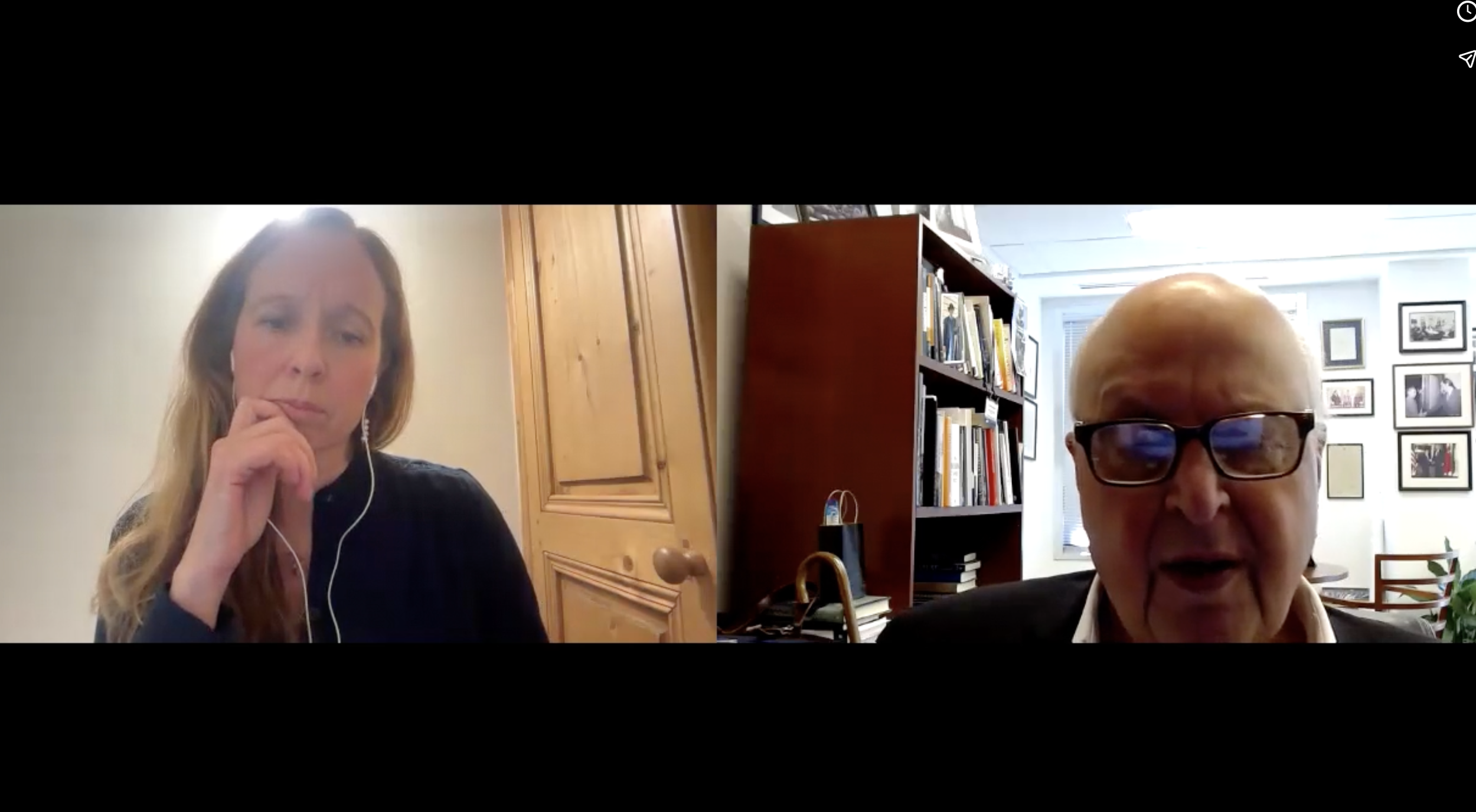
Janessa: They'll probably bring you back.
John Negroponte: Well, I'm not sure I have the energy anymore. You know, I walk with a cane now, and…
Janessa Wilder: Still indomitable.
John Negroponte: So, now you gotta tell me what your question was again.
Janessa Wilder: It was about Iran, and this use of force, and when have you seen force actually accomplish, you know, lead to a real solution? And when have there been limits to that? And where are we now?
John Negroponte: Well, why don't we just generalize for a minute and say, you know, Americans are used to using enormous amounts of force in warfare. You just think about it—Ulysses Grant, Sherman's March on Georgia. Franklin Roosevelt, who's one of my real heroes in history, but boy, did he let his military, and then Harry Truman after him, resort to, I mean, many would say, extremes of force in the way German cities and Japanese cities were obliterated. Mr. Trump uses the word—I think those guys really believed in doing it. And when you look at the bombing of Dresden, you look at Hiroshima, Nagasaki, and the word—that dread word—which must send shivers through everybody else's hearts when Americans use it, the term unconditional surrender, which means you'll go to pretty great extremes of the use of force in order to achieve your objectives.
So, let's just agree that what is the proportional and proper level of the use of force in conflict? And, you know, that is an issue that has challenged many people, many minds, many leaders, many soldiers over the generations. It's not a new issue, but it's facing us now in another and rather dramatic way. I mean, Mr. Trump is giving this ultimatum. I don't know what's gonna happen at 8 o'clock tonight. I really don't. But you can see where you cannot escape charges of the improper use of force if you commit and carry out the destruction of every bridge in Iran. I mean, not every bridge can possibly contribute to the war effort—maybe very few indeed—and it sounds like a potential reign of terror. So, I don't think there's any way of saying it. And then you have the question of whether it'd even work. What did it achieve? After all of that, and the controversy that's going to inevitably surround that, if it's really implemented, you're gonna have arguments about whether it was even effective, let alone legal, right?
Janessa Wilder: Can I appeal to your historical perspective for a moment, Ambassador? Because you started your career in Vietnam, you were there in Iraq, and, you know, conflict spots, hot spots around the world through your service. Do you feel like we learn the lessons from the previous wars, or do we sort of base our next decision on the immediate war following, or are we learning from our history as Americans and in our foreign policy?
John Negroponte: We do, but I think we do it imperfectly. And people don't really remember exactly what the last war was like, and then they have their own image of what that war was. You and I can… we can have a talk here about the Vietnam War, and I can probably give you, you know, three or four different versions of what that was about. And so, we work from imperfect historical recollection. We have a recollection, but I would say it's not perfect—that's one thing I'd say. Second, and you've got to understand, I've been a warfighter. I'm not… and I've also been a diplomat and a peace negotiator.
Janessa Wilder: Can I ask real quick, which was your favorite of those roles?
John Negroponte: Being ambassador to Mexico and supporting the negotiation of the North American Free Trade Agreement—that was my favorite role. It's constructive, it promoted the relations between our two countries, and it's reached the point where Mexico is our largest trading partner, and we have $800 billion two-way trade between Mexico and the United States. And I mention that example because economic relations are an essential part of international relations, and if you can get it right, it can really contribute significantly to an atmosphere of normality and tranquility between countries. I mean, what Mexican or American is unhappy? Now, some are—yeah, some criticize NAFTA—but most don't, and it's brought a lot of prosperity to a lot of people on both sides of the border.
Janessa Wilder: And as you've said before, trading partners and fellow democracies do not tend to fight each other. Let's build those boxes.
John Negroponte: That's a very good point, and I think it goes to a question I think you flagged for me in the run-up to this meeting, which is, what are some of the factors that really contribute to the potential—or contribute to peaceful conditions—between countries? And I definitely think that governance and the nature of that governance, especially if it's democratic, can play a very important role in serving as a building block for peace. And we do say—we tend to say—that democratic countries do not attack each other. Now, I'm sure we can find examples of democratic countries which have attacked each other, but as a general rule, if you have an environment of good governance in a region, let's say, and you have a tendency towards democracy, that can be a very positive factor in building a peaceful environment in that region. And when you think about it, thinking about building peace in a region is not a bad way of thinking about peace generally, because you gotta start somewhere—and obviously it starts with individual countries—but what's next?
It's maybe the peacefulness of a particular region, and you know, the founders of the UN debated this in a certain way. They debated whether the Security Council should be global in nature, have one Security Council representing the whole world and the search for peace in the whole world, or should they have regional peace organizations—a Latin American one, an African one, maybe linked in some overall kind of way by the United Nations, but the actual mechanisms would be regional—regional peacekeeping, regional peacebuilding, and so on and so forth. So, yeah, I think you can make an argument that in many instances peace depends, in the first instance, on a country itself, but then next, I’d say, in working to build peace in different regions—West Africa, the Organization of American States, the African Union, which has made a fair amount of progress in the last 20, 30 years, better than when I first remember it, and so on and so forth.
Janessa Wilder: There’s a lot of folks on this call, too, who have worked with the United Nations as civil society, and of course, we’ve all attended lots of conferences there, and I… as your former role as Ambassador to the United Nations, how are you seeing its relevance and its involvement, as it is increasingly sidelined, it seems certainly in this conflict, but in general? How do you see its role? How can it maintain its relevance and involvement in the state that it’s in right now?
John Negroponte: Well, I don’t think it’s the UN’s fault that sometimes it lacks relevance. It’s because one of the great powers—let’s say one of the five members of the Security Council, like the U.S. or Russia, or China, to mention the three probably most important examples—don’t want to follow the rules. They don’t want to subject whatever particular dispute is involved to the jurisdiction of the United Nations. They say, well, it’s too important for us—we’re not going to leave it to representatives of the international community to tell us whether or not we can do what we think we ought to do. I spent 15 years of my life working on Vietnam, first in the field and very exposed to the war. I had provincial reporting assignments where I went out. I didn’t dispense aid or anything like that. There were other people that did that, but I didn’t do that. But yeah, the PRT [Provincial Reconstruction Team] is somewhat of a descendant of what we did in Vietnam.
Janessa Wilder: I see some questions already popping up in the chat. I’m trying to cover several different bases. My next question is about the grassroots level, and I think, for those of us working for peace assiduously at the community level and the local level, it can sometimes feel that that work is not paid attention to or is discounted by folks at the top. And so, I would just say, how do you view the role and import of civil society? How did you connect with civil society in your role as U.S. officials? And what is vital about the work of those of us in grassroots efforts?
John Negroponte: I’ve watched over the years how many international organizations, including the UN, made serious efforts to incorporate—to allow NGOs and others in the private sector to express their views before the United Nations. At first, being a somewhat stuffy and conservative diplomat, I thought, why should we listen? But anyway, now it’s a fact of life. All these people are registered—or many of them, the larger organizations anyway—are registered with organizations like the UN and have the right to speak, right?
Janessa Wilder: And how do you feel like that is… is it diversifying the voices that are heard? Is it connecting policy to the ground level, where that policy is actually enacted? How do you think that is important, and how do we improve those connections between civil society and—
John Negroponte: You have to say to yourself and adopt as a policy that even though we’re the ones who make the political decision, because that’s the way the system is organized, you can’t spend all your time trying to change the system, right? Some people beat their heads against the wall, saying, we gotta get rid of the veto, or we gotta have weighted voting, or we gotta expand the Security Council. But, you know, there’s very little chance of expanding the Security Council because the Russians and the Chinese won’t have it, and they have the right—
Janessa Wilder: For the U.S.?
John Negroponte: Or the U.S., but it’s more the Russians and the Chinese. I think Mr. Biden had a policy of wanting to expand the UN, but, you know, how do you get past those vetoes? Just to digress for a moment, some people say, let’s get rid of the veto. Something you need to remember, if you’re in favor of that, is that Franklin Roosevelt did not believe he could get the UN Charter ratified by the Republicans in the Senate back in 1945 if we didn’t have the veto. He was told by Senator Vandenberg, who was a political hero of sorts—he was the Republican minority leader of the Senate, or he may have been majority at one point, I think the Republicans had the majority back then—he supported the creation of the United Nations, but he had one condition, and that was we have to have a veto to protect the core interests of the United States. I think people pay more attention to the NGOs, to the individual citizenry, and of course to the press. We’ve always paid attention to the press.
Janessa Wilder: I want to ask you the same question I asked you a couple weeks ago and see if your answer’s different. It’s basically this question—my feeling, and again, you have four decades of experience, multiple wars—I feel like these are unprecedented times. And your response was more measured. I would love for you to share with all of us: what is your gut feeling? What is your analysis of this moment that we’re in now?
John Negroponte: Well, I think it’s very tense. I think it’s… I don’t know, I don’t want to put it on a scale of gravity or seriousness, but it’s very, very serious and very dangerous. There’s no question it’s high up on the scale. But when you compare to the Holocaust, you compare it to some of the things that happened this morning—
Janessa Wilder: Fair, I think you have mentioned trench warfare, World War I.
John Negroponte: Gas warfare—gas warfare, which was a big thing in World War I. The carpet bombing. I mean, I’m not saying what happened in ’45 was more serious than what’s happening now, but let’s not act as if—or let’s not convince ourselves—that we’ve never been through something like this, because we have. We have, and what we’ve got to do is figure out a way—and there the President and others have a responsibility—to come back to our senses and put this back in some kind of framework that we can deal with. Not easy, it’s a tall order, but that’s sort of what the problem is.
Janessa Wilder: And you think that… that we can? You have faith?
John Negroponte: Well, I’ll never say never. I mean, he’s certainly found out that things don’t happen quite as automatically as he hopes they will, and I don’t think he wants to fail. I don’t think he wants to go below 35% popularity, nor does he want the economy to tank, right? I mean, I think he's got some fairly…he's got those basic political instincts, so he's got to think about the impact of his actions, among other things, on his own political standing—first of all, before the American people, and then, of course, secondly, before the world as a whole. And I don't think he's done a good job of it, and it seems like the American people would agree with that statement in terms of how his popularity has fallen. I think the upcoming midterm elections in our country are extremely important. And if you want people to express how they feel about Mr. Trump's policies, you've got to help the get-out-the-vote movement, because, yeah… I don't think he's going to do very well.
Janessa Wilder: Thank you. We will now open it up to those of you who have questions. There's already a few in the chat, and there's the react button at the bottom—you can raise your hand. Ambassador Joanne Cummings is on the call. She asked a great question in the chat. Joanne, if you're there—we all worked together, Joanne Cummings, in Iraq—if you can unmute, you can ask your question directly.
Joanne Cummings: First, Janessa, thank you for crediting me with an ambassadorship that I did not earn, but, you know, I'll take that. The question I have is, having served a career in the diplomatic corps and spent lots of time in the Middle East, both growing up and as a diplomat, now I'm teaching. And when I talk to my students about their desires to go into diplomatic service—or, frankly, their desire to do anything on the Middle East, which is a whole other question—I'm kind of torn, because in the first place, I cannot speak to what the process of application is now, except for what I've read and heard. But the other thing is, what do I want to advocate? My concern, Ambassador Negroponte, particularly to you, is that people who come in at different points are going to be seen in the future as having some loyalty to a party or a person. Can we go back to a nonpartisan organization?
John Negroponte: Yeah, great question, and I don't think it's necessarily as hard as you think. And I ask younger people who might be interested—my wife, Diana, teaches at Georgetown, for example, at the master's program in Foreign Service, and I've done quite a bit of teaching in my post-retirement career. I did seven years at Yale after I retired. You know, you come in as a junior officer—I joined the Foreign Service during the Nixon… Kennedy race in 1960. I came in in October of 1960, so we were all young guys and girls. There were eight out of forty—we had eight women, which wasn't bad. The sad story was they just all disappeared from the Foreign Service because the rule then was that if you got married, you had to quit, which is the most ridiculous rule that ever existed, but that was the old-fashioned Foreign Service, and they didn't get rid of that for about another decade.
But in any case, I don't think any of us felt we were joining so that we could support Mr. Nixon or Mr. Kennedy. I think we saw the government as the structure of the state, and working for the American state as an honorable thing to do in and of itself—to represent the great country of the United States of America. And to pledge allegiance—after all, we swear allegiance. I was sworn in I don't know how many times, because I had nine appointments approved by the Senate, and then every time you got a new job in the Foreign Service, you may remember, usually you took another oath of office to get your new commission for the job you had. And basically, we swear our loyalty to the Constitution of the United States, explicitly, specifically, deliberately. And that's the message you have to emphasize with young people. You want to help save this Constitution? Well, one way to do it is to go work in the government and take an oath to preserve the Constitution. Not a bad way to try.
And most of us who went in—very few of us quit, that I'm aware of, for political reasons. You didn't meet people coming home and saying, I can't stand Nixon's policy, or Bobby Kennedy's too fanatic about anti-communism. We didn't do that. When Vietnam got really hot, then we had a number who quit, but they usually quit over something slightly personal, which was that LBJ had declared that all incoming Foreign Service officers would have to serve a tour in Vietnam, and we lost a few people there. They didn't want to go to Vietnam, and they quit. I went on a sabbatical to Stanford back in ’69–’70—and then I remember one guy, he was practically in tears that he had resigned from the Foreign Service. He wanted so badly to get back in, and they wouldn't take him back in. Now, that's another story. Those who quit at that time ran the risk of not ever being accepted back again in the future. You can make a difference, and you can get jobs like I got. I can name some of the high-ranking Foreign Service officers who made it literally to the top. I mean, Frank Carlucci was a Foreign Service officer, and he became Deputy Head of the CIA, and he became Secretary of Defense. I don't think he felt personally loyal to every single president that had come along the way. You're respectful of the president, and you don't undercut him when you're carrying out your oath of office, but you don't have to be slavishly loyal.
Janessa Wilder: Thank you for that—the question, Joanne, and for the response. And let's go to Libby Traubman—your hand is raised.
Libby Traubman: Thank you for this important conversation, and I can see I have a friend on here, Winslow Myers. He and I have just published a book called One Earth, One Humanity, One Future, and I bring it up because I feel like speaking about the role of America is just the beginning point. And I was just remembering the astronauts who just sent a brand new picture of the Earth, reminding us once again of the interconnectedness of all of life that we share. As I think about trying to resolve our global differences, especially at this time when we are also dealing with and suffering from the climate crisis, which is ruining our living system, and the role that war plays, and the destruction that's going on in many places on the planet because of war, I just feel like—I know this sounds naive, and maybe it's because I'm 85 years old—but I encourage and think we have to be thinking in new ways. We have to be thinking outside our usual limited worldview, and I do agree—think locally and work locally—but we have to be thinking and working globally as well.
And for what I'm looking at today, wars are not solving our problems. Wars have never really long-term solved our problems. We have to begin to learn how to work together in a world that works for everyone. And again, I know it sounds naive, and it's a huge planet and many kinds of people, but as intelligent as we are, as many great minds as participate in this world and this work, surely we can begin to escape the incredible life loss and destruction to people and the planet. I just think we need to think in brand new ways, and I can appreciate the service that you've given over the years, and the role that ambassadors have played to try to build those relationships that are based on a mutual love for the planet and respect for each other, but we have moved so far from sharing that global respect for each other and the living system. I'm deeply, deeply concerned, and I think we just have to move back in a direction that is whole new thinking about how we're going to live together and survive.
John Negroponte: The interesting thing is, I don't think you and I have many differences there, generally speaking. And one example I'd like to mention is that in the ’80s, when I was the Assistant Secretary of State for Oceans, Environment, and Science.
My deputy, Richard Benedict wrote a book about it called Ozone Diplomacy. We sold to the government of Ronald Reagan, and a lot of know-nothings in the area of global environmental protection, we sold them on the Montreal Protocol to protect the stratospheric ozone layer. And Mr. Benedict and I really worked the whole interagency system in Washington to get that done. We had two allies in the political process—George P. Shultz, who was our Secretary of State, and he agreed with our effort, and Lee Thomas, who was head of the Environmental Protection Agency—but the others were all against it. The science advisor of the president didn’t believe that these chlorofluorocarbon molecules were hurting the stratospheric ozone layer. He didn’t believe the science—a science advisor, a physicist.
There was Don Hodel, who was the Secretary of the Interior, and as you know, in the U.S. government, the Interior Department has a lot to do with environmental protection. He was asked one time by the media, if you don’t like this approach to the ozone layer, what are you going to do about the cancer-causing effects of its erosion? You know what he said? A little bit like Marie Antoinette—he said, well, let them use sunblock. I don’t know if you remember a Herblock cartoon—everybody running around with umbrellas over their heads, splashing themselves with this. So that was the atmosphere inside the administration, and yet Shultz went to see Reagan—he had a once-weekly meeting with him alone, a private meeting, the only other person to attend would be the National Security Advisor—and he told the president, look, Mr. President, I think we should sign this agreement. They’re meeting in Montreal two weeks from now, or whenever, and I recommend that we go and sign it. And Reagan gave him that calm response—“Well, if you say so, George.” And we sent Mr. Benedict up to sign the agreement, and we got it, and we still have it.
You can do some of these things. We’re not doing enough of them now—we’re hardly doing any of them—but it can be done. We certainly didn’t lose faith at that time. Maybe some of the others haven’t tried as hard, but I wish Dick Benedict were still alive to make his incredibly valuable contribution to global environmental protection. Any of you interested in the work he did, he wrote a book—it’s Richard Benedict—and it’s called Ozone Diplomacy. The only thing I hold against Dick is that he didn’t mention my name once, and I… I was his supervisor, and I ran all the interference in the interagency process.
Margo January: While listening to the presentation of John Negroponte, I started appreciating this platform even more seriously. Every time I come on the platform, I feel that the work that Euphrates is doing—by reaching the masses—I think that is, to me, the most important.
Because I work in civil society, and I see how the lack of everybody making use of the vote has an impact on the intellectuals governing our countries, making the decisions with a minority vote. Whereas, should we empower the masses more with the knowledge of the importance of the vote—because countries have the most beautiful constitutions—and should the masses make use of their votes, the president won’t be able to make these grave decisions which can lead to all these atrocities against humanity. It’s once we plow more knowledge about one individual’s vote, no matter how unimportant they see themselves—the person working in agriculture on the farms—those are the votes which can contribute.
Those masses can—once we have explained or imparted to them the knowledge of their own power—instead of remaining disgruntled individuals because the people in higher positions are making decisions, but I feel my interpretation is that it is because the masses are not putting their cross where they can. So Euphrates and other organizations—thank you very much—and I also thank those who are higher up in the intellectual fields and also imparting their knowledge. However, I feel that the power still belongs with the masses, and we should reach more and more organizations—NGOs, FBOs, etc.—because amongst this 8 billion people on this planet, I am sure the majority of people have good intentions towards humanity and the development of the economic world and the planet. That’s my opinion. Thank you very much.
Janessa Wilder: And Margo, are you calling from South Africa? Is that the accent I detect?
Margo January: Yeah, yes, I am. The most southernest… the southernmost—I’m from Cape Town. Thank you.
John Negroponte: Well some of this has to do with political theory, right? I mean, in the U.S., at least—and I think in most representative or democratic systems in the world—we have a representational interpretation of democracy. In other words, we elect people to represent us in Congress. It’s an indirect form of democracy. It’s not Rousseauist—you know, town hall meeting, New England style—where everybody in the village comes in and expresses their views, and then the village votes and decisions are made. I mean, that is a valid form and theory of democracy, but it’s not that widespread, and most of us… we delegate the right to represent us to elected legislators, right? They’re the people who decide for us. And if we don’t like what they do, we vote them out in the next election—if we’re unhappy enough, right? That’s just the way it works.
Now, I wouldn’t recommend changing it in a country of 350 million people. I think it’d be hard to find a way of devising a Rousseauist system with such a large population. You can’t do it. You can’t do it.
Janessa Wilder: Yes. And yet, beyond voting—and I think, Margo, you were pointing to—beyond voting, there are so many ways to make a difference, and to contribute, and to have influence.
Obi Onyeigwe: Yes, good evening, Ambassador Negroponte. My name is Obi, I’m calling from Nigeria, actually. I’m very glad you mentioned West Africa, and also the AU, you know, when you were speaking. So, with your experience and the long service you’ve given, what is one thing that you will be remembered for, and what legacy are you leaving behind?
John Negroponte: What is one thing that I would leave behind? Well, I mean, I’d like people to remember the fact that I was involved in the Montreal Protocol for the protection of the ozone layer, because I think it was a significant accomplishment. It’s not the end of the story, but it was significant. I’d like to be remembered also for my role in helping put together the North American Free Trade Agreement, because although I was not the negotiator—that was Ms. Carla Hills, who was the U.S. Trade Representative at the time—I was in Mexico City, and when we reached difficult points in the negotiation, I was able to use the contacts and the influence that I had accumulated as ambassador to influence our Mexican friends in one direction or another. I worked very hard on that—very hard.
I also worked very hard initially to persuade President Bush, George Herbert Walker Bush, to accept the idea of a North American Free Trade Agreement. There were just four of us in the meeting: Mr. Bush, of course, Secretary of State James Baker, myself as ambassador, and one person from the National Security Council staff. And after a one-hour meeting with Mr. Bush—I’d come up specifically to tell Mr. Bush, to inform him that the President of Mexico had asked me to convey that Mexico was ready to pursue a free trade agreement with the United States—that was the basic message. And, you know, Mr. Bush, after listening to us for 45 or 50 minutes, gave us a very interesting and expeditious answer. He said, “Okay.” So then we went ahead with it, and it took us about two, two and a half years to negotiate the agreement.
But we were fortunate enough that when Bush—unfortunately for him—lost reelection, Mr. Clinton was basically in favor, and some of you may remember the great debate that Al Gore had with Ross Perot on television about the merits and demerits of a free trade agreement. And when Perot said that if we signed the agreement we would hear a giant sucking sound of American jobs leaving the United States—that’s not really the way it turned out. And today, Mexico is our largest trading partner, and we have $800 billion worth of two-way trade between the two countries. And, you know, what more important way to try and keep peace on our border and raise the living standards of the people south of the border than to continue with this free trade system that we engineered back then?
Janessa Wilder: Thank you for the question. We have six questions, and we only have seven minutes. I just want to read you, Ambassador, some of the questions from the chat. You don’t have to answer all of them, but just so you can hear a smattering of what folks are interested in, maybe you can choose to answer one of them. Kate says hello from Minneapolis—she wants to know who gets to determine what is proportional, I think proportional response. In reality, how are those decisions held accountable internationally?
Another question about the role of civil society—the strength of civil society that should hold the government accountable is diminishing. This is Victor from Liberia. Which way and support do you think are necessary to hold the government accountable to avoid the use of unilateral power in decisions by a powerful presidency? Another one is from Carol how might this war affect Iranian sponsoring of terrorism or development of nuclear weapons?
John Negroponte: Who gets to decide what’s proportional? Well, we don’t have a world government, right? We have something a little different than that, but we do have a global forum which has the right to pronounce itself on some of these issues. And if we engage in excessive force or disproportionate force, and the Security Council succeeds in passing a resolution to the effect that we did so, then that would be one way of doing it. The issue is—and we all know it—is that we have the power of veto, and we would probably never let such a resolution go through, but that’s one way to make that determination.
Another is the international war crimes tribunal, and it could hold a particular person responsible for having used excessive force. I’m not aware of any instance where the tribunal has ruled against one of the permanent five members of the UN, but I stand to be corrected on that. The Security Council does not have a veto on the work of the international war crimes tribunal.
Emily Smith: I have a thought about Ronald Reagan. This is kind of a walk down memory lane for me. I know that Reagan did a lot of good things in his presidency—he was a popular president—and this may be more in the press and what I heard, but there were things like references to the welfare queen and things that were just, I would say, not very inspirational for one of my background. But the main thing that always bothered me was that he never denounced apartheid, and apparently there were people in his administration who begged him to do that, that he needed to do that, and to my understanding, he did not.
John Negroponte: Well, I have an answer for that. I’m not sure you’re entirely correct, and here’s why. The last ambassador that Ronald Reagan selected to go to South Africa was Black. Ed Perkins—he was a very senior Foreign Service officer—and he went to apartheid South Africa. And Chester Crocker, who had been the Assistant Secretary for African Affairs, and George Shultz had both worked very hard on this.
Ed told me the following story. He said that on a Saturday, before he was about to go to his post in South Africa, the president invited him to the Map Room—that’s down in the lower floor of the White House, where Roosevelt and Churchill used to meet. In that meeting was Reagan, Shultz, Ed Perkins, those were the key people. And the President’s Chief of Staff, probably. And at the end of the meeting, President Reagan said, “Mr. Perkins, I’d like to personally escort you out of the library.” And then Reagan asked Perkins the following question: “Mr. Perkins, Ambassador Perkins, am I hurting you by doing this appointment? Am I hurting you with your own people?” And Mr. Perkins responded, “Mr. President, I’m a career Foreign Service officer. I go, in accordance with our ethic, wherever I am assigned by the President and the Secretary of State, subject to the needs of the Foreign Service. I believe in that ethic, I’ve always carried it out, and I’m prepared to carry it out now.” Now, what do you think of the question that the President asked Ed Perkins? Wasn’t that a considerate question?
Emily Smith: Yes, and Reagan was a considerate man from all I could tell. So, is it the press that we blame for his not being supportive of everyone?
John Negroponte: You know, not everybody tells you everything. I suspect that if you register what I just said, your impression and your thoughts about Mr. Reagan might just improve slightly.
Emily Smith: Yeah, yeah, this is what I was hoping, actually.
John Negroponte: Nobody tells the damn story. Everybody knew it, I guarantee you that. I don’t know what the reason is—you go figure—but we deal with stuff like that all the time in government. All the time. And I loved Reagan. I just thought he was a wonderful man, and he was that thoughtful. That was the kind of man he was—totally thoughtful. And I thought it was very nice what he asked Mr. Perkins. It practically brought tears to my eyes.
Emily Smith: Well, perhaps so, but…
John Negroponte: I understand, I understand.
Emily Smith: Yes.
John Negroponte: I had a totally different experience. But I hear you, I hear you.
Emily Smith: Yes, and I’m so grateful to hear from you on this.
John Negroponte: So now you know a story that some people may not. And Ed told it to me personally. And that’s before apartheid ends. And these people in South Africa have to cope now with a Black American ambassador—it was a great step, a great step forward.
Janessa Wilder: Thank you for that thoughtful question, Emily, and the story, Ambassador, that we had not heard. I want to turn now to Chuck.
Chuck Stocking: My question is, there’s some very good work that has historically been done by non-governmental organizations around the world, but what’s your recommendation as to how do we get that to scale? How do we make it more impactful rather than perhaps anecdotal? Are there some examples that you might point to where you saw this impactfulness really ratchet up?
John Negroponte: Well, the way it works in this country is through political action, basically, I think. And you’ve got to get more than half of Congress on your side of whatever issue it is. I mean, I don’t see any other way. There are a lot of people who work on that, and it can be done, but you don’t just flip a switch, right? And that sometimes is challenging.
Chuck Stocking: I’m thinking about efforts like eradicating polio and some of the other kinds of things that have been done which really move the needle in terms of world health, with not much governmental support, but done in the private sector by people and organizations.
John Negroponte: Honestly, these guys are impossible on international health issues. They just shouldn’t do what they’ve done. Haven’t they tried to abolish the WHO, as far as I can tell? I don’t know, but I think they’ve cut back the funding tremendously. Here’s a problem that we have in our country: if you ask a redneck person who’s very… sort of anti-woke, let’s call it that for ease of communication, there are a lot of them who think that we spend 30 or 40 percent of our U.S. budget—not just State Department budget—on international assistance. Honestly, there are people like that. The fact of the matter is, we spend 1 percent of our budget for—
Janessa Wilder: And now surely less…
John Negroponte: Well, now it’s probably close to zero. But you may remember when they first came in, they abolished USAID. And you know why they abolished USAID? Because many of them had fallen for the line that our aid is this massive percentage of the U.S. budget. When they abolished USAID and stopped funding it, they found, hey, it hasn’t had any effect on the U.S. budget at all. Period. Nothing. It’s a nothing burger. Maybe they’ll think twice the next time. There was no sense of proportion about what USAID constituted as a percent of the United States budget, and I don’t know how they got that idea. They’ve got to get that idea out of their heads. A lot of them don’t want to.
Janessa Wilder: The public needs to get that right.
John Negroponte: Yeah, right—“Oh, we’re giving all this money away.”
Janessa Wilder: I’m going to give the last word. Diane. You had a very thoughtful question in the chat. I’d love it if you could pose it directly to Ambassador Negroponte, and we will end there. Thank you to all of you who have hung on so far.
John Negroponte: From my point of view, it’s been great fun. Enjoyable.
Janessa Wilder: One more question from Diane.
Diane Witters: This might be a common question, but any perspective you can give will be helpful. When we talk about guardrails that might prevent excessive destruction—like leadership is watching polls and the economy and is looking ahead at elections—we’re assuming that Trump is rational and sane, and there are recent indications that this assumption is not valid, and that we are subject to the destructive whims of a single, irrational, frustrated leader. We also have indications that there’s a lack of trained, experienced diplomats who are capable of communicating clearly with Iran to reach a diplomatic solution. So my questions are: could this time be unprecedented for these reasons? And looking ahead, is there a role that international diplomacy can play to intervene in these very unusual circumstances to break that impasse and communicate to both sides before mass destruction happens?
John Negroponte: Well… I mean, it’s a good question. I think it’s a good description of a valid diplomatic goal. And the question that occurs to me right away when you ask that is: are there international players who have some influence on Mr. Trump—whom he’s prepared and willing to listen to? I don’t fully know the answer to that question, but there’s got to be somebody. There have to be some people who can play that role and not be sort of wackos—I mean, people who are actually reasonable. He’s not been very good about listening to others, you know, to foreigners or to other leaders.
The other thing, if I could offer a political view here—I just can’t understand how the Congress literally lies down and accepts some of the things that Mr. Trump does. I mean, why are they so acquiescent? Aren’t these self-respecting congressmen and senators? And if so, why do they put up with some of this nonsense? Really. It’s unprecedented—in my view, that’s unprecedented. And I’d love to see a change in that. But again, that’s, in a way, a plug for political action. You’re not going to change things—you can do all sorts of other stuff—you’re not going to change things without effective political action. I’m sorry to say it, and you may say, “Oh, it’s too hard,” or “I don’t really want to be involved in that,” but…
Janessa Wilder: Yeah, I don’t want to hear that.
John Negroponte: Yeah, you don’t want to hear it. But you actually… you have to think about it anyway. I just urge you to think about it. I’m not asking you to do more than that. You have to reach your own conclusions. Janessa, thank you!
Janessa Wilder: I know you can’t see us, but we are here hanging on every word. This has been so interesting and wide-ranging. Thank you just for being so open and willing to answer questions on any topic, and for really what is a moment—even if it’s not unprecedented—whatever is going on is intense. There’s an intensity and an urgency that I know we all feel. And it’s not just political—it’s AI, it’s the climate, it’s all compounded on itself. And so, once again, the Euphrates team, thank you for bringing us together and having this chance to connect. And Ambassador Negroponte, your first time joining us—we hope you’ll come back and answer more of our questions at a future date—but it was just so wonderful to all have this time. Do you want to say any last words?
John Negroponte: Well, I welcome the invitation to come back to Euphrates. I left it a while ago. I hope the Euphrates is in better shape than the situation. Thank you, thank you for the invitation, and God bless all of you.