
From Shock to Power: Refusing Fear and Reclaiming Peace | 2.3.26 Global Connections Call
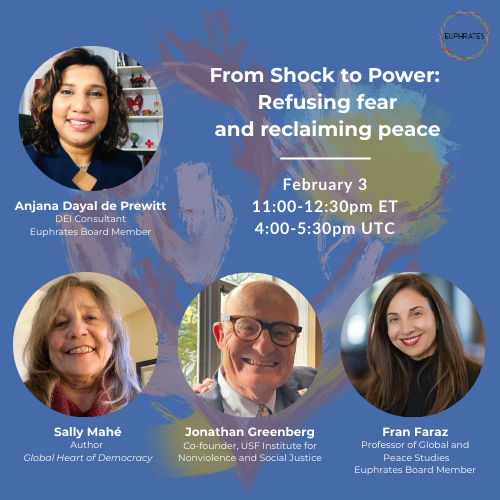
Our first call of 2026 brought together U.S.-based and global peacebuilders to respond to the current moment of political violence, polarization, and democratic strain in the United States. Drawing on experiences in racial justice, humanitarian response, faith, and community organizing, we heard from five speakers who emphasized inner grounding, courageous listening, mutual aid, and local relationship-building as alternatives to fear and reactivity. Rather than sound-bite activism, we were invited into sustained, love-rooted nonviolent action, showing up for neighbors, resisting dehumanization, and choosing connection as a daily practice of peace. This is how we reclaim peace as a power.
We invite you to read the full transcript below and / or Click here to watch the call recording.
Call Nuggets
From Jonathan Greenberg–Fear is rational in a climate of coercion and intimidation; the work is to confront it and convert it into nonviolent power through King’s four antidotes: confrontation, courage, love, and faith. “Fear is contagious — but courage is also contagious.”
From Fran Faraz—We shouldn’t confuse force with power: force relies on fear and compliance, while power emerges from legitimacy, solidarity, love, and our shared humanity. “Fear lives in isolation. Love lives in connection.”
From Sally Mahe – Democracy isn’t only a system; it’s a daily, personal practice rooted in the heart — built through micro-choices that move us toward what we value. “The human heart is the first home of democracy.”
From Anjana Dayal Prewitt–The path from fear to peace is “connect”: connect inward to what brightens your light (values, faith, compassion), and connect outward to others—because small lights together become a larger light. “We fight the issues — not the human beings.”
From sylvia murray: This moment isn’t “shocking” to those who’ve lived under generations of violence; the call is to show up—learn from Black, Brown, and Indigenous leaders, then build protection and solidarity by knowing your neighbors and organizing locally alongside the work of dismantling systems. “If you don’t know what to do right now… go outside. Talk to your neighbor. Make sure you know everyone you live around.”
Hollister Thomas:
It’s been quite a year so far, and no matter where you’re calling in from, I know you’ve heard humanity’s cry for comfort, for guidance, for courage, for peace. There are so many stories that ignite fear and despair, and we can sit in those, but we’re here today to refuse that participation. We’re not going to participate in fear, and instead, collectively, we are here to claim the power of peace.
At the start of each Euphrates call, we like to begin with a moment of quiet. So, as I’ve said before, we can all imagine we’re here in a living room space together, or an outdoor patio, as I get to be today. It can be a cozy space, or a vibrant space. Wherever you are, we’re sharing conversation and inspiration.
So I invite you to grab your cup of coffee or tea, juice or water, and settle in. We’re going to take a moment together, and then I’m going to invite Janessa, our call moderator, to begin our conversation. So first, a moment of quiet.
Janessa Gans Wilder:
Thank you, everybody. Thank you, Hollister, for that grounding.
Thank you all for being here, and thank you to Anjana, one of our board members, for the inspiration behind this call. She, to a small group of us, shared how frightening this moment is for her as an immigrant, as an American. And it really challenged us to think: how can we come together in this time, process what’s going on, and also not be paralyzed by fear, paralyzed by powerlessness, and really step forward.
So that’s the impetus for this call. We have an incredible lineup of speakers, and I think the title really, really says it all: How do we move from shock to power? How do we refuse fear and reclaim peace?
We have an incredible group. I’m going to introduce each one in turn. We’ve got four speakers, and then we’re going to open it up for Q&A and remarks, to really have this be a gathering space to process all that we’re hearing and all that you all are experiencing throughout this time. And then we’ll close with a very special guest.
Our first speaker is a wonderful friend and mentor. He was my professor at Stanford. I took a life-changing course from him on conflict resolution and negotiation that made an indelible impression.
Jonathan has been working in this field, in the field of social justice and conflict resolution and peacebuilding, for a long time. He directed the Stanford Center’s Martin Luther King Jr. Research Project. And before that, he taught for decades in conflict resolution and negotiation in the School of Law. In 2019, he co-founded the University of San Francisco Institute for Nonviolence and Social Justice along with Dr. Clarence B. Jones, the former lawyer, speechwriter, and strategic advisor to Martin Luther King Jr.
When Anjana brought this up and we thought about this topic, I immediately thought of you, Jonathan, because given your experience in this field, in civil rights activism, in nonviolent resistance, and all of that entails, I would love to hear: one, how you’re doing, and two, how you are processing this moment that we’re in. Thank you for joining us. I know you’re on the Stanford campus now and in between things, but I really appreciate you being here.
Jonathan Greenberg:
Thank you so much to Janessa and Hollister and to everyone on this call. I just want to begin by saying that I have admired Janessa and her work with the Euphrates global community for many years. And everyone who’s a teacher knows the most wonderful joy of being a teacher is to stay close to our students and watch their development as they far surpass whatever I have done in influence and impact. So it’s a joy and honor to be with you, Janessa, and everyone.
I want to talk about fear. That’s the topic that Janessa asked me to talk about, and we’re focusing on. And I want to reframe this idea of refusing fear and talk about it differently with you. I want to start by saying that there’s very good reason to be afraid. If we were not afraid, we would not be paying attention.
The Trump regime has escalated violence, brutality, and cruelty to levels we’ve never seen in this country. Ordinary people are being tear-gassed, beaten, arbitrarily detained, and killed. The regime has brought paramilitary force to the streets to deport immigrants and threaten ordinary people who are peacefully defending the most vulnerable people in the community.
The journalist M. Gessen in the New York Times wrote last week, for Minneapolis: “After the three weeks of brutality in this city, it should no longer be possible to say that the Trump administration seeks merely to govern this nation. It seeks to reduce us all to a state of constant fear. A fear of violence, from which some people may, at a given moment, be spared, but from which no one will ever be truly safe.”
That is our new national reality. State terror has arrived. It’s a very grim, but unfortunately accurate analysis. And of course, we know that ICE officers murdered Renee Goode, a mother who had just dropped her son off at school, and Alex Pretty, a nurse at the intensive care unit at the VA hospital, for trying to protect their neighbors.
So people are afraid to risk their lives to exercise our constitutional and moral right to participate in nonviolent protests to defend and protect our communities. The purpose of state terror is to terrify citizens into submission. That’s the goal, like all autocrats and authoritarian regimes. They believe if we’re afraid for our lives, we’ll stay home and out of danger, and then the regime is free to exercise violence without resistance. They can turn our cities into war zones where people risk their lives just being in the street. So we have to deal with this issue of fear directly.
But refusing fear, I don’t think, is the right word. Fear is realistic. If someone had no fear under these circumstances, they would not be human. They would take risks that are not properly assessed. Fear is rational and even necessary to make sure we protect ourselves from reckless actions.
So how do we move forward with civil resistance in the face of this real fear?
The people of Minneapolis are showing us the way right now, every day, powerfully, with incredible courage and humanity, transforming fear into nonviolent power. I want to talk about what they’ve done, but also how they overcame fear.
Dr. Martin Luther King wrote many books, but he wrote one book that was a collection of his sermons. In that book, he has a sermon called Antidotes to Fear, and I want to talk about the four antidotes to fear that Dr. King identifies: confrontation, courage, love, and faith. So he starts with confrontation. And that’s very important, because in a way, confrontation is the opposite of refusal. It’s directly confronting the fear. He begins his essay by saying — and this is in 1963 — “In these days of catastrophic change and calamitous uncertainty, is there any man who does not experience the depression and bewilderment of crippling fear, which, like a nagging hound of hell, pursues our every footstep?”
He starts by acknowledging and confronting the fear. He says fear is the elemental alarm system of the human organism that warns of approaching dangers, without which man could not have survived in either the primitive or the modern world.
So the first step is confrontation — to squarely and honestly address the fear.
In Minneapolis, they’ve done this through combining together organization at every level of the community. There are neighborhood Signal chats in which people are communicating to blow whistles every time ICE agents enter. There are thousands of people patrolling with these whistles to protect their neighbors. They’re coming together because they’re confronting the realities they face, and they’re confronting their fear.
And if you remember, in Birmingham, Dr. King called the whole campaign Operation C — C for confrontation — even though Birmingham was the most dangerous city. They called it Bombingham. So the first step is confrontation.
The second step, he says, is courage. And he says courage is the determination not to be overwhelmed by any object, however frightful, enabling us to stand up to any fear. Dr. King says courage and cowardice are antithetical. Courage is an inner resolution to go forward in spite of obstacles and frightening situations. Cowardice is a submissive surrender to circumstance. Courage breeds creative self-affirmation. Cowardice produces destructive self-abnegation.
Courage faces fear and thereby masters it. Cowardice represses fear and is thereby mastered by it.
And if you look at the people in Minnesota showing up — hundreds of thousands of ordinary people braving 20 degrees below zero to support their neighbors — they are showing this tremendous courage. Filming ICE agents to keep a record of their lawlessness, even after the killings of Renee Goode and Alex Pretty.
Fear is contagious, but courage is contagious. And people in Minneapolis — this is a quote from one of the citizens — “I’ve never felt so backed up. It feels like we’re on a giant team together as a city.” Solidarity breeds more solidarity, and it breeds more collective action — protests, boycotts, strikes, walkouts, mutual aid — throughout the entire country. The courage is contagious, and we see it building.
The third antidote to fear is love.
Dr. King says hate is rooted in fear, and the only cure for fear-hate is love. Hatred and bitterness can never cure the disease of fear. Only love can do that. Hatred paralyzes life. Love releases it. Hatred confuses life. Love harmonizes it. Hatred darkens life. Love illuminates it.
And if we look at Minneapolis, you can see love flowing naturally from what Dr. King called the interrelated structure of reality. All human beings are caught in an inescapable network of mutuality, tied in a single garment of destiny.
Nonviolence is radical love in action — caring for each other, caring for our neighbors, seeing our neighbors as our brothers and sisters. And Dr. King said the aftermath of violence is the beloved community. Which is creating, now in front of us: people delivering meals to people who are at home, too afraid to leave home; escorting children to school; bringing families to doctor’s appointments. This is radical love. That’s natural, and that’s coming through so powerfully.
The fourth antidote to fear that Dr. King identifies is faith. And he says he’s not talking about a positive religious faith that offers an illusion that we shall be exempt from pain and suffering. Rather, he’s talking about developing the inner equilibrium needed to face strains, burdens, and fears that inevitably come.
That’s the kind of faith he’s talking about. And of course, the Black Freedom Movement was generated from the Black churches in Alabama and Georgia and Mississippi and Louisiana — the spirit of the people coming together.
And we can see in Minneapolis the same thing — faith leaders coming together across faiths. Rabbi Abraham Heschel came to Selma, Alabama, and he said when he marched with all the other faith leaders and all the ordinary people, he was praying with his feet.
And so that’s what’s happening now. The faith is spreading. It’s contagious, building on each other. So we know the path. It’s nonviolence. It’s confrontation. It’s courage. It’s love. And it’s faith.
In 1964, Dr. King, in his Nobel lecture, said the demand for dignity, equality, democracy, and justice will not be abandoned or diluted or postponed. If that means resistance and conflict, he said, we shall not flinch. We shall not be cowed. We are no longer afraid. We shall overcome.
Thank you.
Janessa:
Oh, Jonathan. So much to reframe. I think you just did a jiu-jitsu — really taking the fear that is human, like you said, and acknowledging that, and then how do we use that, how do we channel that and reframe it, in those beautiful inspirations from Dr. Martin Luther King Jr.
I just want to echo, too, that I felt all four of those things when I saw you last in person and you hosted this beautiful gathering with the USF Institute for Nonviolence and Social Justice. The room was packed. Joan Baez was up there singing song after song. If you all can imagine these civil rights heroes from the movement — there was such a sense of power in that room, reclaiming the power and standing in the power, and it was a power grounded in such love.
It was just love. That was it. The love was the power in that room.
And so I just thank you for all of your decades of work in this environment, on this topic, and for standing shoulder to shoulder and really inspiring us to join that chorus — to not be cowed and to channel that fear into love. Just so, so grateful.
Jonathan:
Thank you so much. I mentioned I have to leave a little bit early at the end, but I’m so grateful and honored to be with you and everyone on this panel. Thank you so much.
Janessa:
We are going to turn now to Fran Faraz, who is here. We’ll get her on in just a moment — there she is.
Fran is one of the longtime members of the Board of Directors of Euphrates. She’s a professor of Global and Peace Studies at Golden West College, where she teaches this work: conflict resolution, nonviolent action, social justice, environmental peacebuilding. She’s organized international peace conferences and facilitated dialogues on genocide, migration, trauma recovery, sustainability, and human rights.
And really, for any of you speakers, this is an open question. Fran, one question to consider, if you’d like to, is: your homeland originally is Iran, and I have been so—really unbelieving what I’m seeing, both of these things unfold in real time in Iran and in the U.S.
And I wonder, given your work and your background, if you draw a connection between those two—if there’s a lesson learned in Iran that you’re applying to the U.S., or what you make of both of these things unfolding at the same time in front of us.
Fran Faraz:
Thank you, Janessa, and thank you, Euphrates. I’m just grateful to be here and talk on this subject at such a timely moment. I’m grateful that Euphrates has always seen the moment. And Janessa, you have been such a driving force in this, as well as everyone at Euphrates, to address things when we see them.
Because we are all confused. We are all shocked. We are all trying to figure it out. And spaces to have these dialogues are so important.
So much of what Jonathan spoke about — I was sitting there thinking, I want to ditch everything that I wanted to talk about and just immerse myself in that conversation. It reminded me of a professor at the Harvard Law School graduation last year who said it in one sentence: at this moment, fear is natural and courage is essential.
So it’s natural for us to fear, to have fear, but it’s essential to show courage. And it’s essential for each one of us to know that not all of us will be on the streets. Not all of us will be doing advocacy in the same way. But it’s so important that each and every one of us finds our space, our gifts, our talents, our passion, and contributes in the way that we can, to bring ourselves out of the shock.
A lot of what Jonathan talked about, I want to frame through the lens of power versus force. Coercion becomes very normal when we confuse these two. Force has certain dynamics. It has certain properties. And it’s important to understand the properties of force and the properties of power, so we know that we have power even if we do not have force.
The more we become clear about our power and use our power, and understand the gift of it, the more we understand the weakness of force. We can constantly meet force with power.
Having lived in Iran and the United States — a good part of my life in Iran and a good part of my life in the United States — and also studying nonviolence, I have to say it’s chilling how familiar these patterns are across countries, decades, and cultures.
Coercion always starts slowly. It comes in with certain language. That language is usually “us versus them,” very easy answers to complicated questions. It’s always about security. It’s always about order. And if we do not meet it at that moment, it keeps growing.
In Iran, years of imprisonment, punishment, and brutality have made people extremely anxious about simply surviving — staying away from the fear of being taken to jail for absolutely no reason, tortured, or worse. Over time, trauma from the streets moves into the nervous system. People don’t lose hope, but managing hope becomes difficult. Managing a sense of security becomes difficult.
That is force.
On the other side is power. And power looks like people taking each other in when someone is being chased. People knocking on doors and being welcomed in. The authorities marking a house so they can come back later — and then the entire street putting the same mark on their own doors so no one can be singled out. People going up on rooftops together, making noise together, so no one can be isolated.
We see this in every civil rights movement. Solidarity is power. That power can never be taken away.
In the United States, the repression looks different. The dynamics differ across contexts, but the mechanism is the same. Here, repression lives in polarization, in constant crisis, in exhaustion, in moral overwhelm. It’s a different mechanism, but it brings the same shock.
Fear lives in isolation. Love lives in connection. That changes the math completely.
The property of force is fear, repression, pressure, compliance. The property of power is emergence — emergence from alignment, from legitimacy, from our shared humanity.
This power, driven from love, is not sentimental love. It is disciplined love. As Jonathan mentioned with Dr. King, it begins with collecting facts, understanding what is true, negotiating from a place of power, and if that fails, stripping away hatred and moving into direct action — action based on love, legitimacy, strategy, and discipline, not reaction or retaliation.
Force is exhausting. It always leaks energy. It always needs something to push against. Love and power are different. They are regenerative. They keep generating themselves.
This moment is asking us not to harden, but to remember where our real power comes from and to practice it deliberately together. That means knowing what we are doing, understanding the facts, and understanding what we are dealing with.
When people feel their shared humanity, shock does not have to remain shock. Shock can become clarity. Clarity becomes courage. Courage, practiced together, becomes collective power — people power.
The dangerous moment is when we remain stuck in shock. The moment we pull ourselves out of shock, find clarity, and reconnect with our power, transformation begins. People in Iran have been doing this for nearly five decades. There has never been a lack of courage or action. But shock must be worked through. And that is the moment we are in now.
Janessa:
We don’t want to stay there, like you’re saying. It’s natural to feel that shock, but we want to move into the power. I love how much the themes between you and Jonathan — love and courage — are already coming up. And I love what you shared, Fran, about fear being isolating and love being the connective force.
That’s one of the real dangers of growing polarization — it pits people against each other at the very moment we most need connection and unity. So how do we connect to the other, whoever that other may be? Through love.
Thank you so much, Fran, for your remarks. And we’re going to turn now to Sally, my dear friend Sally Mahé, who is a founding staff member and senior advisor with the United Religions Initiative. She brings decades of experience helping build interfaith people power from the ground up.
She’s also an expert on democracy, which is why I wanted you with us today, Sally. She’s the author of two books on democracy, The Global Heart of Democracy, published last year, and A Greater Democracy Day by Day. She frames democracy not just as a political system, but as a vital daily practice — individual and collective — and something we must actively practice if we want to keep it.
We hear so often that the future of democracy is at stake, or that this is the end of democracy. I’d love to understand from your perspective what that really means. What are the principles of democracy asking of each of us now? And how do we support one another in embodying them?
Sally:
Oh, Janessa, thank you for having me. And I want to congratulate Euphrates for always stepping up. When issues are hitting our hearts and hurting, Euphrates says, “Let’s get involved.”
For me, democracy is about diving deep — diving deep within ourselves. And what we’ve just heard on this call is such a beautiful example. When there is fear and shock, what also arises? Love. Collective power. New experience with power. These things go together.
Yes, there is isolation. Yes, there is fear of being targeted. And at the same time, there is the opening — like Jonathan described in Minneapolis — of people going out by the hundreds, day after day.
This is a profound time, and this is a profound way to come together. The question you asked — what are the principles of democracy asking of us now, and how do we help one another? — really landed for me. There’s a lot of knowledge and talk about democracy, but I want to focus on the principles that move our hearts. Justice. Fair treatment. The dignity of all. Every voice matters. Freedom of assembly. Freedom of the press. Freedom of religion. The right and responsibility of each person to have a say in matters that affect our lives.
One invitation is to fall in love again with the principles of democracy — not the ones someone else holds, but the ones you hold.
Over the years, I’ve come to believe that democracy isn’t only rooted in systems of government that derive power from the people. It’s rooted in something deeper. The impulse that gives rise to democracy lives in the heart. It serves a higher purpose than material or political gain.
Democracy gives people the responsibility and freedom to live out their unique purpose. It invites us to make decisions through our hearts as well as our heads.
Terry Tempest Williams once wrote, “The human heart is the first home of democracy.” Especially now, I think it’s time to really learn what those words mean.
A mentor once said to me, “Sally, it’s about seeing the need, reaching out, lending a hand.” See a need. Reach out. Lend a hand. Those words still touch my soul. They point to the heart of democracy — that it’s personal. It comes from a human impulse to care and serve, rooted in the heart, and shared across cultures and continents.
As we gather on this call with people from around the world, I imagine us as an island of coherence in a sea of chaos. We’re here to appreciate one another, to listen, to learn, and to understand people power.
The root of the word democracy — from the Greek — means people power. This is a fearful time, yes, but it’s also an opportune time. A time to dive deep personally and ask ourselves what people power really means to us.
One of my heroes of democracy is Doris Haddock, known as Granny D. At 89 years old, she walked across the United States to advocate for campaign finance reform. She said, “I could walk across the country as easily as I walk in my garden.”
She wrote that in this generation, the fate of our natural environment and our democratic environment will be decided. We must all take part in the great drama. It’s more than politics. It’s a struggle for our soul. And it’s exquisitely personal to each of us.
We are living in a time of transition. Democracy is becoming personal again. It lives in our daily choices.
I once spoke with a global thought leader, Audrey Lynn, who said we need to change how we understand power. There is a greater power that flows through us when we focus beyond ourselves, when we think of the greater whole. It’s a deeper form of power that connects us.
We may be living in epic times, but it’s not the times that are epic — it’s the people. We are creating the epic through our choices. The movement from fear and shock to inner peace and strength happens in micro-moments — in small daily choices. Do they move us closer to what we value most, or farther away?
Some friends of mine ask each other three questions every night: Where did you find beauty today? How did you step out of your comfort zone today? And I would add a third: What choices did you make that moved you toward what you value, and which ones took you away?
Personal power lives in these choices. And as we’re learning from quantum physics, what we do contributes to the interconnected field of all life.
I want to close with words from John Lewis. He asked, why must we immerse ourselves in struggle and unrest to effect change? Each of us must answer according to our conscience and faith. He believed we are all a spark of the divine. And when that spark is nurtured, it can become a flame.
The destiny of humankind is to remember that we are light, and to live from that awareness in all matters of human affairs.
Thank you.
Janessa:
Sally, thank you so much. What I’m sensing — and I think this is true — is that even if we are witnessing the breakdown of a sclerotic form of democracy, or an imperfect form whose foundations may not have been right, there is also the potential that we are stepping into something deeper. I’m curious if you feel hopeful that we’re moving toward a deeper form of democracy.
Sally:
I do. I think it’s a forced entry. You could say the birth canal is alive and kicking with the birthing of something new. I believe it’s calling each person into greater responsibility than we’ve known before. The systems and structures of democracy have taken us far, but they’re not going to carry us into the future. We have to keep asking: where does deeper power come from?
And I think that question will lead us into a more accurate understanding of what it means to be human and to live as a global community.
Janessa:
That was beautiful. Thank you so much for all of your remarks.
Anjana serves on the Euphrates Board of Directors and brings more than two decades of experience advancing inclusion, equity, and community resilience in conflict-affected contexts around the world. She served as Director of DEI at the American Red Cross until she was recently let go because of the anti-DEI movement. I think that is such a cool part of your bio, Anjana — I’m sorry, but talk about being directly in the crossfires.
Your career has spanned work in over 30 countries, engaging humanitarian response and systems-level change. Anjana writes and speaks with rare moral clarity from lived experience grounded in deep humanity. And so I wanted to end with you, Anjana, for some moral clarity and deep humanity on the topics we’ve been talking about.
In your own situation, how have you moved from shock to power, from fear into peace? I know you’re an incredible woman of faith, intention, love, and compassion, and that you embody and live this so fully. I’m literally getting chills as I’m thinking of you. I welcome you into this space and whatever you’d like to share with us.
Anjana Dayal de Prewitt:
Thank you for the kind words. It takes one to know one, Janessa. And what an honor to go after Jonathan Greenberg and Sally. I’m so grateful to be here and to be having this conversation.
When you talk about fear, let me divide my response into two prongs: the inner practice and the outer action.
For the inner practice, going back to what Sally began with — the deeper dive. Connect. Connect is my word. Connecting with yourself. I believe each one of us, even those we sometimes see as enemies or opposing forces, carries a light within us. And that light grows brighter with love and compassion and all the things we’ve been talking about. It diminishes when we lean into hate, oppression, and the force that Fran was talking about.
For me, inner peace in times of fear comes from taking that deep dive and connecting with myself — with the things that brighten my light within me: love, compassion, seeing everybody through a lens of empathy. And leaning into faith. I go into my spiritual scriptures. I ask, “What would Jesus do?” What did he ask us to do in moments like this? He did get angry, but what was the ultimate thing he did?
Going deeper into my value systems — that connection really helps me.
For outer action, again, the answer is connect. Connecting with others who carry that same light. When we connect those little lights together, they become larger. Imagine little gardens in different contexts with flowers bringing fragrance, lights shining bright and chasing away the darkness.
Many of us have mentioned Martin Luther King Jr., whose voice is so important right now. I was recently visiting his monument in D.C., and every time I go there I start crying. Everything is articulated so clearly — why do we forget it? Situations like these can be complicated, but moving forward with peace and light is not. It’s a decision. It’s a choice we make in spite of everything.
Dr. King said, “Darkness cannot drive out darkness. Only light can do that. Hate cannot drive out hate. Only love can do that.” We know this.
For those who are younger on the call, let me bring in a more contemporary voice. Bad Bunny, when he received the Grammys, said something that really touched my heart: “The only thing more powerful than hate is love.”
There are voices here and now reminding us how to go forward. Inner action — connect with our deep values. Outer action — connect with others moving toward that light. Brighten it no matter how dark the outside world feels.
Rumi said, “When the sky is darkest is when the stars shine the brightest.” This is the time to shine the light we all carry. We cannot afford to let it diminish by getting into rhetoric, bubbles, and repeating hateful narratives.
There is humanity in each one of us — whether in uniform, immigrants, anyone. Dr. King said we must fight the issues, the hatred, the oppression — not the human beings. Gandhi said, “An eye for an eye will make the whole world blind.” We fight the issues and create the beloved community by humanizing the other.
I also want to share a concept from West Africa that emerged during complex emergencies — drought, armed conflict, devastation. Teachers asked: how do you bring hope when people are starving and dying?
They created a framework: I am. I have. I can.
I am — my values, my faith, my beliefs.
I have — my relationships, my friends, my family, the people I’m still connected to across oceans.
I can — I still have choices. I can write. I can speak. I can cook my delicious Indian biryani and eat it.
We must focus on what we still are, what we still have, and what we still can do.
I’ll end with a poem I wrote at the beginning of 2025:
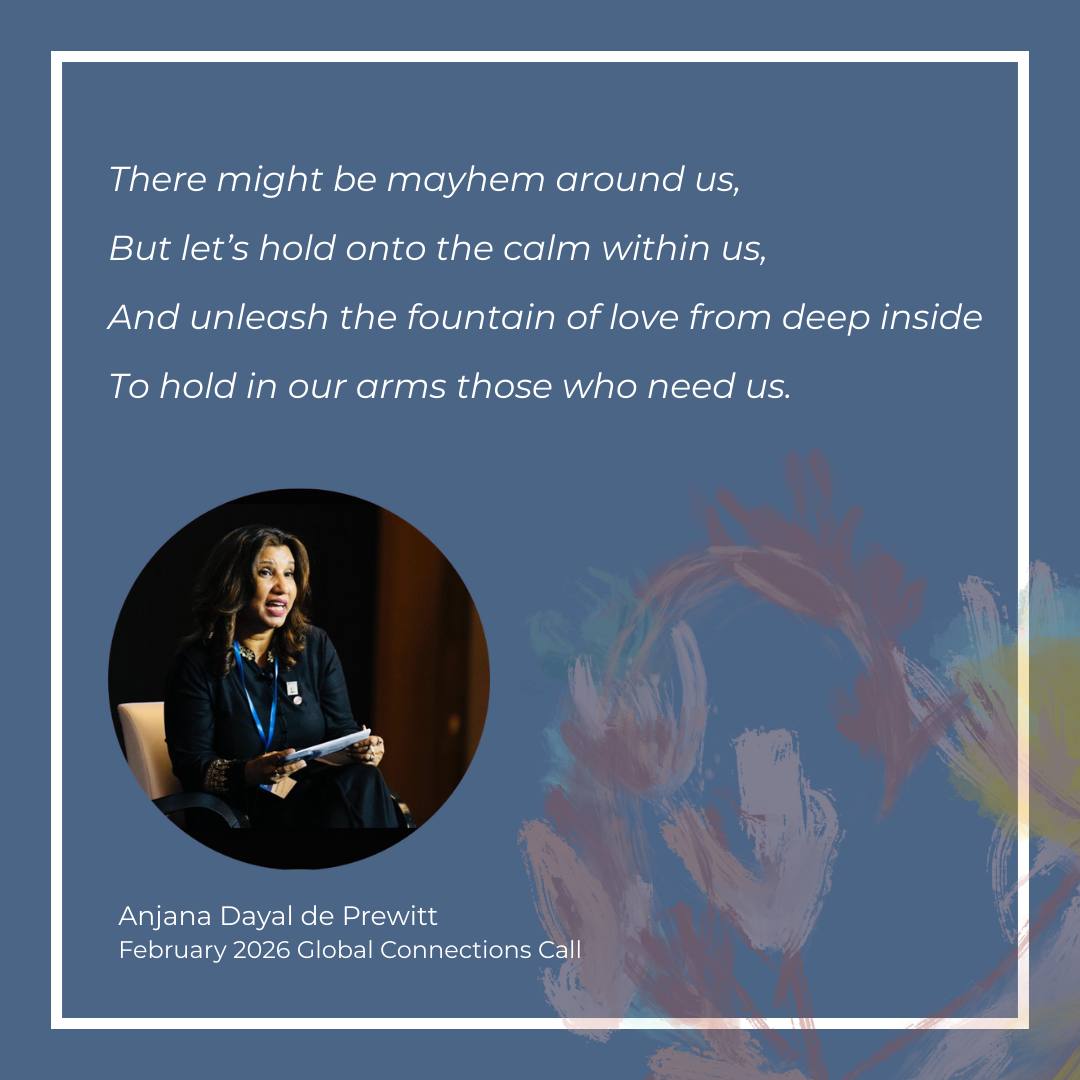
There might be mayhem around us,
But let’s hold onto the calm within us,
And unleash the fountain of love from deep inside
To hold in our arms those who need us.
The magic is always within us.
Let’s take a deep dive into our core.
There live peace and all the answers
For us to embrace and explore.
Yes, there is fear in the heart,
But courage lies right beneath it.
We ought to go beyond all doubts
And bathe in the shoots of faith and grit.
Yes, the journey may be long and hard,
But we, too, have the inner fire.
If anyone will win this, it is us —
Calling on all the peacebuilders, humanitarians, and teachers.
If anyone will win this, it is us.
When we go deeper, we soar higher.
Let’s breathe.
Let’s breathe and take it easy.
Let’s light up our vessels with our little light.
And as we protect our inner peace,
Let us glow and shine bright.
Thank you.
Janessa:
Oh, Anjana — your poem and your remarks were so deepening. The way you named courage beneath fear, going deeper, going beyond — every speaker has offered that invitation. Let’s not stay stuck in shock or fear. Let’s dig deeper into the resources we already have.
We have everything we need within us. I felt that strength from you — especially knowing you are in the middle of these culture wars — and how you are choosing power over helplessness. Thank you so much.
Thank you to all of our incredible speakers, and to everyone for being here. I’m going to turn it over to Hollister so we can hear from you all now.
Discovery Time
Hollister:
This time is discovery time, not just questions and answers, inviting us all to consider that we are the experts in the room, and so if anybody has brief reflections to share, please do so. You’re welcome to use the chat. You’re welcome to raise your virtual hand or your digital hand. We have about 20 minutes together, just to call on the wisdom in the room.
Ayiza Salman:
Hello, everyone. I feel so moved, and I got tears in my eyes listening to this really empowering message of just taking an action, because it’s something that I was struggling with personally a lot. If you just look at the news once a day, it depresses you to your core, and as someone who wants to be a changemaker, I have not been able to be one, because I keep feeling the weight of the world’s problems holding me down, and sort of putting me into an advocacy of sorts that is restricting me from taking an action.
And I think this call was a reminder that no matter how bad things have gotten, we are still in a position to at least recognize that something’s wrong in the world, because not many people are able to do that. And at least we have each other to turn to and inspire one another, to understand that we still have some sort of power.
And it’s not going to change the world in one day. It’s not going to help everyone, and that is a horrible feeling, and that is the fear that I feel like I personally have — what if we put ourselves out there and it’s for nothing? What if something gets compromised along the way? But I think that fear is something we need to acknowledge and then also move forward.
We need to stop using the word “but,” or those contradictory terms, and we need to start saying “yes.” Yes, there’s so much that’s wrong in the world, and we have to do something about it.
So I think this call was that reminder, and I really hope that me and everyone else can take something away from it and do something within our communities, even if it’s with just five people. We live in a world of seven to eight billion people, and somehow 88 of us have come together here and inspired all of us. It’s allowed us to smile.
When we see people in power just breaking the world apart, I also see power in this small community, and I think that holds a lot of value. The fact that we’re able to recognize it is something to be grateful for and take inspiration from. So yeah, thank you so much.
Wazieh Offuh:
Yeah, thank you, everyone. Hi, everyone. I’m so excited, and it’s a privilege to be on this call. Anjana, I just want to say thank you so much for your encouragement. I think they are boosters, and they are courageous words — to everyone, especially to me.
While you were speaking, it resonated so deeply with me, because for the past few weeks I’ve been dealing with some stuff, but listening to you has shared a lot of light. “I am, I have, and I can.” It gives me hope, and it tells me that I still have something to keep going. I can still do other things, even when I feel stuck, even when I feel like everywhere is dark and there seems to be nowhere.
I’m so grateful for uplifting my spirit, and I thank you again for reminding us that we can lean on our faith. Thank you so much. Thank you.
Erika Borek:
Hi! Yes, thank you to everybody, and hi, Anjana. I know her from her time at the Red Cross, and she is fantastic, and was fantastic. So thanks to everybody.
My question is: for the younger generation — like teenagers who are on social media, who are receiving this information — maybe an understanding or seeking to understand the person in the mask, and seeking to understand the immigrant, all sides seeking to understand — they might not be as open to that. They might feel one side is ultimately completely wrong, and one side is ultimately completely right, and that’s that.
I know social media and polarization is a huge issue, but in terms of having those conversations with that younger generation, tactical ways to do that — as a mom, I try to lead with those values myself, but sometimes it’s hard to keep saying the same thing or trying to think of a different way to say it.
So I’m curious, from your perspective, talking to that younger generation who might be really impacted by polarization — maybe some ideas, or references you can give me.
Hollister:
I appreciate the question and the thoughts. They also speak to Kent’s question about polarization, so I’ll invite anybody who shared today to unmute.
Fran Faraz:
I can speak to that. I think sometimes we start by doing something common. So whenever things get rough at our college, I go to the place that is the coffee cart. I ask the person, can I give you whatever amount of money, and every third person, you tell them somebody has paid for you.
Or just stand there giving out smile cards that our good friend Nipun Mehta and ServiceSpace has, and give them a heart or something like that.
We don’t have to immediately go into “What do you think about immigration?” “Do you think they should be here or not?” Those conversations are difficult to manage.
Some of the simple things that bring people out of polarization are simple acts that remind us — remind ourselves — of our shared humanity. That can be the first step. I don’t have to put anything in danger or anything like that. Just a simple thing to remind us of shared humanity.
That opens us up to conversations later, and to have some really deep connections. First move ourselves into that space so we can have a good conversation.
Hollister:
Thank you, Fran. Those acts of service and love meet the heart right away. Sally, go ahead.
Sally Mahé:
The word appreciation reminded me of a talk I had with my three grandsons — two are 15 and 18. Their tendency as young men is to be defensive, like, “Well, this is what’s right, this is where I am.”
And I said: as you’re talking to someone who disagrees, think of one thing you appreciate about them first. It’s simple. It’s a reflex for all of us — what do I appreciate about this person who is obviously different from me in how we think?
Start with that. It’s a powerful connector. It opens doors you may not even know were there to open. So I just want to throw in: appreciate first.
Anjana Dayal de Prewitt:
Erika, thank you so much for that question. Really, Kent — that’s the question of the hour.
In addition to the two beautiful answers already shared, one thing I learned early on as a humanitarian, being on the ground, trying to develop programs after disasters or conflict, was to always triangulate the information.
Sometimes — and I’m seeing this as so relevant right now in our scenario, in this polarized world — we tend to just listen to either CNN or Fox, or just stay with one source. And that doesn’t work, because everybody wants to feel safe, everybody wants to not hear criticism.
One thing that has helped me is that I love to go to a hairdresser who talks about all the bad things — I can’t even repeat some of it — but she has a very radical view. And hanging out with people who think differently from you, really listening to them.
I go between CNN, Fox, MSNBC, Al Jazeera, Indian news, BBC — all kinds — trying to change who I’m listening to and make sense of it. I think that also helps reduce polarization.
And even when we disagree, letting people speak — dialogue is very important.
Something I never thought I would say, but I’m loving what Tucker Carlson is doing quite a bit these days. You see him talking to so many different people. People are really getting into conversations, and it’s beautiful when people can have them.
Just labeling people is not the right thing. We need to go beyond the labels, humanize people, and know that everybody carries that light and that humanity. And then, little by little, we can walk through polarization.
Remember, millions of dollars have gone into creating this polarization, and we will have to bring the currency of love — millions of loving hearts — to move through that.
Hollister:
We’re starting with 83 hearts right now, so that’s a great start. Kimya, then Angela, Francis, and Kate. Let’s make sure we have time for everybody. We have about 10 minutes left for this section.
Kimiya Roohani:
I have two things to mention. The first one is to Erika, who shared her concern about discussing polarization with the younger generation. I don’t think we — I mean, talking about it would be helpful, but showing them would be much more useful. And I say it as a lived experience, because I grew up as a religious minority in my country, and most of my rights had been denied since childhood.
But my parents never acted in a way that made me feel like the other people who were benefiting from those rights are “the others” and we are “the we.” Instead, we communicated with neighbors and friends who were from other religions, and they showed that we are one.
So I think if you’re talking about your own children, maybe if parents have relationships with people who are characterized as “other,” this will be the main help to the kids, so they don’t see life in this polarized way. And even if there is the influence of media, they have a different lived experience, as I did.
And I want to send a big hello to Ayiza, who was a cohort member of 2025 in the Euphrates peacebuilding program.
I also wanted to mention something about news. News outlets do not cover exactly what happens in the world. They cover some parts of it. A lot of things that happen in the world are never covered in the news, and neither in history.
Most of the amazing things that are done, and most of the amazing people who have done great work, have a marginalized place in the news and in history. We hear about people going to prison and we read about these things in the news, but we never read about people buying clothes for each other in prison, which is an act of love.
Or we hear about people being denied rights in different countries, but we don’t hear other citizens helping them gain those rights. So news and history are not very good representatives of what actually happens in life and in the world.
Angela Sage Larsen:
Thank you. I’m going to go a slightly different direction, and that is an embarrassing direction.
I was walking with my friend on Saturday to lunch, and a car stopped in an intersection, and it was blocking another car. The car that was being blocked just started yelling their heads off. The driver was yelling, screaming, honking.
I’m looking at this, and I look over at the driver and I was like, are you kidding me? What is wrong with you? Everything is so tense, and you’re yelling at this driver — have a little grace!
And as I heard “have a little grace” come out of my mouth in a shrill scream, I just started cracking up. I was laughing so hard that I realized, oh my gosh — A, I needed to calm down myself a little bit.
But the other thing that really stood out to me was how important laughter is at this time. Yes, we’re dealing with very serious issues, but what better form of resistance? We’ve been talking about joy, beauty — we also have to talk about humor and laughter. Being able to laugh at ourselves, and to be able to go through these serious issues with a sense of lightheartedness.
I think Dr. King was definitely focused on that, as was Jesus. We’ve talked about Jesus and so many other nonviolent leaders. There’s such a sense of joy in doing this work. We’re talking about what we love, and so there’s got to be joy, and that’s expressed in laughter.
Janessa wrote a great Substack the other day about art as resistance, and I found that really helpful. So I’m trying to remember to find the joy, express the joy, laugh at myself, laugh when something is funny or ironic — and there is a lot of irony these days. It’s okay to laugh about it.
So I just wanted to share that funny and really embarrassing little story. Thank you all so much for the pure love and joy that you’re bringing to this discussion. I’m so grateful to be a part of it.
Hollister | Euphrates:
Thank you, Angela. Thanks for keeping it real and relatable. Those moments where you feel so righteous and then acknowledge that you are also contributing to part of it — thank you.
Frances Jeffries:
Well, thanks, and thanks for everyone being on this morning, and especially to the presenters and the organizers.
I want to go to the conversation about the new media, which I would argue is just a new form of ways that we always got information. None of us, I think, in all honesty, ever did a comprehensive review of major issues. We had a few reliable sources, and we said, “I heard from so-and-so,” or they referred to another source.
It’s the same process. The images of people using media now are different than they were before, but it’s the same process. We did it this way, too — we just didn’t have the same tools. So that’s one thing: not to be distracted by what you’re seeing. Keep in mind that everyone, for all time, finds ways to get information, and then they validate it by continuing to use it and reform it in their own practice.
The second is that, in my work, I’m with many people, probably 16 and up still, and I found that I was not listening. I was interested, I might pose a question, as was suggested, but I was waiting my turn to tell my part of the story, because that was what was important to me.
And in doing that, I was limiting my own growth, my own ability to see the issue that had become intractable, let’s say, because I wasn’t listening to the new ideas. So therefore, they never got incorporated.
And needless to say, people go away. They don’t want to be ignored, so they just go away. And then we say, well, what happened? How can we get them back?
The listening part, I will say for myself, is really tough. Because you’re used to being able to share. And particularly as you age, you are used to being unchallenged. People just let you get by with stuff, and no one says, that makes no sense.
Finally, with the generations behind me, I feel accountable for my generation’s decisions when I’m speaking one-on-one. I represent those, like it or not. And in doing that, I’m asking a person to trust me, even though they’re looking at decisions that they think are pretty messed up, and have left them holding the bag to solve.
You’ve got to understand — I don’t think most people would say, “I don’t trust you,” because that’s not personal, but it’s what you represent by virtue of your age, your ethnicity, your gender, your geographic origin, whatever. You represent decisions that aren’t going so well.
And you’ve got to make space for other people to move in with different perspectives and ideas that are current. I’m talking to myself — I’m saying “you,” but I mean me.
I’ll acknowledge it’s a tough road, but it is also very exciting. And when there is trust with a person who thought they weren’t heard, I found it the most invigorating, the most rewarding experience I’ve ever had — to think, oh my gosh, I really heard that person, and I can see exactly what they’re seeing. And it’s not pretty, but yeah. I would do that. So I’ll stop there.
Hollister | Euphrates:
Thank you, Frances. Listening as a skill, and a gift to yourself and to others — I love that you highlighted it. It’s just as much a gift to you. It’s the foundation of all de-otherizing and peacebuilding work, really — listening.
We have two friends here who have joined us from Minneapolis. Kate had her hand raised, but she put it down. I don’t know if you were just being polite because you saw we were coming to the end of the call, but our bestie friend, Sylvia Murray, and former colleague is here. She now lives in Minneapolis — it’s been her home for some time now — and I’m grateful to know she’s there, and I’m grateful to know Kate is there.
You two have a lot to offer your community, and you have a lot to offer us. We’re appreciative of all the work I know you’re doing on the ground in your communities and neighborhoods.
Kate, if you’d like to share for a couple minutes, and then I’m going to invite Sylvia to unmute when Kate is done, and Janessa will bring us to a close after the two of you have spoken. It feels appropriate to give you the last words in this space. Thank you so much for being here.
Kate Towle:
Well, blessed am I to have met Sylvia. I can’t tell you the strength that I gain from knowing her and the work that she’s done with Euphrates.
I’ve had a difficult time finding my words. This is like nothing I’ve experienced. I admire each one of you for being where you are, doing the work you are, and being here. And I know you’re brave. You may say you’re not, but as we heard a little bit ago, we know that courage is not born in an absence of fear.
The demands for mutual aid and showing up are intense. And all of us here are reeling, and I see in this call you’re reeling right along with us, and that means a lot. We have our private communications, we check in with local friends, and we’re trying to describe to the nation and to the world what it is that we’re holding. I don’t always have the words.
Today I’m touring a space for community building. I just learned I’m about to publish a new book. I just learned that my publisher is on the board of Georgia Fort’s team — she just got arrested for doing independent journalism. I’ve mentored our Attorney General, Keith Ellison’s daughter. I’m in the thick of it, and yet I don’t feel like anything I’m doing is brave.
And yet, we’re out there. We’re preaching bubbles, not bullets. We’re serving sweet potato comfort pie. I’m raising money for a friend whose jaw was shattered by a flash bomb. And, you know, I’m supporting and tending to my Latina daughter-in-law, whose family’s vulnerable. And I’m taking care of my elder parents, 90 and 93.
I’d like to say that I am hosting a call next Monday for you to be in solidarity with Minneapolitans, if you’d like to hear us. We’re getting together with Paul K. Chappell. He’s an international peace educator who came to Euphrates. He’s going to talk to us, but we love you. We love us. We love democracy, and that’s why we’re in the fight.
Hollister | Euphrates:
Thank you, Kate. You found a lot of beautiful words, and many more actions. Thank you so much. sylvia, I’ll let you bring us to a close, and then Janessa will share just a few housekeeping details at the end.
sylvia:
Hi everyone! It’s so good to see everyone! It’s been a minute!
I first apologize — I came into this call super late. I was accompanying a neighbor for safety, so Anjana, Farzana, Jonathan, Sally — I’m sorry I missed what you shared, and sorry if I’m coming in hot with something that’s not the right match. But I’m going to do my best.
I’m sure everything you shared was really beautiful, and I’m grateful for Janessa’s offer to close this out. As Hollister mentioned, I’m listening in and calling in today from Anishinaabe Dakota land, today known as Minneapolis, under federal occupation.
It’s February 3rd, and I want to honor that just two days ago, February 1st marked the five-year marking of the coup in Myanmar. And February 2nd is four years since Amir Locke was killed by the Minneapolis Police Department at age 22, and his family is still fighting for justice.
We’re in the beginnings, the midst, of interconnected struggles. We’re in the beginning of Black History Month here in the United States, and it’s a month to really highlight that all of our struggles are interconnected, and all of our futures in liberation are bound together.
As peacebuilders here, it is definitively our responsibility to be learners. So if you’re going to do anything this month, I urge you to take time to learn from Black, Brown, Indigenous leaders, and to act — in some way.
When Janessa asked me to close, she said, “I know you don’t want to be reduced to a sound bite.” And she’s right. But more importantly, this moment can’t be reduced to a sound bite. Liberation — this moment, moments past, what is to come — needs your long-form attention. Nothing can be a sound bite anymore.
I also recognize I only have like eight more minutes, so I am going to make this a sound bite — but it’s calling attention to the fact that this needs to be long-form work.
I will be honest: in thinking of something to share today, I struggled with part of the name of the theme of the call, because I was thinking of the word “shock.” To me, this moment isn’t shocking. None of this is shocking. This violence isn’t new. Black, Brown, Indigenous people have known this violence. They’ve been resisting this violence for generations. The U.S. is rooted in this violence.
The violence at home, and the violence we’re funding and fueling abroad, is kind of the most American thing I know. I think of the chant I’ve been shouting in the streets with neighbors all of January: “From Minnesota to Palestine, occupation is a crime.” This is not new.
As peacebuilders, peace leaders, activists, advocates, we need to own the fact that this isn’t new, and it won’t be going away until we truly commit to full transformation and liberation for all.
And recognize that the violence isn’t only happening over there, and it’s also not only happening here, where I am, in occupied Minneapolis. It’s everywhere. So even if you think you’re moving through your day totally or relatively unaffected, there’s someone in your neighborhood who’s afraid to leave their home. There’s someone in your neighborhood who has to go to work but is terrified when they leave the house.
So you’re not unaffected. I urge everyone here to see the world through that lens: you are affected, and you have to show up. If there was ever a moment to show up — there were so many moments to show up already — but if you are arriving now, now is the moment to show up. And it’s okay to arrive now.
Janessa asked me to think about what’s a lesson from my time at Euphrates and in this moment, and that’s the lesson: show up. Really commit to that. I think to live Euphrates’ highest value of love is to show up.
It’s what I learned accompanying peacebuilders with Euphrates, and what I’m learning continuing to accompany my proximate, immediate community here in Minneapolis, resisting occupation. The power and love of showing up continues to ring true.
If you don’t know what to do right now, start with some of the learning I mentioned earlier. Learn from Black, Brown, Indigenous leaders. Do some reading. Do some listening. Start there, and then go talk to your neighbors. Go outside. Talk to your neighbor. Make sure you know everyone you live around.
It doesn’t have to be about what’s going on in the world in a big way. What’s their name? What do they do every day? Who are they? What’s a quality about them that you can remember? Just go and learn about your neighbors.
Because while we need to support each other — and like Kate mentioned, we’re doing mutual aid — we actually can’t mutual aid ourselves out of this situation, out of these conflicts. We need to be disrupting and dismantling systems. But we do need each other, and we need to know how to support and protect each other.
To do that, you have to know who’s around you. Talk to the person who lives next to you, the person across the street — map out your neighborhood in a radius of several streets and go talk to people, about anything right now.
That’s all I’m going to share of what I have to say right now, because this is not the start of another panel — this is a close — so I’m going to wrap my thoughts there.
For anyone who knows me, knows that I often turn to poetry for moments of inspiration, reflection, motivation. I saw in the chat that it sounds like, Anjana, maybe you started people off with a poem, which I hope to read at some point. I’m also going to close us with a poem that, for me, reflects this moment of showing up.
It’s called “What Moves Us” by Shailja Patel.
Some moments, history comes to us and says, What do you truly want?
We tremble, often we run, from the terrifying possibility that we could choose movement.
That we could begin exactly where we are in all of our screwed-up imperfection.
Some days, we stand before a world, and the question vibrates the air around us:
What do you choose?
This day. This moment.
This heart-stopping, glorious adventure.
There’s strength like patriarchy, strong like institutions, strong like $2 billion a day, military occupations, spiked with genocide, anchored in neoliberal greed, buttressed by terror, designed to deliver 200-volt shocks on contact.
Then there’s the strength of what flows:
Tears. Grief.
Memory. Blood. Energy. Breath.
Collective action.
The strength of what moves us opens our throat, ignites our hips, unleashes our voices, puts the move back into movement, distills the motion from emotion.
Movement strong as a river.
Current of joyful resilience. Wave and curl, crash and swirl, patterns that constantly change.
Movers who channel each day the courage of divers to plunge again into this churning water.
Thankful for what yields results, curious of what does not.
Building lung capacity to finally embrace the wholeness of our struggles exactly as they are.
Some moments, life asks of us, what do you hope?
There’s hope like a battleground, hope that’s all sound bites, hope that rehashes a thousand manifestos — what we intend, believe, imagine, what we plan, propose, and dream, what we say, expect, pretend, how we think things should look.
And then there’s the truth on the ground:
What we show up for each day, with our fearful, angry, tired, clumsy selves, with our complex, brilliant, wounded, kick-ass selves.
And we grapple with the chasms of all that’s gone before, we negotiate the heartbreak of decades of betrayal, we push ourselves to replace but with and, know with how, steel ourselves to listen to what enrages us most.
We stretch our brains and wills until we feel it, to hard analysis until we get it.
We unpack systems and structures and models and mine the stories and map the data till we know what works and what does not.
What truly moves us.
Some years, life comes to us and says, what do you know?
Why we kept at it for 40 or 50 years. Why we have never regretted it.
That this movement still moves us in our guts, in our hips, our hearts.
That this laughter, this trust, this earned and tried and tested respect is a house we have built brick by brick, and it will hold.
Some mornings, life wakes us up, sets our hearts beating, sets our nerves thrumming, warms us.
We’re about to leap into our iciest fear, our largest growth, our most piercing joy, and some mornings, we take a huge breath and say yes to it all.
And some evenings, life wraps us round in the softness of twilight and asks, What are you waiting for?
Truth?
Justice, reparation, healing, in our lifetimes, in our lifetimes, in our lifetimes.
Each day, love comes to us and says, what will you show up for?
What, in the end, is the truth of your heart?
And we answer with our bodies.
We show up for the struggle, we show up for each other, we show up just as we are — precious, flawed, limited, magnificent human.
We show up for history. We choose the power of movement, and we love by showing up.
Thank you, everyone.
Janessa:
Sylvia, amazing. Thank you for not being a sound bite. Thanks for being the call to action.
I know we’re way past time. I just have one more call to action for you all. Please, please, please join Fran’s class that starts today. It’s called Pathways of Courage. It’s exactly on this topic — on U.S. civil rights and the pathway of courage in this country. There’s like two spots left, so be one of the two first to get them.
The other call to action is: please show up with us. We want to grow this core of volunteers. We are looking for you to be volunteers in all sorts of ways. We want to come together, be together in this moment, show up for each other, and be moved, and listen for how to be moved to meet this moment. So please, please, please be in touch with us to sign up, and to serve, and to volunteer.
Thank you all so much for an amazing evening for me, being together in solidarity, in love, and encouraged. Bon courage from Paris, everyone. You can unmute and say goodbye, and thank you so much to the speakers — sylvia — and all of you for being here.