
From Theory to Practice: Dr. Whitney McIntyre Miller on Integral Peace Leadership
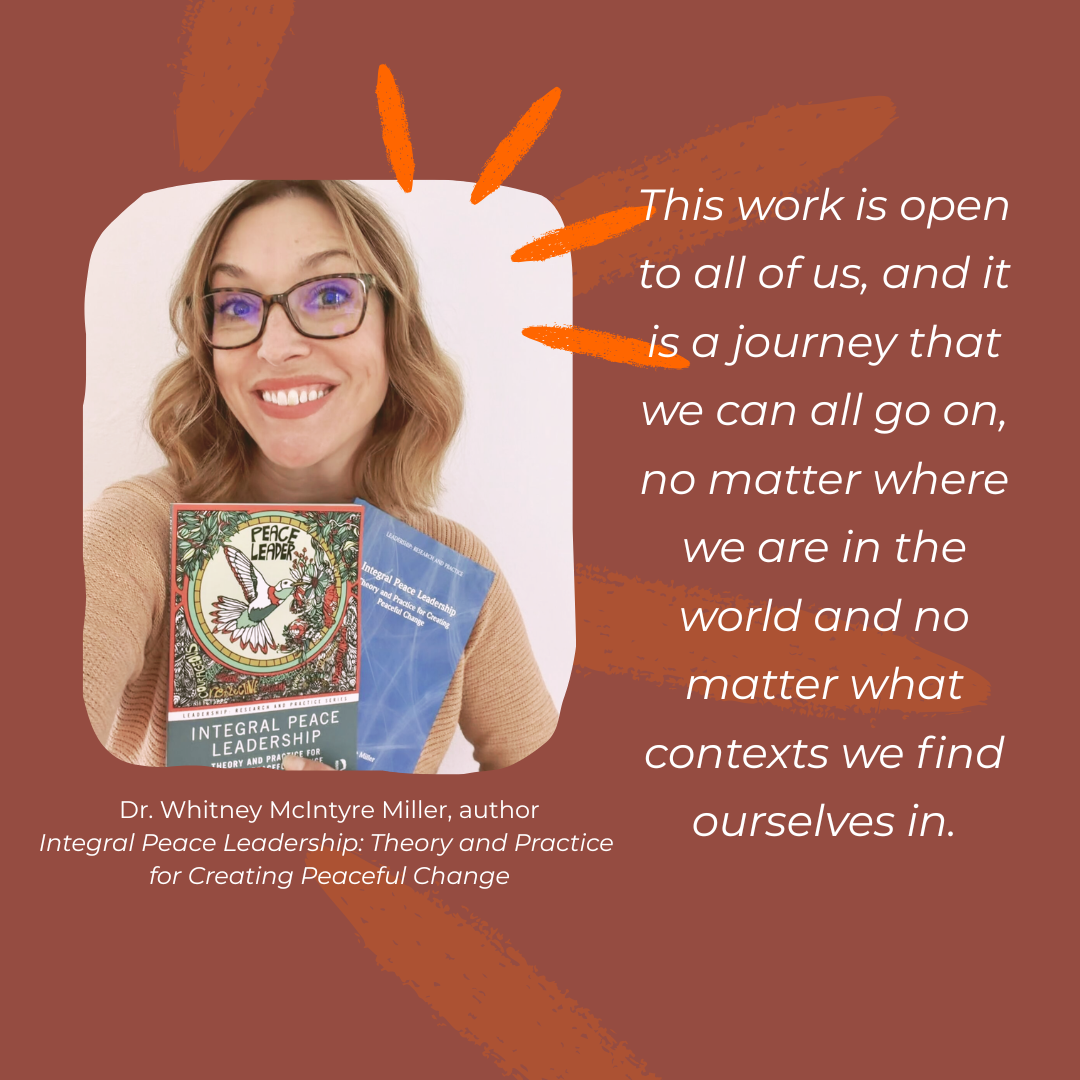
We are thrilled to spotlight our friend and thought partner Dr. Whitney McIntyre Miller in celebration of the launch of her new book, Integral Peace Leadership: Theory and Practice for Creating Peaceful Change. At a time when violence and systemic strain feel ever-present, Whitney offers a deeply needed vision for leadership rooted in courage, self-awareness, and collective responsibility. Drawing from decades of global engagement and academic research, she bridges lived experience and theory to illuminate what it truly takes to build just, equitable, and sustainable communities. Our conversation is more than an interview — it is an invitation for all of us to step more fully into the work and power of peace. Please enjoy the full interview below.
+++++++++++++
You aren't simply an academic author. You've lived into integral peace leadership. What were some formative moments or experiences that shaped your journey into peacebuilding and leadership work? Was there a moment when you realized these two worlds were inseparable for you?
As I talk about in the book, I had several opportunities in my formative years to engage in social justice work and see this work in action. When I was in college, I was able to participate in the Semester at Sea program that took me to 10 countries around the world in 100 days and really exposed me to a lot of different communities and spaces. This, coupled with my opportunity to work for the U.S. Department of State in Bosnia during peace implementation, really opened my eyes to the need for peacebuilding in communities around the world.
Then my experience with the University of San Diego's Women PeaceMakers Program really encouraged me to find ways to begin researching leadership and peace together, which I did during my doctoral program. Once I moved into my academic career, I began to notice that there was not a lot of scholarly literature that aligned peace and leadership in a way that made sense to me. Having traveled to over 50 countries at the time (over 60 now) and having worked with courageous peace leaders around the world, I really saw the gap that was there and felt called to try to find a way to bring the experiences of peace leaders around the world into the academic literature.
That really began my cycle of engaging theory to practice and practice back to theory, which is how I see my work. I get to engage with peace leaders around the world and learn from them and then translate that into academic theory that can then help others begin or enhance their peace leadership practices in their own communities.
Many people see leadership as strategy and peacebuilding as relationship or activism. How do you understand the intersection between leadership and peacebuilding, and why do you believe they must be integrated to create lasting change?
For me, I see leadership as individual and collective action to make just, equitable change. I see peacebuilding as the vehicle through which to bring that change toward a future of a culture of peace, or what my colleague Stan Amaladas calls peace dwelling. Peace leadership is a combination of those two things — the individual and collective actions that we must take in order to challenge the violence and aggression that live in our world, while also working to build the systems and structures that we wish to see in order to achieve this notion of just, equitable communities and spaces for peace.
To me, it is nearly impossible to separate leadership from peace. Jean Lipman-Bluman, a leadership scholar, once asked, “Leadership for what, if not for peace?” I echo her sentiments and believe that we must all be working toward peace in whatever capacity we can.
Your framework begins with Innerwork — self-awareness, emotional regulation, personal practice. Why personal practice as the grounding force of peace leadership? And what tends to unfold when leaders attempt systemic change without first cultivating that internal foundation?
Here is where I provide an unpopular opinion. Yes, the first area of the book is the Innerwork area, where the personal peace practices in which we must engage to work with others live. I do feel like this is an essential space in peace leadership, which is why it's in the book. However, I do not necessarily agree with scholars and practitioners who feel that we must enter the work of peace and leadership through our own personal peace practice. There are many practitioners who are unable, or have difficulty, finding the space to focus on their own personal peace journey, and this can become a challenge for them. I feel strongly that we don't want people to feel uninvited to the work if personal peace practice is not their first foray into it.
What does need to happen, however, is for people to find their space in personal peace practices in order to be successful. So yes, personal peace is essential to integral peace leadership, but it does not necessarily need to be the only way that people find themselves in this work. Many peace leaders need to cultivate a space for this practice and, from my research, I have learned that once people do cultivate this space, they feel grounded in the work and more prepared to engage with others. That is the importance of personal peace — finding the space within ourselves to be as best prepared as we can to interact with others and engage others in this work. Because it's not just about us; it's about us being prepared and inviting others — those who are like-minded and those who are not — into the space with us.
Your book includes 16 stories from leaders working in very different parts of the world. As you gathered and heard those stories, what surprised you the most? And did you start to notice any common threads — across all those different cultures and contexts — that really reinforced the heart of integral peace leadership?
One of the things I really like about all of the stories included in my book is the fact that they are all unique. I was very intentional in including stories that had a wide array of perspectives and opportunities to engage in this work. I want anyone who picks up the book to be able to see themselves in one of these stories and know that it does not have to be a certain type of person in a certain type of context to engage in integral peace leadership work. This work is open to all of us, and it is a journey that we can all go on, no matter where we are in the world and no matter what contexts we find ourselves in.
Also, as I describe in the book, there are two lessons that I think are really important that reveal themselves in the stories. These are that peace leadership is messy and we must embrace that messiness, and that peace leaders around the world have a sense of critical hope. They believe that the world can be a better place and that we can get there when we work together, but they do not do this naïvely or in a utopian way. They are able to hold the challenges and real traumas of our world while also still believing that we can and will make the world a better place. I think this is what makes integral peace leaders so unique.
Part of the integral peace leadership model looks at changing systems and structures. In a world that feels so polarized, even hostile, how can we step into systems of power in a healthy way without becoming reactive or totally burned out?
There is no mystery that our world is increasingly polarized, with fewer and fewer people willing to engage in conversations with those whom they feel are the “other.” Those who wish to engage in integral peace leadership, however, find ways and spaces to challenge themselves and others into this work. This often takes patience and perseverance, and the willingness to keep engaging not only with others who see the world the same way, but more importantly with those who are initially inclined to push back against peacebuilding efforts.
It is also important for us to remember that we must take care of ourselves and allow ourselves to take breaks and give ourselves grace when we are feeling frustrated or like we can't move forward. We cannot do the work that helps bring about sustainable, peaceful change when we are run ragged or feeling thin on patience. So we must give ourselves permission to take a break and reset. This is very hard for peace leaders to do, especially when we are so embedded in the systems and structures that we are trying to change. It is not easy work, and often it feels as though the needle moves slowly, but the peace leaders that I speak to are willing to make the effort, do what is needed, wait, push, help others understand and hear them, and find the right people in the right places to help us do this work effectively.
What advice do you have for someone reading this who feels called into peacebuilding, but doesn’t see themselves as a “peace leader”? Any first steps?
While I imagine that most people who pick up this book already have some peace leadership interest or practice, I do hope that it finds its way to people who are new to this field. What I hope this book does is inspire them to find one way — any way — into the work. I hope this book serves as an invitation that anyone, in any context, can do something to make the world a better place. It does not have to be a grand gesture. It can be a small step in their homes, in their communities, or within themselves.
I hope this book gives people permission to try in whatever way feels most comfortable to them. I also hope it helps them realize that there is a community of scholars and practitioners out there waiting to welcome them into the work. In the book, I talk about Euphrates Institute and the Peace Leadership Collaborative, and I hope that people who are just starting their journey are willing to look at these groups and find spaces where they feel supported and welcomed. Integral peace leadership is a team sport, and I hope people see that there is always space on the team for them to join.