
Adaptive Leadership: Learning, Listening, and Moving with Change
Peace leaders are meeting a world that keeps changing. Communities are carrying old pain and new pressures. Trust is strained in many places. People are being asked to lead through uncertainty, grief, division, and change, often without clear answers.
In moments like these, leadership has to be more than a title or a plan. It has to be a practice. It asks people to listen carefully, notice what is happening beneath the surface, stay present in discomfort, and invite others into shared responsibility. It asks us to care for the human side of change.
To support this practice, Euphrates Institute offered Adaptive Leadership, Deepening Awareness of Self and Systems as Peacebuilders, in collaboration with Marc Manashil of CoInnovate Consulting. The course welcomed 22 participants from Euphrates’ wider peace leadership community, including those connected through the Peace Practice Alliance and the Peace Leadership Collaborative. Participants represented varying countries including Kyrgyzstan, India, Nigeria, the United States, South Africa, Côte d’Ivoire, and Indonesia and brought with them experiences from families, schools, communities, organizations, and local peace efforts. All came with a shared desire to deepen how they lead, serve, and respond to the needs around them.
The course helped participants look more closely at the difference between technical problems and adaptive challenges. Technical problems may have known steps or clear solutions. Adaptive challenges ask something deeper of us. They often involve relationships, values, identity, loss, fear, trust, and change over time. For peacebuilders, this distinction matters. Many of the challenges they face cannot be addressed by information alone. They require listening, patience, courage, and shared learning. As one participant shared, “Technical solutions cannot drive transformative changes in leadership goals.”
Over six weeks, participants brought real challenges from their peace work into the learning space. They explored the difference between authority and leadership, practiced diagnosing the systems around them, considered stakeholder perspectives, and explored how to take thoughtful action without rushing toward easy answers. The course invited them to slow down enough to see more clearly, then take small steps with greater care and intention. For one participant, the most valuable learning was simple and profound. It was “diagnosing the system.”
The learning was shaped by the teaching and by the people in the room. Participants shared from their work with families, youth, schools, communities, organizations, and local peace efforts. The live sessions, small group conversations, WhatsApp exchange, and case reflections created a space where participants could learn from Marc, from the framework, and from one another’s lived experience. One participant described the online format as a gift because it brought “people from each corner of the global society” together to exchange ideas and learn from one another. Another shared, “I loved how safe and kind the space was. I never felt like I couldn't share my thoughts or ask for explanations.”
In the written feedback shared after the course, eight participant voices are represented. A majority of the participants shared that they were very satisfied with the course. Every participant who shared feedback said adaptive leadership would help improve their peacebuilding work. They also all shared that the course helped them think about leadership differently. Each participant agreed or strongly agreed that the course supported them in addressing an important challenge they have been facing in their peacebuilding work.
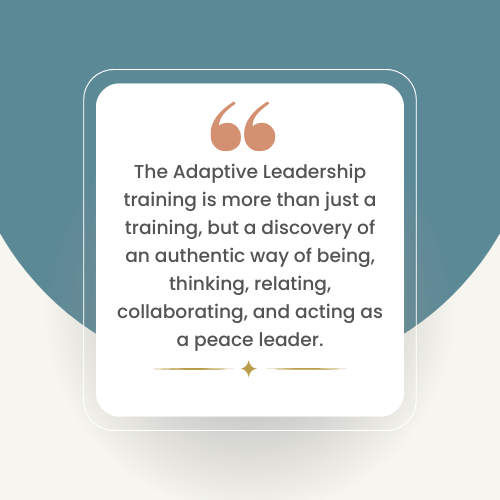
Participants described a meaningful shift in how they understand leadership. Several shared that they now see leadership less as a position and more as a way of being and acting with others. One participant described adaptive leadership as “an authentic way of being, thinking, relating, collaborating and acting as a peace leader.” Another shared that leadership is “not only a position to assume,” but an activity anyone can practice through shared responsibility. Another named the shift even more directly, writing, “Never lead by imposing ideas on people, but hear them out and embrace people’s ideas.”
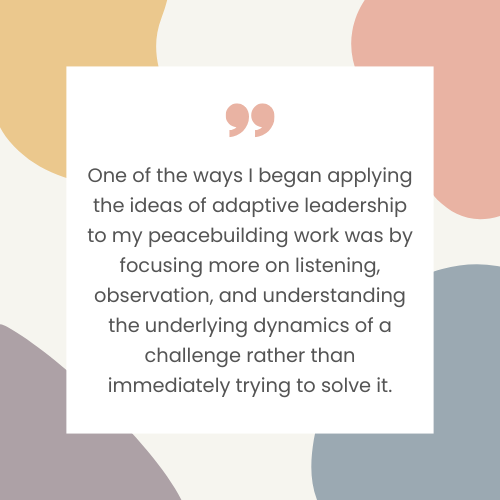
Participants also began applying the course directly in their work and daily lives. One participant used adaptive leadership ideas while responding to a family dispute, creating space for patience, self-awareness, openness, mindfulness, and compassionate listening. Another began engaging community members more directly as stakeholders in a local peacebuilding effort. Another shared that the course helped her rely more on teamwork, shared ideas, and collective problem-solving. One participant began applying the ideas as a student representative, noticing how adaptive leadership could help her serve classmates across different age groups. Another described becoming more intentional about listening, observing, and understanding underlying dynamics before trying to solve a challenge.
Participants also described strong learning in several key areas. Across all eight responses, participants agreed or strongly agreed that they could better determine when, where, and how to take a risk. The same was true for strengthening awareness of stakeholder perspectives and learning strategies to help manage discomfort in others and resistance to their peacebuilding efforts.
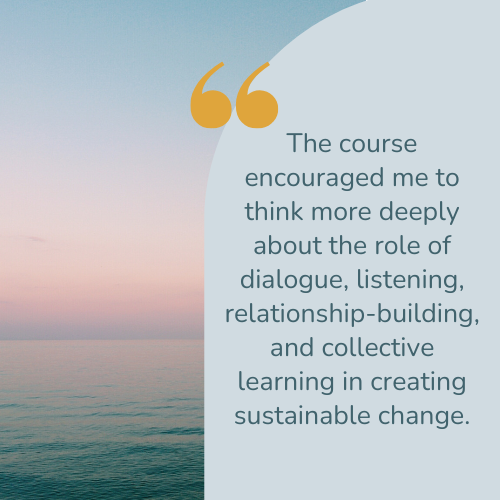
The reflections gave life to those numbers. Participants spoke about learning when to raise or lower the level of tension in a group, how to listen more closely to stakeholder perspectives, and how to lead through invitation rather than imposition. One participant shared that adaptive leadership helped them understand how to adapt to a situation before trying to lead within it. Another named “the perspective of adaptive challenges” as the most valuable part of the course. Another shared that the course encouraged patience, dialogue, relationship building, and collective learning. These reflections point to a deeper change in how participants are thinking about peace leadership itself.
The live sessions were especially valued, with every participant who shared feedback describing them as extremely helpful to their learning. Participants appreciated the practical examples, participatory style, small group conversations, staff reflections, and the chance to learn with people from different parts of the world. What seemed to matter most was the shared space where peace leaders could bring real questions and think honestly together.
One of the most meaningful moments of the course came through a shared exchange between participants. In response to reports of anti-immigrant tensions in South Africa, including concern for Nigerians and other African migrants, a Nigerian participant invited the group into deeper accountability, care, and attention. A South African participant responded with appreciation for the reminder and shared possible stakeholders and local connections that could help guide further learning or action. It was a small moment, but it showed something important. This community is more than a learning space. It is also a place where changemakers can call one another into responsibility, respond with humility, and help each other see where more can be done.
What stands out from this course is simple and important. Peace leaders do not need more pressure to have every answer. They need spaces to pause, practice, listen, and learn with others. They need tools that help them understand both the visible challenge and the deeper patterns underneath it. They need community as they make thoughtful choices in complicated situations.
One participant called adaptive leadership “a compass tool.” That feels like a fitting image for this work. The course did not offer one fixed path. It helped peace leaders notice where they are, who is with them, what is changing, and what small step may be needed next.
Euphrates has a growing community of peace leaders connected through the Peace Practice Alliance, the Peace Leadership Collaborative, and continued learning opportunities. These leaders come from many countries, communities, and fields of practice, and they remain committed to learning, connection, and individual and collective growth. Short courses like Adaptive Leadership offer space for deeper study, shared reflection, and practical tools that leaders can carry into their work. As the needs of the world continue to shift, Euphrates remains committed to accompanying peace leaders as they listen, adapt, collaborate, and practice peace in real time.