
Ripples of Peace | An International Day of Peace Gathering with Peacevent
What does it take for peace to move from an inner conviction into everyday life? We explored that question together on International Day of Peace alongside Peacevent, a peacebuilding initiative in Kashmir that grew out of the Peace Practice Alliance (PPA). Through its fellowship, young people deepen their practice of peace and develop projects shaped by the needs of their communities.
Stephanie Nash, Amjad Saleem, Dr. Amit Wanchoo, and Chestnut Booth offered different ways to understand that work. Their reflections brought us back to inner steadiness, the courage to repair relationships, and the trust that allows others—especially young people—to lead. We heard that peace is rarely one dramatic breakthrough. It grows when we listen, make room for one another, and choose to act even when we cannot know the outcome.
Peacevent fellows Nuha Haris, Mir Kashif, and Sadam Hussain Khan showed us what those choices can become: thoughtful efforts to care for the environment, hear young people’s aspirations, and build connection with Kashmir’s transgender community. As Irfan Pullani, Owais Khan, and Simran Kour shared, the fellowship offers learning, mentorship, and support to help such ideas take shape.
Their stories invite us to consider what we can nurture together—and how far one ripple might travel.
We invite you to read the full transcript below and / or Click here to watch the call recording.
Call Nuggets
How to practice peace in difficult moments. While in the hospital with her brother, Janessa reached deep to find steadiness and peace amidst fear and uncertainty.
Impact of 20 Days of Peace initiative. Chestnut described how the 20 practices helped her listen, reach out, and rebuild goodwill with people close to her.
Support creates further ripples. Peacevent grew from Euphrates PPA program into a fellowship that pairs mentorship with micro-grants. Fellows are now carrying what they learned into projects in their own communities.
Peacebuilding meets practical needs. Peacevent’s Kashmiri fellows’ created initiatives that address education, climate action, mental health, and community acceptance.
Ripples need people willing to carry them. A local idea can grow when its leaders have encouragement, mentorship, and modest funding—along with the freedom to learn from the first attempt.
Janessa Gans Wilder: Welcome so much to this special gathering on the International Day of Peace, and whether you found your way here, through Euphrates or Peacevent, you are so welcome. Thank you so much for being here. To give you an overview of our program, we have a very exciting, jam-packed schedule. We're going to have a few speakers on a range of topics. They will explore peace from the personal to the community and global levels. We will also hear about our 20 Days of Peace program from someone who took part and can share what they experienced.
I was thinking about how we were all gathering today on this International Day of Peace. And I was really thinking about what does peace mean? You know, it sounds so airy-fairy: peace and joy. And I spent the past two nights in the hospital with my brother, who had a traumatic injury and a traumatic accident.
And there was a moment in the middle of the night, not last night, but the night before, when I was there, you know, all the beeping, and this was the intensive care unit, and I thought, I cannot believe this is happening. I can't believe I'm here. I can't believe my brother is here in the bed. I can't believe this is happening, and I wanted to just be removed from that. To me, it felt like I would have to leave and go somewhere to find peace, and I realized there was no way out. You know, this is where I was, and this was the reality and the situation, and I had to find the peace right there, in that situation. I was remembering that the Euphrates Institute takes its name from the river. The river did not appear in a space of beauty and calm.
This river, this current of life force and beauty and peace, appeared in the midst of death and destruction, in the middle of a war zone. It was going through the worst imaginable places. The most despair I had ever felt and the most destruction I had ever encountered were right there. It was right in the midst, and that just showed me that the power of peace is accessible to us. Right now, I know so many of you, I'm thinking especially of those who've just completed this program in Kashmir, and you know, it's an active conflict zone, that there are so many things going on that you live in the midst of. I'm thinking of those in Gaza, I'm thinking of those in Sudan, and all over the world. This isn't something to take lightly, and this is something that we can call on that power of peace for those in those dire situations, and for each of us in our most challenging moments, what does that mean?
That peace is present, it is a power, and it takes us through, you know, right in the eye of the storm, right in the midst of when we need it. And so, to me, there's a power in claiming that for ourselves and for each other. We're all connected in this river of peace, and as we see, demonstrate, and prove that power, we give more courage and strength, and help those who persist who might need a little extra encouragement. So that's really what I'm holding to today.
I would love to turn it over to my co-host, Irfan Pullani, who's going to tell us more, about our wonderful fellows who are joining us today, and the continuing program.
Irfan Pullani: Thank you, Janessa. And welcome once again, everyone. Very good evening from where I'm speaking. I'm right now in the United Arab Emirates, and it's wonderful to join back the Euphrates community, and my dear fellows from Kashmir, and our dear speakers who have joined for this call today. It's a very powerful start to this call, as Janessa just shared where she has been, in the last couple of days, and how difficult and revealing it was. And thank you, Janessa, for being here and for bravely sharing, the last couple of days, what your life has been through, and we all hope and pray things get better, and thank you.
We all know how uncertain the peace for all of us is, let it be personal peace or community peace as a whole, and it's not something that we can take for granted, for sure, and that's the biggest reality that any such incidents or the observance of this day would give us. It's absolutely uncertain. We can't predict what life takes us through, or what the impact of our peace, or our own well-being is.
It's wonderful to see this call happening. It's a great honor to be a part of this community for a long time, and I look forward to sharing more about the stories and the purpose and why we are trying to connect these two communities.
Here we are today on the International Day of Peace, as some of you might know.
It's a UN observance day, and it started in 1982. Since 2001 the UN has been observing this day as a day for nonviolence and ceasefire. And this year's theme is “Invest in Peace: For Everyone, Everywhere, Every Day.” The key idea, as I understand it, is that peace isn't only something negotiated between governments. It is also built through everyday actions, relationships, and communities, and that's the very purpose of this call.
So, once again, warm welcome to all of you, thank you for joining, and back to you, Janessa.
Janessa Gans Wilder: Thank you, that was so helpful, Irfan, hearing about the history of the International Day of Peace, and then our two organizations coming together. We really wanted to just give everyone an inspiring time together, and so we reached out to speakers who we thought would touch on different aspects of peace from the personal to those between nations, those between communities. It's just on all levels.
I'm really excited to introduce our first guest, who I have known now for almost 7 years, and my dear friend Stephanie Nash, who is a Hollywood actress. But she also has this other side to her, which is mindfulness coach, a spiritual, intuitive person, and guide and teacher. So, I it's you're like a jack-of-all-trades, Stephanie, and I wanted to start with you because I am so needing personal peace practices to find that center in the midst of all the challenges and chaos, and whenever I've been with you have brought me right to that point. I'm so grateful that you are willing and eager to offer that and guide us through, as a group, how we can find that peaceful center.
-MEDITATION-
Stephanie Nash: Thank you. And everyone can hear me fine, right? Yes? Good. Yes. So, I just first want to say how lovely it is to be here from everyone gathered from all over the world, with intentions of goodness, of connection, of peace. And as I honor that. As it feels appropriate to you, I would like to guide a short experience to contribute to our inner peace, maybe that helps take us through, just the way Janessa described the river. So first, I'm going to and you can do this with eyes open, eyes closed. I will, at one point, invite you to open your eyes, but you know, you can work with that as it feels appropriate for you. But first, I'm going to invite you to just tune in to how you feel in this moment.
Just notice your body. What's going on? Are you excited? Are you tired? What's going on? And then take a nice deep breath in, and a big Sigh out to release anything that's not needed. Just let something go, and feel a wave of release in the body. It's a kind of relief and release. And then we're going to breathe in together in this sacred space, where we're meeting from our highest selves. And as we breathe in, we're receiving, we're opening to this beautiful energy here today, what everyone's bringing. And then as we breathe out with the release, we share ourselves, our own good intentions, our beauty. With everyone here. We're gonna work a little bit with the breath in and the breath out. And then when we breathe in, I'm going to use the metaphor of a tree.
We breathe in, the spine stretches up in a way that feels good, the way a tree grows up from the ground. In the breath out, we allow our roots to go down into the ground, connecting us and grounding us. And I love the metaphor of redwood trees, which are these huge, the biggest trees on the planet. They're just absolutely huge. And their root system is not very deep, but their root system connects with all the other trees down there. And that's what stabilizes them. That's what grounds them. All trees grow in two directions at the same time. And on the breath in, we stretch up. We connect, and on the breath out, the roots ground us. And the stretching up of the tree, that's where we manifest in the world.
That's where we provide shade and care and comfort and support to others. And the breath out, as we release, we ground. We're growing in two directions simultaneously, kind of letting go of a little bit of Oh, what we hold on in the center. And then I invite you to allow that process. Of stretching up, growing upwards, growing downwards, with that release. Let that process just continue naturally on its own. And see it. I invite you to see it. You can find a still point in the center. T.S. Eliot, a famous writer. There's a piece he wrote, and one phrase is, he talks about the still point of the turning world. And the analogy for me for that is like the eye of a hurricane. You've got all this wild energy going around and in the center.
It's peaceful. It's still so maybe we can just access that still point in the center, no matter what's happening on the outside. Might be beeps, it might be wind. There's always gonna be something happening. And a majority of people on this call all know conflict all too well, so to find that inner still point. That inner place of peace, and it might be just a point. It's an act of grace. So there's the eye, the still point in the center, and the movement of the breath on the outside. They can become a kind of massage. Just allowing these two things to happen simultaneously. And from this place of peace within, even if it's a tiny point, may we Allow our hearts to open and bless this gathering.
Maybe bring a gentle smile to your lips. As you allow your energy, your heart, your good intention to spread out into this sacred space, maybe opening the eyes and seeing everyone in their little squares from all over the world connecting in this moment. To share. To celebrate, to connect in peace. Let's take a last, nice, deep breath in together. We breathe as one, our grounded tree lifting up. Releasing out into our roots. Still, just able to touch that still point. Thank you. Welcome all. It is well that you have come. To this still point. And the grounding presence.
Janessa Gans Wilder: Thank you, Stephanie. Oh, I loved the I just loved the feeling of the rising up, and then being connected when you were talking about the root system to every single one of you on the call, and I was reminded that someone had just said that trees can communicate through their roots, let's say some tree is ailing or needs extra help, and the other trees in the network send their resources and their support to that tree, and so there's all this communication, and thank you for grounding us in that visualization, because here we are, all connected through our roots. That's what keeps us grounded, that's what keeps these giant trees upright from falling over. So here we are, connected.
I found that still point. Thank you so much for that, and for Stephanie.
Irfan Pullani: Thank you so much, Janessa, and thank you, Stephanie, for that wonderful start of this whole call. And, It has been deeply grounding, and thank you. I would like to start directly by inviting our speaker here. Mr. Amjad Saleem, a peacebuilding and humanitarian practitioner whose work has focused deeply on young people, trust, belonging, and social cohesion. His experience spans the International Red Gross and Red Crescent Movement, and global youth initiatives, and his work today increasingly explores the connections between peace, planetary health, and radical hope. He's also an assistant professor at the Zakat Foundation Institute and serves on the board of Euphrates. Amjad, it's wonderful to have you with us, and over to you. Thank you.
Amjad Saleem: Good evening, everyone, from Kuala Lumpur. Thank you Stephanie for that grounding. That's what I needed, so I really appreciate that. To a lot of familiar faces I see. I haven't seen a lot of them in a long time, so really great to see people here from Euphrates and from Peacevent as well. Happy International Day of Peace. I want to start off with, story of a young person, because as Irfan said, my background is working with young people. I want to start off with the story of someone called Pralisha.
Pralisha is a volunteer at the Nepal Red Cross in Kathmandu. During COVID-19, Pralisha noticed something quite interesting that didn't really add up, right? She was like because obviously, for those of you who've been to Nepal, like many parts of South Asia, there's a lot of apartments. And what she noticed was that the rooftops across the city were empty whilst people below were curing for vegetables, and Nepal imports a lot of vegetables in huge quantities, and food travels hundreds of kilometers to reach a city. So being an agricultural graduate, she saw a connection, and no one gave her permission to do this, but she decided to put in a proposal to a competition that we were running at the International Federation of the Red Cross and Red Crescent Societies. It was what she called Tower-nomics, which was automated vertical farms for the city.
It was an idea that she basically wanted to build soil-free towers in Kathmandu, where people in apartment blocks can grow clean, pesticide-free greens on rooftops and balconies there. It was really connecting her ideas of agriculture, but also trying to fulfill a need. The reason why I start off with that story is because Pralisha never thought about wanting to take charge. She didn't have a title, she just saw the cue. She saw the rooftop. She connected the dots. That, for me, as Irfan is saying, is a ripple. And after many years working in the humanitarian sector and working with peacebuilding organizations, I'm convinced that peace rarely starts with the big things. It starts with relationships, it starts with someone wanting to be heard, feeling heard, someone discovering that they belong, someone being trusted enough to act.
And like Pralisha, there are many young people across the world who are regularly doing that. They have actually challenged my assumptions about peace and leadership. One of the things that we often hear, particularly working in the multilateral space, is we call young people the leaders of tomorrow, right? We always say that there'll be someone who will always say, young people are the leaders of tomorrow. I've really come to hate that phrase. Mainly because tomorrow is a very convenient place to put someone else's leadership. Without giving them the agency and responsibility today. Because young people live with today's realities, right? Whether it's the conflicts, whether it's climate anxiety, inequality, polarization. Identity, belonging.
Many times, our organizations say, here's our agenda. Here are our rules, now tell us what you think. And we call that participation. But that's actually participation without influence, which means that there's no agency. So, I think part of creating ripples is about how do we change the question from how do we prepare young people for the future?, to how do we create the conditions for young people, and people in general? To shape the present and co-create the future, and that's what I think the concept of ripples are. I call it the five A's of youth engagement, in the sense that young people are agents of change, because they don't wait for permission. Their advocates, because they can speak uncomfortable truths in rooms where they're often absent. I often say, for those of you who remember the good old fairy tale of the emperor with no clothes, who was the one who pointed out that the emperor had no clothes? It was a young person. So, you know, they speak those uncomfortable truths. They're architects, like Pralisha, because when voice is not enough, they design the institutions and futures they want to inherit. They're anchors, because peace is sustained in their families, in their schools, in their neighborhoods. Because they take one idea, and they let that action become many, and that's the ripple effect. But ripples only travel through water that's willing to carry them. As Janessa was saying, Euphrates was founded on this idea of the river, right? So what is the water that peacebuilding travels on? And I'd like to point out to you that peacebuilding travels on trust, and I asked the question, " What if peace travels at the speed of trust?
Then what is the cost of building that trust? So it's not the speed of funding cycles, it's not the speed of press releases, it's the speed of trust. Trust is not free. It costs time. Because it's built by showing up repeatedly, especially when nobody's watching. It costs vulnerability, because someone has to go first. It costs control. Because to trust someone, is to let them try something you might have done differently. And it costs the risk of being let down. And if you go back - Pralisha had this idea. I'd like to think at the IFRC, we trusted her to take that idea and run with it, and it had a cost, and look at what happened when it became possible. She's now a social entrepreneur, she's won quite a number of awards, and she's actually set up a business on this.
I think that building trust is part of creating the space for peace. And so, in that sense, the micro-grants, that I think you will talk about later on, is about showing trust in the ideas that you're coming forward with. To the fellows carrying the work forward in Kashmir, thank you for that. Thank you for coming up, because it's important that you do this. When you build trust, we need to think about five Rs. I started life as an engineer, so I'm very theoretical. Five A's, five Rs. I need some framework, otherwise it doesn't really work in my brain.
We need to take responsibility for building trust, because trust begins when we start our own selves.
We need to build relationships, because it means showing up.
We need to ensure respect, so we need to treat people, particularly young people, as partners. We need to reflect, and I think the exercise that we had early on helps us in that, because honestly we learn from our failures.
And we need to renew, keep on choosing.
And that's part of the investment, in peace. I want to just finish off by saying that peace is not just our relationship with ourselves, with each other, with our institutions. Increasingly, my work is around planetary health, because that's also changed how I think about peace, because if we're not at peace with our planet, we can't be at peace with ourselves, we can't be at peace with each other, because we're all an interconnected system.
Living in Kuala Lumpur, we've been suffering from the haze, which is affecting people's health, which is affecting people's relationships with each other. So, it's all interconnected in that sphere. So, I think one thing I want to leave you with is to say that we need to have this aspect of radical hope, as Irfan mentioned.
I stumbled across this by accident, this book called Radical Hope, by a philosopher called Jonathan Lear. He says that radical hope isn't optimism. He says optimism says things will only probably get better. Radical Hope says, I don't know what will happen, but I know what I do next still matters. And so it's not a passive perspective. It's an active participation, because one person acts, another one joins in, relationship grows, trust grows, community begins to believe change is possible, an institution responds. All of those things are the ripple effects. So I want to leave people with just these five questions, maybe, particularly for the fellows from Kashmir.
Where can I be an agent of change?
What must I advocate for?
What can I help design and build?
Where can I be an anchor?
Whose voices can I amplify?
Don't carry the burden of believing you individually have to change the world, because we adults also have a very bad habit of saying that your generation will fix this. We spoiled it. You guys are gonna fix it, and you know, we believe in you, and all of those things. That's actually not giving you hope. That's just transferring our guilt and our responsibility onto your shoulders.
Peace rarely begins through one enormous breakthrough. It grows through relationships, through trust, through belonging. If enough of us create those ripples. Then we don't simply create a ripple, we will change the current, and we'll have a river. So, thank you so much for allowing me to ramble on for a bit. Like I said, it's 11.30, so I'm well past any sense of coherence, but thank you so much for allowing me to share some words with you.
Irfan Pullani: Thank you, thank you so much, Amjad, and it has always been incredible to listen to you. And Amjad, he has been a long-standing friend, I should say, and a supporter of the whole program that we do. We connected through the Euphrates community and the program that we did. And then has been a great support for designing, curating, and implementing this whole program that we do in Kashmir. Thank you, Amjad. I really appreciate it. And from there, we are taking it from Kuala Lumpur back to Kashmir now. I have my dear friend, Dr. Amit Wanchoo, who is the Founder President of the Rotary Club of Kashmir. And he's also the District Coordinator for Peace and Conflict Prevention, and a Paul Harris Fellow from Rotary.
He's a doctor, social entrepreneur, cultural revivalist, and has spent, over two decades working in healthcare, community service, and peacebuilding in Kashmir, so Dr. Amit, welcome, and thank you for being with us here.
Dr. Amit Wanchoo: Thank you so much, Irfan, and thank you, Euphrates, and all my co-speakers and friends. I would like to focus on two, three things. For me, peace in itself basically comes from the human heart. And during my whole last 30-35 years that I have lived in Kashmir, I have seen that, unfortunately, violence is always a private, limited company which has got a lot of funding from all across. Peace is always something which is fighting that private limited company. And we mostly depend on our own strategies, especially in negotiations. So, for the students, because I don't want to bore them with long speeches, I would like to share a few practical things that I have come across in these last two decades.
I want to focus more on the negotiation part. We had once a very major conflict here in Kashmir around 15 years back. There was a strike, and everything was closed, and the problem was that neither the ruling party was agreeing on anything, nor the opposition was agreeing on anything, and we also had the separatist camps not agreeing on anything. At that time I was in Rotary because I started Rotary way back in 2003 here as the youngest president of Rotary in the world. The crisis was such that all schools were closed, all colleges were closed, everything was closed, and there was no chance that peace could get through.
And suddenly, as a doctor, I came to know that the person who is in charge of the ruling party has diabetes. And the opposition leader who was opposing it, also had diabetes. It was the month of November, and I saw that 14th November was Diabetes Day. So, I came up with the idea of doing a diabetes conference. I had to invite everyone from all camps. I also came to know that from the separatist camp, there's also a person who has got diabetes who was leading the movement. So we invited all the three, but we did not tell each of them who else is coming, because if we would have told them, they would have never come to the same table.
So, while the invitation was done, I also requested my teacher, who was at that time the head of the Department of Endocrinology, to come for a guest lecture. And we invited around 3,000 people. And you all know that politicians' weakness is the public. When the public is in front, they don't do anything, they always want to charm them. And the moment all of the three people landed, they were so furious on seeing each other. I knew that for the goodwill of the people, I have to do this. I was worried that now maybe my job is gone, because one of the ruling guys is going to just get me out.
But nothing like that happened. I asked the sir to kindly start with the library's lecture. So, the moment he started with the diabetes lecture, another 15-20 minutes, you could see all these three people discussing their medication. Which medicine are you taking? What is happening? And believe me, everything slowly eased out so much, they came, they lectured, and that was the breakthrough of that crisis, and the strike was called off. I always believe that peace is very strong. It comes from the human heart. And you have to basically put in your input.
The second situation that I want to share with you is about when violence touches you closely. I lost my grandfather in 1992. He was assassinated by terrorists in Kashmir. It was a very painful moment for me, because he was my best friend. I would literally sleep with him, do all the homework with him. He used to work for the downtrodden, he was a big socialist leader here, for the sweepers, for everyone. And for one year, I did not go to school. And you know that I come from a minority here, and I was the only minority student in the school. But all my Muslim friends, they were all along with me for all that one year. What grief does to you is that either you are full of anger and you build walls or you start identifying and building bridges. Peace is that direction which helps you to build those bridges, and that is the most important thing that we all have to do in life. I know it's very difficult. At times, you cannot do it. But that is the journey. It's the journey from grief to goodwill. That's where the peace comes in the process.
The third point I want to mention is that when I started my college also, I was in the medical college. Again, you can imagine just one Kashmiri Pandit boy in the whole medical college. And let me tell you that I was the unopposed college president in the university elections. I was the unopposed college president in the medical college elections. The kind of support I had, it was phenomenal. And I have seen that when the intention is good, because within you, almost every human being that we see, irrespective of religion, caste, they all have some basic things of humanity. The only thing is where and how we are touching that.
Are we touching at the right process? Unfortunately, peace gets defeated when politics come. That is where we all find it very hard to fight. That was one of the reasons that we started Rotary here, in order to reach out irrespective of any religion, or whatever. In fact, today, on the International Day of Peace, we just installed the second peace pole of Rotary in our Islamic University of Science and Technology, which is one of the finest universities we have here. And before that, we had done an installation of Peace Pole in Pahilgam.
So, my basic point is always that all the youngsters who are listening to me, and many of them are from our place, we have seen a lot of conflict, we have seen a lot of violence throughout all these years, but the basic fact always remains - are the right people leading that peace process? Are the right people connecting you? Because unfortunately, one of the negative aspects of today's world is also media and social media. Like, you get anyone A, B, C, and they start just doing all the negative commentary about the other region, or the other religion people, and that's where a lot of hatred comes in. So, my journey throughout these last 20 years that I have seen is that it is the responsibility of every person because peace starts from the heart. And in my journey, I will tell you that I divided my life into two parts, and that is something to do with the heart. The first part was health, H and E, and the second part was the art. So I basically could see in the conflict that it's not only the physical health that you have to take care of, it's also the mental health.
The kind of stress that you get in these conflict zones, the kind of trouble that you see in a lot of violent zones, not only here, it's all across the world, that affects a lot of mental health. You cannot bring in peace, because peace starts from our own self, from our heart, from our own. So, that's what I believe is very important, and that's where the journey starts.
Irfan Pullani: Thank you, Dr. Amit. Thank you so much, for sharing those wonderful reflections and stories. I have been deeply tuned to what you were sharing, and with the Nepal story from Amjad all connect in some way. Even though the scope of the stories are different, it all has a uniform chord that connects to think about peace,
So, let's all work together, and with this incredible community connecting globally in this wonderful space. I want to take it back for a minute to give a quick introduction about who we are, why we are, and how we are.
I have my very good friend, colleague, associate, and brother here, Mr. Owais, who is a law student from Kashmir, and my colleague Simran. We are Euphrates PPA Fellows, the Peace Practice Alliance program that Euphrates runs. After the PPA program, Euphrates has been kind enough to support us with a micro-grant, or small grant, as they call it, and with that, we were able to develop a post-fellowship project. I have been a peacebuilding researcher in Kashmir for the last 6-7 years, ever since law school.
Owais was born and raised in Kashmir with all the social discussions revolving around peace and conflict and everyday life. So, we both joined this program. I have been to Kashmir and I've met many young people, but It took me seven years and one Euphrates program to meet my colleague and partner to develop a fellowship program. We wanted to take our shared framework of learning that Euphrates provided us with. It’s a very strong and powerful structure, including the integral peace leadership model.
The Euphrates program was six months and we took it to a 3-month program to get this learning to some of the young people in Kashmir. That's how we developed this initiative called PeaceVENT. The idea means to invent peace. That's Peacevent.
Janessa Gans Wilder: Oh, I just love it, Irfan. I love the ripples in describing how this happened and the connectedness. I just wanted to say with the speakers that and I don't know if this is the same for the Americans in the group, but in an environment where there's all this, focus on certain political leaders, on othering, othering different groups, and othering people who are different. And I just want to say, personally, how even hearing people from different parts of the world and people who don't look and sound like me, it fills up a part of me. Hearing things that I so believe and so align with and resonate with. Rather than othering. I just want more diversity - it helps me feel more myself, feel more full, and then connected, the love expands, and the love feels fuller, and we are more ourselves.
Thank you, Amjad, Amit, Stephanie, and Irfan, for telling us the history, it's just so helpful. Especially on a day today, Yom Kippur. I know it's a Day of Reflection and Atonement, and International Day of Peace. It just feels so vital to come together. I just think every single one of us on this call, maybe you're feeling that same way, that we are connected, even in our difference, even across so many thousands of miles.
I just want to give a brief intro, because one way that we can practice these skills, not just on a call when we're together, but in daily life, Euphrates just did this really fun campaign, beginning September 1 and leading up to today, to the International Day of Peace. It was called 20 Days of Peace. Each day, they sent out prompts - share a meal with someone you don’t know, invite them to coffee; who in your life do you need to practice forgiveness with; take a walk in nature and feel the lessons and the peace that nature offers us; express gratitude; take a pause, even in the midst of chaos.
So it's just these little reminders, little moments that we can take in our day on a personal level. You know, as Amit says this starts from the heart, and Amjad said it starts with each one of us, and then those things ripple out. I wanted to invite someone who did participate in the campaign, who's one of the wisest people I know, also a dear friend and a spiritual healer and teacher, to share her experience. She's long thought about peace, but she engaged in the campaign and really took it to heart in doing the practices. This is Chestnut Booth. I'd love to invite her to share some of her reflections on the campaign.
Chestnut Booth: All right, thank you. So, while I have spent a lifetime of prayer and peacebuilding and policy development, my background is within higher education in the United States. I've also traveled to India and spoken in many cities in India three different times, and my heart has gone to problem solving and peacebuilding through our inner, deepest articulation of our own moral and spiritual values, so that we constantly choose to act from those, and to speak from those. But even though I've done that for a lifetime. I was so thrilled with the little exercises of the 20 Days of Peace Building as Janessa just articulated, I love the breathing, I love the pausing, I love the observing, I love the, what are 5 things that I can see right now, 4 things that I could touch right now, 3 things that I am hearing. I listened so deeply that day, and heard things in my home I hadn't heard before. It asked me to just be aware of what I was smelling, and that was an interesting exercise. And then tasting. These little practices are there to connect us with our deepest values. And as I did these exercises, I knew that I was only gaining this inner stillness. In order to be aware of where the conflict was in my life, and what my next steps were. Now, you don't know this, but all day long, I get calls from people around the country and around the world who are having their worst days. I am a person that prays with other people, and so I get called when there are accidents.
When there are heartbreaks, divorces, when there is, a business problem that cannot be solved, and bankruptcy is pending, so I just pray with people. But I know that as I, practice that inner centering. My inner values, that I will always be able to counsel and guide and just be quiet with people that are in great need of sometimes just having been attacked, or in their advanced stages of disease. And so I love the little practices that we had, but I knew I had to look for opportunities to practice them in just my daily life. And I had two people that were problems in my life in the last few weeks. One was a family member, and one was a church member. And I thought, perhaps, the family member, that we had a moment of strain that might not ever be mended.
About a month ago. I was yelled at in a way, in an even violent way. And I practiced all of our peace practices. I was curious about it, I wanted to know. I silenced my own self-defense and was vulnerable for several minutes while I really listened to the individual. And when I walked away from that, I vowed that I would be a peacemaker. And with these little exercises over the last 20 days, I took little steps, shared a meal, I took vegetables over, And kept knowing that what blesses one blesses all, that I had to be interested in the well-being and values of the other, even though they seemed to conflict with mine. And you can tell, there is a happy ending to this.
We are back to normal relationships, but I have not stopped the deep earnestness to make sure that I find my own good in another's good, and that I continue to deeply believe that all things work together for good, even though we don't know how it's going to work out. If we continue to invest in these ways, peace-building ways. I am a person of faith, and so in my prayers, I believe that God can continue to work it all together for good. No one left out. Of the blessing. Let's see if there's any oh, you know, on a lighter note, at church, we are making some important decisions. Often an institution has an important decision to make, and our little church does. And there was someone who had a different set of values, a different perspective, and was voting against things that I was voting for.
And I, on one of the days, encouraged me to say, how can I reach this person? And instead of being able to share a meal with this person, I picked up the phone and said, I would really like to go to a string quartet this Friday. My husband will be out of town. I have an extra ticket. And I know you love classical music. I know you're more of a symphony guy than a quartet guy, but it is a world-class quartet here in St. Louis. Would you come with me? And he offered to drive, and we had the happiest conversation. I have known this man for 40 years. We had a happy conversation, a dear sharing of heart, a lovely sharing of the finest music of Brahms quartet, and we came back.
And the goodwill that he expressed to me, and then the goodwill on our church board when he yielded graciously to a vote where he was in the minority, and he just said he would support the next steps with all of his heart. Okay, that's my story. Thank you so much for 20 days of peacebuilding.
Janessa Gans Wilder: Thank you, I had chills all over as you were sharing about your family member, and your steps, and how we can access excuse me, and how to access peace. I just love how very personal you were sharing and yet you kept talking about the universal peace for all, blessings for all, peace. Even as we go deep like with the tree, we are connected, this is universal. Thank you so much for sharing about the campaign and how you lived through it and your takeaways.
Now, we're gonna see some very practical examples of these ripples and of peace projects and we'll get to hear from some of the grantees. Can't wait to hear what you all have in store and to learn more about these projects.
Irfan Pullani: Thank you. We launched Peacevent with the support of Euphrates. In 2024, we did an incredible program and in 2025 we added an in-person segment to the to the program, because the peace training or the peace practice training we received was, mostly online, but we had the privilege of adding at least a very brief in-person layer to the program that we have been trying in Kashmir. Last year it was just a one-day program, a full-day workshop, but then we were able to scale this program, and we were incredibly blessed to also receive support from the European Union's Global Youth Mobilization.
When we had 50 fellows last year. We had 100 fellows this year. We received over 300 applications, and that too from both Jammu region and Kashmir. We were able to bring in and connect youth from this region as well, thanks to our colleague Simran here. But the whole idea of micro-grants has been there in the program last year in itself. We wanted not just to train these fellows, but to take it beyond that.
Owais Khan: Thank you so much, Irfan. My name is Owas Amin, and I am the program coordinator and in-person lead at Peacevent at Kashmir Journal. As we all know by now, that today we are celebrating International Day of Peace, and we have been hearing different, speakers, speaking about the importance and what peace means. It's a day that reminds us that peace isn't just an abstract idea. But it's an active and daily practice that we choose to do. And we all chose to be here today, and I believe that this is one of the strongest peace activities that we can do as well.
Before, I, before we go into the micro-projects, I want to start by framing what this next segment is all about. Our Peacement Fellowship was never designed to end in a seminar room. But we were actually looking to make something impactful out of it. During the in-person time here in Srinagar this year, 34 fellows came together from 6 regional groups. And they didn't just sit through the sessions, they were actually challenged to design projects addressing specific needs they identified in their communities. It was on three tracks. It was on education, it was on climate action, and it was on peace and development. And every single group received rigorous support, facilitation, detailed written feedback, and mentorship.
A few selected fellows also went on to receive micro-grants funding to bring these proposals that they were working through to turn into a real action on ground. Every group submitted their design using the same template, and then we gave them rigorous feedback. Individual written review, not just generic comments.
Groups took that feedback, and they came back, and they actively strengthened their projects. And after that presentation, every group, presented live to the review. Panel, and answered the questions they were asked, and different things they were asked regarding those projects. And finally today, which brings us here today as results as well. And each group receives mentorship and support regardless of the outcome that we are going to announce here today.
Asi Aman, led by Noha Balkhi: A listening-first project with 30 adolescents in institutional care in Pampur, helping them voice their aspirations and receive educational and personal support.
Education to Emancipation, led by Sheetal Sharma: Awareness sessions with schools, parents, and communities in Jammu to help girls at risk of dropping out stay in school.
Iqra, led by Salik Saif: Fact-finding and guardian outreach to help out-of-school girls in Srinagar access formal education.
Raah-e-Shammah, led by Atifa Rayees: Field documentation and a small waste-segregation pilot with vendors and residents around Dal Lake.
Shahjar, led by Sadam Hussain Khan: Dialogue circles with the Kashmiri transgender community, in partnership with Sonzal Welfare Trust, to build everyday contact and acceptance.
Yemburzal, led by Noha Haris: A replicable waste-audit and climate-education model piloted at Nilag Baddam.
Irfan Pullani: The fellows formed groups, met multiple times, and followed the whole process. The support is “not about the very little micro-grant or the funding support.” It is also a chance to use what they learned through the program and initiate an activity that could later become an initiative, an NGO, or a larger-scale activity. All six groups will receive mentorship to help turn a simple activity into an initiative.
ICRA: The project to help girls get enrolled back in school is “very relevant to the context of Kashmir.” The group will have an opportunity to work further on the case study, with help publishing it through the platform. It will be considered in an upcoming cycle.
Education to Emancipation: The Jammu group’s education awareness project, particularly focused on girl students, has been kept for the next micro-grant funding cycle in February and as preparation for the next PeaceVEN Fellowship.
Rahi Sharma: The team will receive help to structure the project further before it can be supported.
Nuha Haris: Well, first of all, a very good evening, everyone. And wishing everyone a very happy International Day of Peace. Before I begin, I just first would like to express my heartfelt gratitude to all the speakers who have taken their time to share their experiences from different parts of the world. As a young fellow, being able to listen and being inspired by all of you has truly been meaningful for us. I'm Nuha, a fellow of the Peace and Development Leadership Fellowship, where YAM Brazil was developed as our community climate action project. Yam Brazil focuses on Nilnaug Bhat Gam, where increasing tourism and recreational activity can create pressure on the environmentally sensitive landscape.
But our project is not simply about cleaning the litter. The bigger gap is often when we clean an area without actually understanding what waste is present over there. How much there is, and whether it returns afterwards.
We follow a basic four-step procedure: understand, experience, act, and follow up. First, we conduct a structured waste audit to establish the baseline, recording waste categories, number of bags where possible, and total weight. Second, we conduct an experiential climate education session with students, connecting climate change, waste, responsible tourism, and collective action for their own surroundings. Third, up to 25 students take part in a supervised cleanup, where they help audit, categorize, and document the waste.
The most important part is the follow-up. After one or two weeks, we return to the same site and conduct the assessment again. We look at whether the waste has returned, what kind of waste has returned, and why. If it comes back, we don’t consider that a failure. It becomes evidence that can help identify issues such as inadequate waste collection or a lack of bins or segregation.
The impact we hope to create is threefold: environmental impact, improving a defined waste hotspot; educational impact, moving students from simply knowing about environmental problems to participating in solving them; and long-term community impact, developing a repeatable model combining climate education, waste auditing, action, and follow-up that could be adapted by other schools and youth groups in environmentally sensitive areas of Jammu and Kashmir.
Yembursal is not just a cleanliness drive. It is about turning environmental concern into measurable, student-led community action.
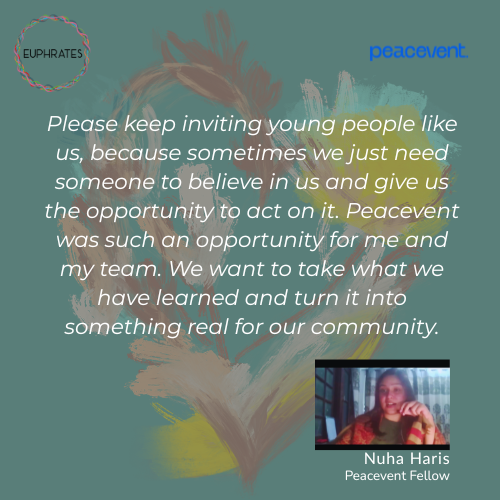
Before I finish, I would like to thank the Euphrates communities. Please keep inviting young people like us, because sometimes we just need someone to believe in us and give us the opportunity to act on it. Peacevent was such an opportunity for me and my team, and we want to take what we have learned in our leadership lab, and as well as in our online sessions, and turn it into something real for our community. Thanks for allowing us to create ripples as well. We hope Yemen Brazil can be one such ripple, and we hope this community will continue to support us and make such initiatives possible in the future as well. Thank you so much.
Irfan Pullani: Thank you, Nuha. As I told their community, our fellows, are very vocal about their activities, and in fact, with the very little resource that we are able to provide, they are doing incredible activities, rooting from the very sessions that we designed as a part of this program. We had a particular session on climate and peace.
I have two more groups that we will be supporting in this roun
Mir Kashif: Good evening, everyone. I am Mir Kashif, and I am part of the Ahsan Project, which means “hope for peace.” Our project is built around a simple idea: before we decide what young people need, we should first listen to what they have to say.
We often look at orphans and other children living in institutional care through the lens of vulnerability. We think about what they lack, what we can give them, or how we can help them. But we wanted to ask a different question: What do these children think of themselves? What do they want for their future? What are their dreams and worries? What kind of career do they imagine? What does a peaceful and hopeful future look like to them?
We are planning an engagement with around 30 adolescents, aged 13 to 16, at Shaihamdam Memorial Trust in Pampur. We will begin with games and icebreakers, so we don’t enter the space as strangers asking serious questions. Then we will have a dialogue circle where children can voluntarily talk about friendship, belonging, their interests, and their aspirations. After that, each child will create a vision board showing something they want for their future—a career, a skill, a place they want to visit, or a personal goal.
We don’t want the project to end with a nice activity and a photograph. We are planning a second visit one week later. Between visits, we will look at what the children actually asked for. Maybe they want to know about scholarships, streams after 10th grade, vocational education, or a particular career. With support from the Peacevent Network, we want to bring relevant guidance to them.
Each child will also write a letter to their future self. We will keep the letters and return them six months later. We will leave behind a resource sheet on pathways after 10th grade in Jammu and Kashmir, so the support doesn’t disappear when we leave.
The most important part is that we don’t want to go there thinking we know what these children need. We want to go there saying, “Tell us what you need, and let’s see what we can build from there.” We believe peace is not only about preventing conflict. Peace begins when a young person feels heard, understood, and hopeful about their future. That’s what we hope Ahsan can create: listening that becomes hope, and hope that becomes opportunity.
Irfan Pullani: Thank you, Kashif, and thank you for sharing.. So, from the climate we moved to the project, to support the children. And then we'll also be able to support one more project.
Sadam Hussain Khan: Good evening, everyone. It's really nice to see your smiling faces through this screen. Our project is called Shahjar, a word we chose because in Kashmiri, it echo Shohul, which means shadow. Shahjar is all about Kashmir's transgender community, a population so undercounted that even official estimates range from under 500 to over 4,000 people - most never even formally registered. They have delivered at the intersection of two conflicts. One internal, the pressure to hide who they are from their own families, and the other one we know, decades of being reduced to a single derogatory term instead of being seen as neighbors.
We are going to partner with an organization already working in Srinagar, the Sunzel Trust, founded by Dr. Ajaz Ahmad Band. We will provide sustained, structured contact between this community and young people, so acceptance stops depending on a handful of activists and starts becoming shared and ordinary.
Shahjar is about three things. First, small peace and healing circles bringing together 15 to 20 community members, supported by a qualified doctor, Dr. Zahid Zahra. The doctor will lead these sessions because mental health is a crucial part, and we are not trained to lead them.
Second, we will hold a larger public, opt-in session where consent is essential. We also plan to speak with more than 100 students about the issues this community faces in schools and other places.
Third, we will create a consent-based record and hand it over to the Sunzel Trust. They will keep and use it after our project ends.
That is Shahjar. I’m really happy we have the opportunity to work on this project, and we are ready to begin. Thank you.
Irfan Pullani: Thank you, Sadam. We’ll share more about these projects through our channels, and Owais can put our email in the chat. If anyone in the community would like to know more, we’d be happy to connect.
To close, this has been a very diverse cohort. The children’s support project is led by two psychologists; Sadam is a medical student; and Nuha, who leads the first project, is an engineer. I told Janessa how proud I am of the community we are building in Kashmir and the peace literacy these fellows bring. I’m also grateful to my friend Simran for her incredible facilitation of our two-day program in Kashmir.
Simran Kour: Hi, so good evening, everyone. Thank you, Kashmir Journal, for bringing us all together on the International Day of Peace. And this is a very special moment. It's a very special moment for me, because we're both PPI alumni, and I'm very happy to think how we joined hands and came together to implement this project. As Irfan mentioned, Peacevent is a post-PPA project, and for its second edition this year, EQRA came on board as an implementation partner. And the whole program was inspired by and based on the Integral Peace Leadership Framework by Dr. Whitney McIntyre-Miller. After taking the participants on an online journey, we did a Peacevent Leadership Lab. For two days (and two days is not enough) it was a wonderful beginning, because peacebuilding, peace leadership, takes practice. EQRA has a 7-day peace education program. We took some of the topics from those seven days, included some in the online program, and during the in-person program.
We explored peace, conflict, and violence through experiential activities and reflective exercises. Throughout the two days, we connected peace within ourselves, and peace in our relationships to peace in communities. And the whole experience, all the shareings were grounded in the context of Jammu and Kashmir, and with the lived experiences of our participants, our fellows. And this was especially important to us. Self-awareness was actually very central in the two days, because we wanted our participants to not just reflect on the problems or the conflicts in the community, but also we ourselves as individuals, were contributing to those conflicts. Like, for each participant, we prompted them to reflect on What are my biases? What are my prejudices? What stereotypes do I enforce? So that when they design solutions, they would have a better understanding of how they can interrupt the cycles of violence and conflict in the community.
And that's how we inspired them to develop these, projects, and just heard from them, and I'm very excited to see how those projects will be implemented. Once again, thank you so much, Irfan. Thank you so much, Euphrates. It really feels like ripples of peace, because we are the alumni. And now we were able to work with these fellows who are going to do such great community impact, so very grateful.
Irfan Pullani: Thank you, thank you. I’m going to hand it over to Hollister in a minute to close the call. But this is the idea I mentioned at the beginning—what we meant by a ripple. In fact, I told Janessa this is the ripple of the ripple. We are sharing and expanding the learnings we gained through these programs with our own fellows. Now, through their small activities, they are taking those learnings to the communities where they’re needed most. I’m grateful for this community and our gathering, and I’m proud of the fellows.
I want to note how brave they are. Shahjar, for instance, works with a marginalized community in a society like Kashmir that I would call conservative. The idea, the courage, and the plan for that project have come from the training we were able to provide. I’m really proud of that.
Thank you so much, Euphrates community. Thank you, Janessa, Krista, and everyone here for being with us and for what you have given us. We will continue this journey and keep building partnerships. Thank you.
Hollister: Thanks, Irfan. Thank you, everybody who shared. It was definitely a feast for International Day of Peace, and I was so grateful to be with you in that feast. I put a couple invitations in the chat for you all to be aware of.
I just wanted to take this last moment to appreciate everybody who spoke today. Thank you so much for your time and your heart. I just feel like what everybody had in common was that we each had a search within that made us aware of what we felt in our heart. It was this sense of innate love that made us all have a desire to make it practical and applicable in our own personal lives and our communities, whether it was 20 days of peace practices, personal invitations to forgiveness, care for communities that need our support and love and our active hearts. It felt like it was a call within to move us from love on the inside to love on the outside.
This morning, I received a perfect benediction. It was an email, dedicated to the International Day of Peace, and it feels like a great way to end our time together.
This quote is from a theologian, Emmanuel Karagole from Uganda. “The excess of love is what shapes a revolution. A revolution of nonviolent love. Surrounded by a cloud of witnesses, perhaps we too can dare to not only say no to violence, but to respond to violence through an excess of love. When we do so, we find ourselves as part of the revolution of tenderness.”
And I felt like that's what we were all here today, a cloud of witnesses celebrating an excess of love that's gonna shape a revolution. It's not cliche, it's facts. So thank you for demonstrating those facts for us today. So grateful to be with you all.