
Courage In a Time of Conflict | Year End Global Connections Call
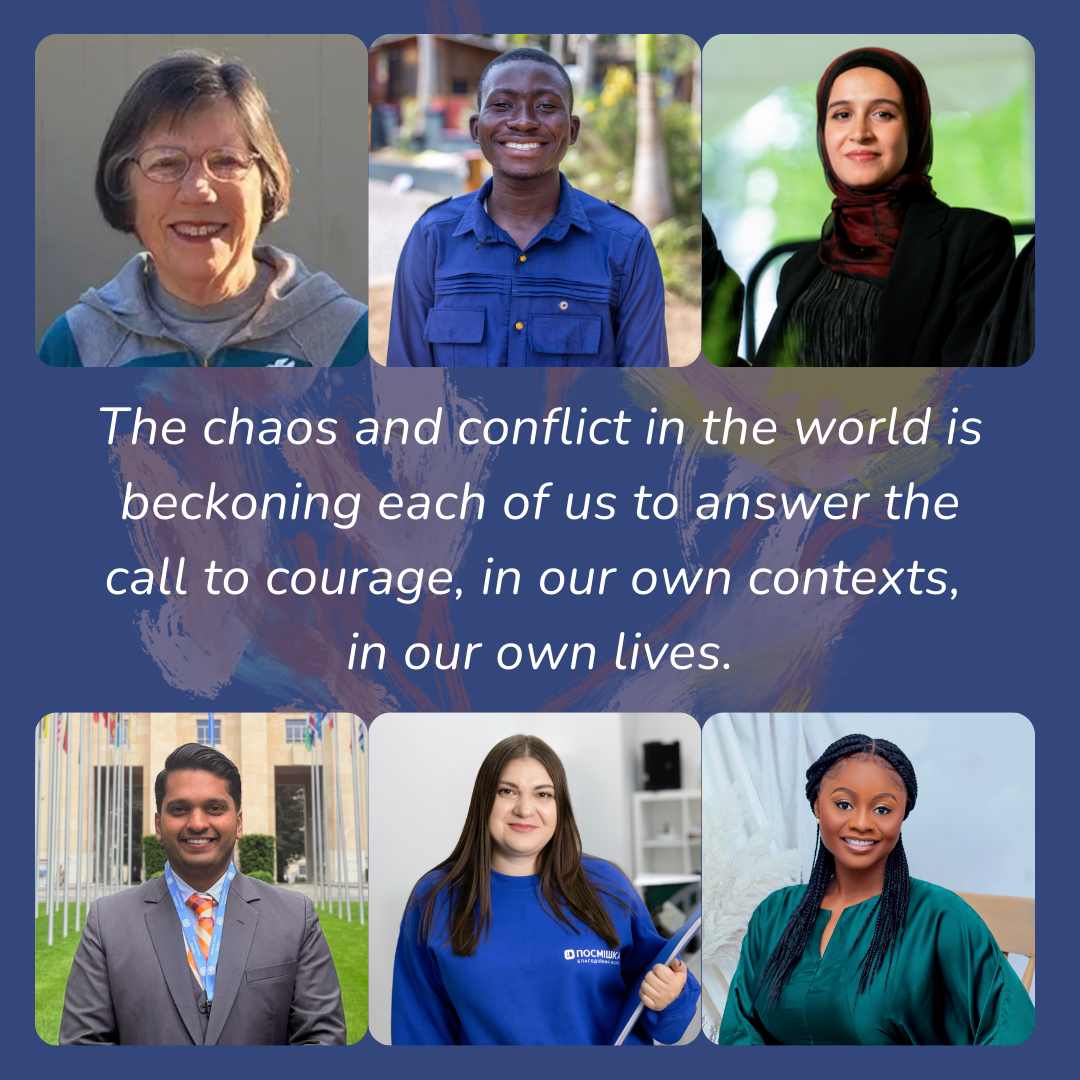
Our year-end Global Connections Call explored the many ways courage appears in our daily lives, especially in moments shaped by grief, conflict, injustice, and uncertainty. Participants shared deeply personal stories that revealed how courage is less about dramatic actions and more about steady commitments—showing up, telling the truth, listening deeply, creating beauty, and holding onto hope even when tomorrow is uncertain. Across continents and circumstances, the call highlighted courage as a quiet, persistent force that helps people continue their work, care for others, and believe in a better future. Together, the conversation illuminated how courage grows through community, empathy, and connection. Voices from Egypt, Nigeria, Gaza, the United States, Ukraine, and Kashmir infused the call with global depth and resonance, widening our understanding of what courage looks like around the world. We invite you to read the full transcript below or click here to watch the 60 minute recording.
Full transcript
Hollister | Euphrates: Well, welcome! Euphrates is such a beautiful network, and I'm so grateful all of you were able to turn on your cameras. It was fun to see your faces, and again, you don't have to keep your camera on the whole time, but it's a great opportunity for us to see who’s in this space together — to make it as family-style as possible. Euphrates is a beautiful network of peace builders, peace seekers, peacemakers, and global citizens.
We have a lot of incredible programs and courses, but I really feel that what makes Euphrates Euphrates is you all — the community.
We are first and foremost a community, and each of you plays a vital role in being part of it, whether your contribution is presence, peace practice, financial support, prayer, or maybe all of these. Thank you so much for being here. Our call today is a celebration of this community. We have board members — you can wave — advisors, team members, alumni, people who have been part of our programs, super supporters, cheerleaders, all here with us today. And we have some new folks, I can see, who are now fully embraced in this global family. We hope you consider yourselves part of the Euphrates community.
Euphrates hosts these monthly public gatherings. They’re an open forum, a space designed for deep listening and sharing — for inspiration, information, and transformation. We hope they help open our hearts and minds to the good that is present in the world. So if you're new here, welcome. And if you've been joining us for months or even years — I know some of you have been here for years; I see you, Emmanuel Fubang — welcome back!
It's good to be with you as we bring this 2025 call season to a close.
In 2025, Euphrates decided we were going to open up our values again. We were going to explore our seven values in both our team meetings and these conversations. Just as a reminder, those values are understanding, inspiration, transformation, service, sustainability, oneness, and love.
And today, we're holding these values inside the container of courage.
This year, I read a book by Ryan Holiday called Courage Is Calling. It’s filled with stories of courage — from the ancient Greek Spartans to heroes of the U.S. Civil Rights Movement. The book begins with three strong sentences from a Greek warrior and student of Socrates, Xenophon. I thought I’d read them for you:
“Let us not wait for other people to come to us and call upon us to do great deeds. Let us instead be the first to summon the rest to the path of honor.
Show yourself to be the bravest of all the captains, with more of a right to leadership than those who are our leaders at present.”
It felt like such a poignant and applicable statement — still relevant today, millennia later. The chaos and conflict in the world are beckoning each of us to answer the call to courage, whatever that looks like in your own context, in your own life — personal, communal, global.
Today, we’ll share examples from within our community, our Euphrates family — individuals who have answered the call to courage in their own way, with their own unique gifts. And because we know that everyone on this call has had these moments — your own examples of being called into courage — we're going to leave some time at the end for as many voices as possible to join the chorus of courage.
First, though, we're going to start with singing. I think it's a great way to open a conversation space.
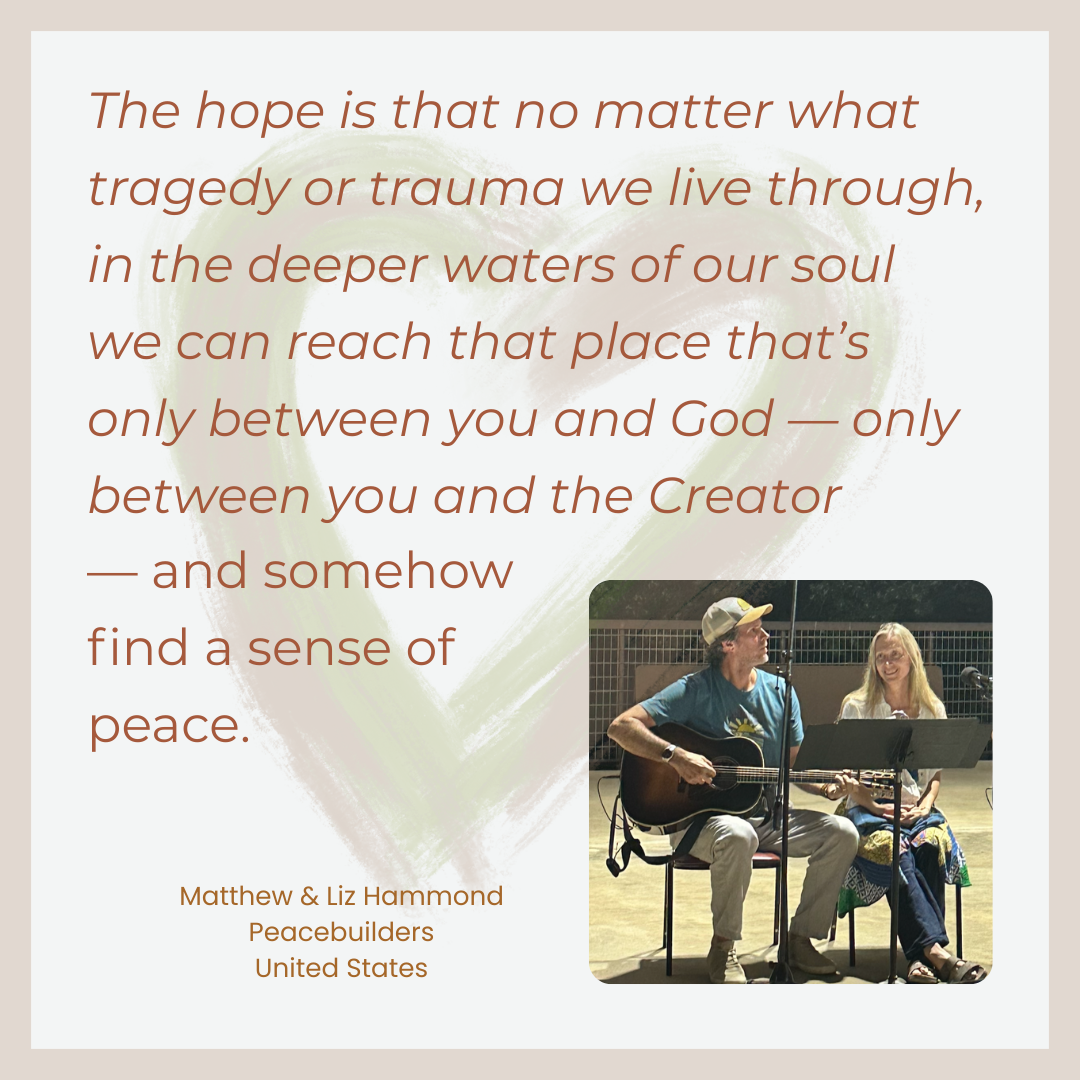
I’ve invited my dear friends Matthew and Liz Hammond, from the United States, to share how they’ve been courageously singing and creating ripples of peace, promise, and healing over the past few months. I’ll let them share their story in their own words. Welcome, Matthew and Liz. We’re going to spotlight you so everybody can see where you are.
Matthew & Liz Hammond:If you’d asked us four months ago if we’d be on a Euphrates call at the end of the year, we would have gladly offered to play music.
We’d happily have supported the wonderful work Euphrates is doing. But if you had told us four months ago that we'd be sharing music that has helped us work through losing our daughter in the floods of Central Texas back in July, we never would have believed you. It just didn’t seem possible.
On July 5th, we were headed to a beloved summer camp. We've been there for almost ten years. We’ve taken that route more times than we can count. We left in the early morning hours — it was dark, and we had to arrive by a certain time. We thought we had found a way around the storm; we had looked at the weather carefully.
But a bridge we had crossed many, many times had just washed out. When I saw water where I thought the bridge should be — water 25 feet above where it belonged — our van plunged in. By a miracle, we all got out.
But it was a 40-mile-an-hour raging river. By another miracle, most of us made it to the riverbank. Our daughter, Malaya, did not.
We began searching for her — lots of prayer, lots of community. People from every walk of life stepped up to help us find her. And by a miracle, on the morning of the third day, we found her lovingly washed up on the shore of the only Christian camp in the area. We were on our way to a Christian camp, and we found her a mile downstream from where we went in — at a time when many others were not being found.
To be with her, on that spot, and to commemorate it… and to sing… This was the song she felt led to sing. Our daughter Malaya loved singing — as we do — and we’ve sung as a family many times. She chose to sing this song in the van before it went into the river.
The story behind the song is this: it’s based on Elisha and the Shunammite woman. Elisha was a great prophet who healed, and when her son died, he asked how she was. She replied, “It is well,” because she somehow knew her son could be healed.
I hope, if you feel led to sing it with us, you’ll join us. You’ll pick up the refrain quickly — it is well, it is well with my soul. The hope is that no matter what tragedy or trauma we live through, in the deeper waters of our soul we can reach that place that’s only between you and God — only between you and the Creator — and somehow find a sense of peace.
Janessa Wilder: Matthew and Liz, I just wanted to say: the moment you started playing, my kids came running in. The music was so beautiful, and afterward they said, “Please tell us the full story later.” They really want to understand the message behind what you shared.
What stood out to me as you were singing is that this isn’t courage in the absence of conflict, or peace in the absence of trials. This is courage in a time of conflict — and what you sang was a message of peace even in the midst of what you’ve endured. Thank you for bringing that message not just to our heads but to our hearts and souls, and letting it sink in through the medium of music, which is so powerful.
Blessings to both of you and your family on your ongoing journey.
I was also thinking of Lamar on the call and wondering how she was responding to your song. Lamar is joining us from Gaza, and she said earlier that she wasn’t sure she’d be able to connect, but she’s here — and we’re so grateful. Lamar, our hearts are with you.
With that, I’ll turn to our first speaker. We have an amazing “choir” today to delve deeper into this theme of courage — something we’re all yearning for right now. We all want it, we all need it, and we get it from each other. I’m excited to bring forward these different voices that exemplify courage in their own ways.
Our first speaker is Roba, joining us from Cairo, Egypt. And Roba, I learned that we have something in common — we both have tried to rescue people from Gaza. I can only imagine how emotional that journey was for you; I know it was a rollercoaster for me, and I received so much support along the way. Thank you for stepping into that work.
Ongoing, Roba has been teaching and holding space for students in Gaza — helping them learn about peacebuilding, courage, and all these themes even in the midst of everything they are facing. It’s so easy, because of how painful it is, to turn away. Even when I get a text from you, Lamar, I often have to take a breath — I can’t just tune out. I have to stay present. And Roba, you’ve been doing that for your students.
So I’d love to hear from you. Courage takes many forms. For your students, it’s physical courage. They’re facing starvation, and deadly bombardment on a daily basis. What lessons of courage have you learned from them — from young people who have to express courage in such a physical, immediate way?
Roba (Cairo, Egypt): Thank you so much. First, I want to say that some of my students are here — as you mentioned, Lamar is one of them, and Wesam is also here today. I would love for us to hear from them later, if time allows, because I believe their voices matter even more than mine.
But yes — I have learned so much from them. This question about courage in the face of adversity is very personal to me. When we talk about courage, we often imagine something loud — someone standing in front of a crowd giving speeches. But with my students, especially those in Gaza, I’ve learned that courage can be incredibly quiet and profound.
Sometimes courage simply means waking up and showing up to class.
We teach online. I’m in Egypt; most of them are still in Gaza. Some are in Egypt, and a few are elsewhere. But the majority are still in Gaza.
They show up to my classes — and I see that as courage. Many are in very harsh circumstances. Sometimes the only device they have is broken. They may be watching class with a cracked screen, or re-watching recordings in dark places. And still, they show up.
To me, courage is watching them try to continue their education. They have never given up on passing their exams. I’ve been teaching for eight years, and I have never seen anything like their persistence. They prepare for international exams under airstrikes.
This is not just courage — it is bravery, dignity, and grace.
I remember one of my students last year logged into class right after an airstrike. We knew her area had been hit. I asked if she needed to rest or skip class, and she said, “Miss, I want to be normal for just one hour.” I still remember that sentence.
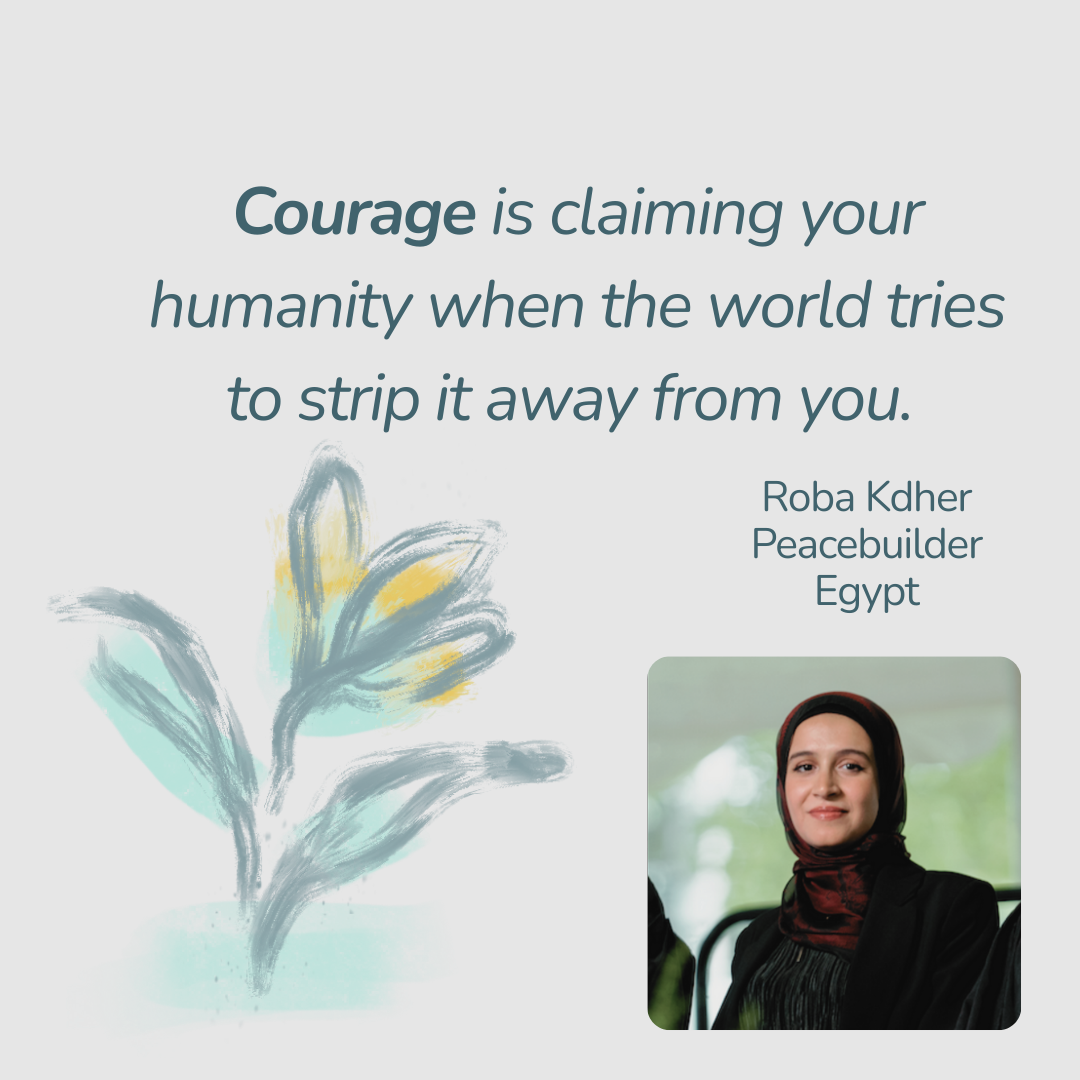
It is the courage to claim your humanity when the world keeps trying to strip it away from you.
And it’s not just the students — it’s their parents, who work day and night to help them feel a sense of home, even if they have no home, even if they are living in a tent. I find that incredibly courageous.
Courage is not always about being loud. It’s about being kind. Staying kind in unkind situations is so hard. Those of us not living in these conditions cannot imagine how hard it is to stay human, to give to others when you yourself are in such need.
This is not to belittle anyone — it’s the opposite. We need to learn from them.
If you ask what courage looks like “there,” it looks like teenagers — 16-year-olds — trying to study, trying to be kind, trying to help their friends, trying to read novels. Next semester we’re reading The Great Gatsby together. I teach English and literature. For them to read about the world, to stay connected, to ask me how Egypt is, to ask Vicki how the weather is in Seattle or about her culture — this is them staying connected. This is them saying, “We still care. We still want to learn. We still want to be part of this world.”
That is the biggest lesson I’ve ever learned about courage — and I’ve learned it deep in my heart from my students. Thank you, Lamar. Thank you, Wesam. You inspire me every day.
Janessa Wilder: Thank you, Roba, for representing their voices so powerfully, with so much love and clarity. They truly are amazing. And that one line — “to give when you need the most” — is such an embodiment of selflessness, something we all need to listen to and learn from.
Thank you for your ongoing efforts and your teaching.
Let’s turn now to Esther Doo from Nigeria, another champion of youth and women especially. Hi, Esther!
I’d love to invite you to talk specifically about your work — because courage often conjures an image of masculine power, the warrior archetype. I want to invite you to help us reframe that for women. How have you seen courage in women, or inspired women to step up and claim a seat at the table in your work in women’s empowerment and gender inclusion?
Esther Doo Ugba: Thank you so much. It’s really amazing and inspiring to be here. And thank you, Roba, for all you shared — the work you are doing is truly incredible.
I always say that children grow up to become adults, so they deserve all the attention and care we can give. Every single person in this room was once a child. We need to protect them, take care of them, and show them that the world can be better than what they see around them now. Thank you for your great work. It’s an absolute pleasure to be here.
I always like to write things down before I speak so I don’t miss important points, so I may look at my notes. But essentially, for a very long time — and I believe many women can relate — women and girls have been afraid to advocate for themselves in their own voices. We have been conditioned to fear being misunderstood, being labeled, or being accused of “wanting to be like men.” Jana practically said everything I wrote down!
We often find it difficult to speak up because, in many cultures, the moment a woman is assertive or tries to express her point, she is judged. In the culture and region I come from, I struggled with this for a very long time. I carried that fear silently for years, not realizing how deeply it had embedded itself in me.
I had to do the inner work to come to awareness — to see that this fear was tension I had held in my body for so long. But here is what I’ve learned through my work, my witnessing, my healing, and my journey as a girl and now as a woman:
A woman is uniquely built to know what is good, safe, and true for her. Only she can feel the full depth of her own needs and experiences. Nobody else can give her that. And if she cannot speak for herself, how can anyone else advocate better on her behalf?
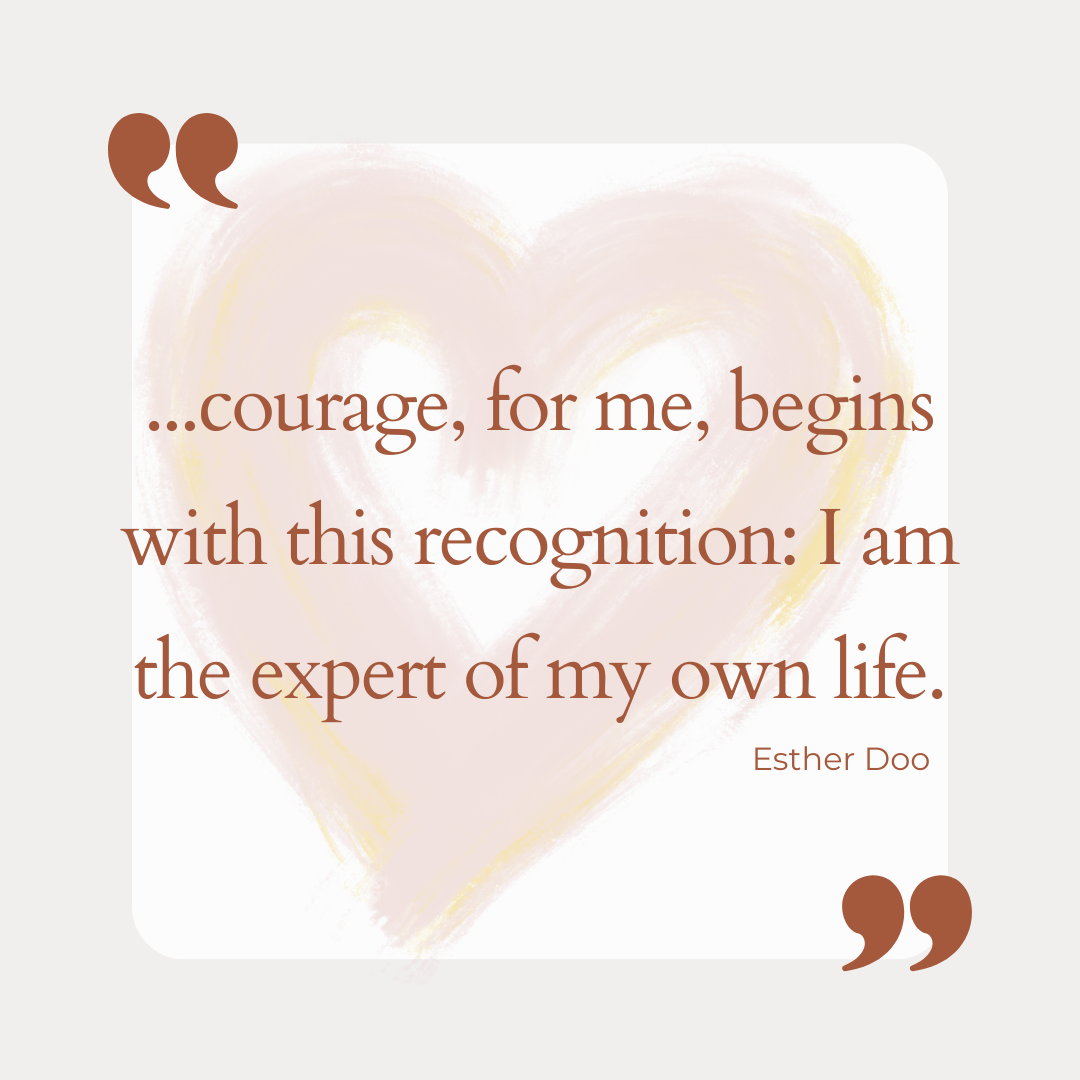
So courage, for me, begins with this recognition: I am the expert of my own life.
My voice is not an invitation — it is an affirmation.
It affirms awareness of who I am as a full human being.
This is why empowering women is very important to me. Women who are independent and self-sufficient are not only developmentally bold — it is a moral and societal necessity. When women no longer depend on men for emotional, financial, or physical security, they are far more likely to make decisions that reflect their truth. They are more likely to access opportunities that elevate their lives, and they are more likely to recognize their own dignity and worth.
And they are better able to break free from restrictive stereotypes and patriarchal norms that perpetuate violence.
True equality — or for those who prefer the term equity — requires both. I believe the world we are striving for will ultimately combine both equality and equity, because we need both.
This future requires that women feel safe and secure because of their own agency, autonomy, and the presence of a just society — not because there is a man standing next to them. In many cultures, a woman’s respect is conditional on a man’s presence. No woman should feel that her safety is borrowed or dependent on someone beside her.
That mindset fuels the very violence and discrimination we are trying to dismantle. It belittles women into believing they cannot move forward without someone else.
A world where women feel truly safe is a world where our rights are protected and respected. It is a world where safety is designed into communities — not demanded or begged for. Where safety is built into laws, systems, and everyday realities. A world where women are empowered to choose, to speak, and to lead — which is so often the opposite of what we see.
In my work in protection, gender inclusion, and preventing sexual exploitation and abuse, the solutions almost always return to one core truth:
Women must be empowered to give themselves what they’ve been conditioned to depend on others for.
Dependence — especially forced dependence — is the breeding ground for abuse. When there is an imbalance of power, someone can exploit another emotionally, financially, psychologically, or sexually.
I have seen this clearly in the medical field. In Nigeria, our health system is failing. Maternal mortality is extremely high because of that. And so much preventable violence happens simply because women do not feel safe or feel courageous enough to advocate for their bodies.
It is heartbreaking that male gynecologists far outnumber female gynecologists, when women desperately need safe spaces and compassionate listeners who understand their lived experiences. Increasing women’s presence in this field is not just representation — it is protection.
No matter how knowledgeable a male doctor is, only a woman can truly understand the experience of childbirth. And having more women in that space — women trained, knowledgeable, and able to relate — would go a long way toward creating the compassionate, safe environments we talk about, and toward reducing the violence women face every day.
Yet harm continues because so many women are socialized to trade courage for acceptance — to stay silent in order to be seen as good, virtuous, or “feminine.” But silence has a cost.
Janessa Wilder: Esther, I’m so sorry to cut you off — we need to keep moving for the next speakers. But what you’ve shared resonates deeply. These lessons apply to women in every society and culture in the world — not just in Nigeria. Thank you for bringing this vital lens to our conversation about courage. I hope we can bring you back in the after-hours session — we’re building quite a list.
Janessa Wilder: Now we’re going to turn to Irfan Pullani. His bio is in the chat, because in the interest of time I’m skipping formal introductions, but please read about how remarkable these folks are.
Irfan is one of my new BFFs — he was my first guest on the (not yet released) podcast, and he is a technical specialist and peacebuilder. He’s doing groundbreaking work training peacebuilders and youth in Kashmir — the first time something like this has been done.
What stood out to me most about Irfan is how intent he is on listening. He came in with no agenda, and listened to over 500 family stories. That form of courage is less discussed, but so important. So Irfan, I’d love for you to share: what does it take to have the courage to deeply listen to others — to stay humble and curious instead of pushing an agenda — and how has that shaped your work in Kashmir?
Irfan Pullani: Thank you so much, Janessa, and thank you, everyone. It’s always wonderful to be back in the Euphrates circles and to see so many colleagues, friends, and community members — including dear Jenny. Thank you all for being here.
Thank you, Janessa, for that introduction and for reflecting on our recent podcast conversation. Before I speak about my work, I want to acknowledge the powerful reflections shared by the previous speakers — especially Roba’s stories about her students and Esther’s words about courage. Their insights really struck me, and I think we all connected with what they shared.
Most people associate courage with speaking out, taking a stand, or defending beliefs. But in Kashmir, I have learned a different form of courage — the courage to listen first.
I’ve had the opportunity to have deep, conversational dialogues with hundreds of families in the region. Through this, I’ve realized that courage is curiosity over certainty, and humility over the rush for solutions.
Often in Kashmir, conversations are shaped by memories of fear, militarization, displacement, and grief. Every person carries their own narrative — their own version of history, pain, identity, and memory. When we listen deeply, we allow someone's truth to be valid, even if it unsettles us. That’s important.
It requires entering the space not as an expert but with presence, humility, and openness — with a willingness to learn. That has defined my last six or seven years of work in Kashmir.
Deep listening has shown me that people don’t only share suffering — they share hope. Across places like Kashmir, Gaza, Ukraine, or elsewhere, human beings long for the same things: dignity, safety, and connection. Humility invites humility; curiosity invites curiosity.
After receiving the PPA fellowship from Euphrates, we launched a hybrid training program for young Kashmiri leaders on peace leadership and development advocacy. There was an in-person segment facilitated by a colleague from the United Nations, and something remarkable happened.
A participant who had barely spoken during the earlier sessions — someone who had always been the quiet listener — finally spoke up. He said that all his life, he believed leaders needed strong voices. He never realized that leadership begins when someone truly listens.
That was one of the most powerful reflections to emerge from the training.
My dear friend and colleague, fellow PPA alumnus Alam Owais — who is also Kashmiri — and I ran this program together. It was the first attempt at a peace leadership training for youth leaders in Kashmir. And the most transformative part of the program was the listening segment.
Only at the end did we share our professional reflections.
We also had a special participant, a rising young leader from the Rohingya refugee community in Bangladesh — Murshid — who is here today. His story was incredibly powerful and added so much depth to the program.
I am deeply grateful for the knowledge and support from the Euphrates community that helped make this possible.
My reflection is this: peace begins when we hear stories we were never taught to hear.
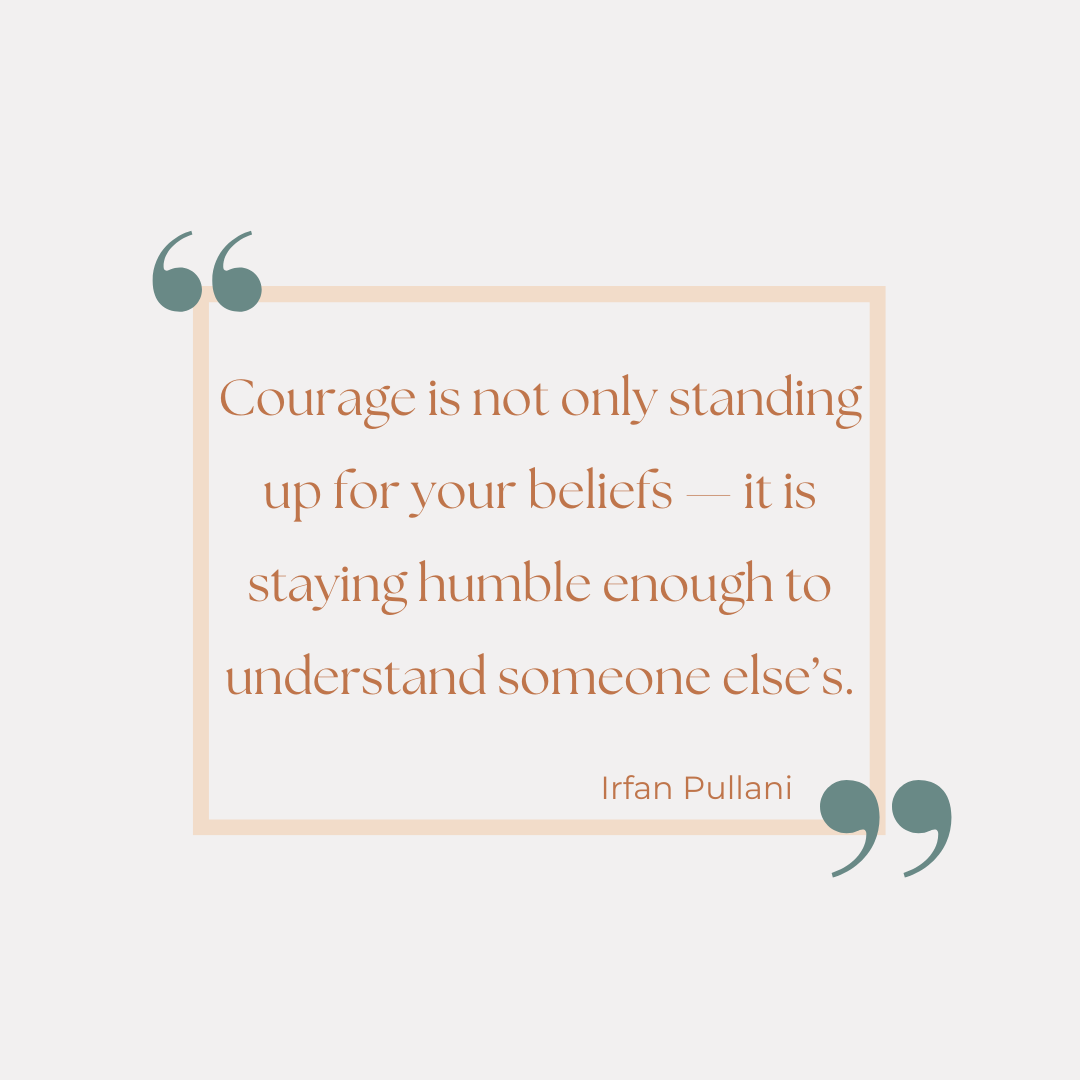
Courage is not only standing up for your beliefs — it is staying humble enough to understand someone else’s.
Janessa Wilder: Thank you to everyone you mentioned, Irfan, for joining and sharing. And thank you, Irfan, for modeling peace and nonviolence in the way you move and lead.
I asked you recently, “What’s next?” and you said, “I’m listening. I’m listening for what’s next.” That openness is a gift.
Janessa Wilder: And you model that in the way you are and the way you live. I’d like to turn now to Ana Chernova, who is Ukrainian and currently living in Ukraine. She is an incredible advocate for human rights and for women in peacebuilding and negotiation.
Ana, I’m going to leave this open for you. If you would, please take about five minutes to share how you seek courage, and how you are living courage in your day-to-day life there.
Anna Chernova: Hello, everyone. Thank you for inviting me. It means a lot — I feel your support, and I feel connection, especially now. When I reflected on this question, I realized that when people hear the word courage in a war zone, they often imagine something big or heroic. But in my experience, courage is about…
Courage, for me, is made up of very ordinary things.
When the full-scale invasion began, I volunteered in Odesa, and I saw social workers, neighbors, and complete strangers helping each other every day. That was courage.
When the missiles fell and people still tried to create a sense of home — to cook a simple meal, to take care of children, to comfort someone — that was courage.
Many of us had to leave our homes, but even in displacement people continued supporting one another, finding small ways to keep going. I have seen so much quiet heroism — women sharing food, older people checking in on each other, volunteers working through exhaustion.
Sometimes courage is simply choosing to stay human.
Even now, as the war continues, my work helps me stay grounded. I coordinate with local organizations, support families, and try to create stability where I can. There are days when it feels impossible, but even then, I remind myself: doing one small good thing is already an act of courage.
That is how I live it — moment by moment.
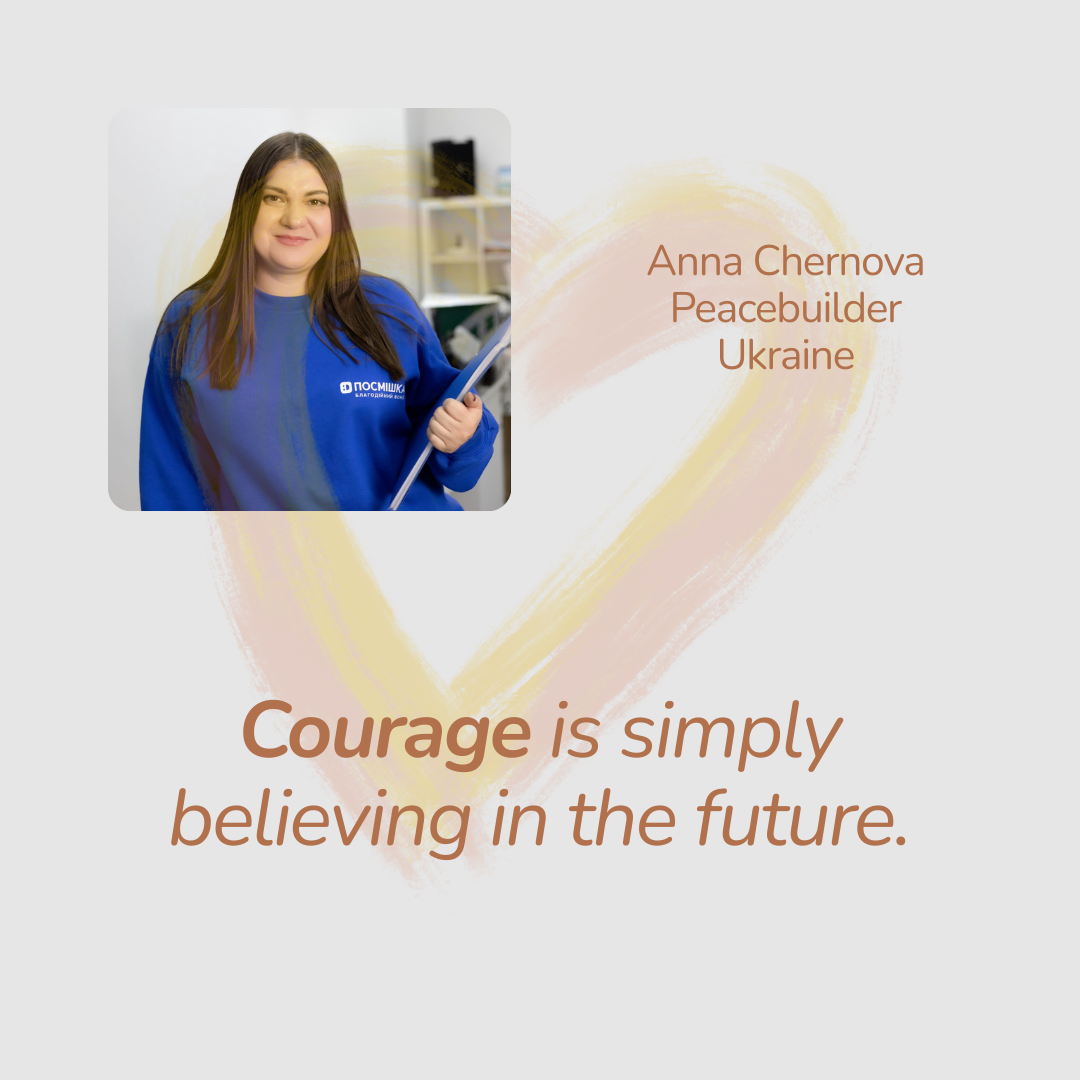
For me, sometimes courage is simply believing in the future. Because we don’t know what will happen tomorrow — we don’t even know what will happen in the next moment. We try to live each day as if it might be our last, but courage is when you still allow yourself to make plans.
For example, deciding to go on a holiday… buying a train ticket or a plane ticket for next month. You never know what will happen, but you still find the courage to buy that ticket because you believe that life can continue — that something good could happen.
For me, that is also courage.
You just never know. Sometimes it feels unsafe to plan anything — even something small. And yet courage is when you still choose to do ordinary things.
For example, protecting your mental space. I try to protect my inner world from the constant stress and the news. That, too, takes courage.
Sometimes courage is simply saying ‘stop’ to the devastation around you, even if only for a moment. Giving yourself permission to rest — to manage your time, to take a break from all the pressure.
Courage can be as simple as turning off the air-raid alerts for a few minutes so you can focus, breathe, or finish a task. Or allowing yourself to concentrate long enough to buy those plane tickets, even when everything feels uncertain.
This is what courage looks like in Ukraine — small, practical acts of survival every day.
Janessa Wilder: So well said, Anna. And I also want to name another layer of courage you’re showing — I know it may seem small, but speaking so openly in another language is incredibly brave. I’m living in France right now, and I know how humbling and challenging that can be.
Your English is wonderful, but what touches me is that not only are you speaking powerfully about your experience, you’re doing it in a language that isn’t your own. And many of you here today are doing the same. That, too, is an act of courage.
Janessa Wilder:
And now for our last speaker, we are turning to a native English speaker — so Libby, you don’t get off the hook.
Our dear Libby Traubman. Libby is a veteran peacebuilder at the grassroots level, co-founder of the Jewish-Palestinian Living Room Dialogues, and the brand-new author of an amazing book that I’m loving, One Earth, One Humanity, One Future.
Both the book and your life, Libby, show how you never shy away from the hard topics that require our courage — nuclear weapons, environmental loss, deep divisions — and of course, for this community, the profound loss of Len, your late husband.
I’m giving you these prompts, but you can take this in any direction you want, or not answer at all. My question coming into this was: How do we summon the courage to keep going in the face of loss? And how have you been able to do that with such grace and determination? If you don’t mind, we would love to hear your reflections.
Libby Traubman:
Thank you so much. You know I love Euphrates — the work you do, your global expansion — and I keep referring new people who should know about you.
When you mentioned courage, I started reflecting on my whole story: where I’ve come from and where I am now. To put it in context, I grew up in Indiana. It was very white, very bigoted — a lot of racism. My worldview was so small. I knew so little about other people, other countries, other ways of life.
Then I met Len. He was from California. We married and moved to San Francisco, and that’s where my whole world opened up. Suddenly there was diversity — different ethnicities, different foods — so different from my white, bland Indianapolis. (Sorry if anyone from there is listening!)
Living with Len was an experience. We began engaging in all kinds of community activities, and one thing led to another until we became involved in peace work. It started in the early 1980s when we joined Beyond War. That was the beginning. And honestly, courage for me — coming from the Midwest, living such a sheltered life — was getting in touch with myself. I had so little self-confidence. The idea of giving a talk anywhere was terrifying.
One of the first things I learned about courage was the willingness to step outside my comfort zone. If I didn’t know something, I could prepare. I could learn the history. I could show up.
For example, after our work with Beyond War, Len and I traveled with International Physicians for the Prevention of Nuclear War. We went to the Soviet Union for three weeks — we “met the enemy.” That’s where we learned the power of story. Many of you have heard me say this over and over: An enemy is one whose story you have not heard.
That idea became a focus for where to put our time and energy.
Beyond War also took us into dialogue work with Armenians and Azeris. I spent a month in Baku and Yerevan with a small team while Len stayed home. Later, we worked with Israelis and Palestinians. Roba, I think of Gaza all the time — my heart aches for everyone.
The Jewish-Palestinian dialogues began 32 years ago, and they’re going stronger than ever, especially given what’s happened in recent years.
So when I think of courage, I think of two things:
First, stepping out of my comfort zone. I was terrified when I moved to California. I knew nothing about global issues, about other cultures. It was step-by-step learning — expanding my thinking, engaging with people unlike myself, forcing myself to give little talks in public even though I was shaking.
Second, the image behind me — the Earth — has been our guiding symbol. The understanding that all is one, and we are all one. That’s why, even at my age, I felt I had to write this book. With my wonderful partner’s help, I put those feelings into words.
Courage is stepping out of comfort, learning about “the other,” trusting that I can grow new skills, preparing, practicing, stretching myself.
And Esther — in 2010, Len and I were invited to Nigeria to work with Christians and Muslims. At first we said, “We can’t go to Nigeria! We’ve never been to Africa! What would we do?” Then we realized: of course we should go. We did have skills to share — listening, dialogue, storytelling. And it became one of the most amazing, life-changing experiences.
Courage is doing the thing that feels strange and foreign and difficult — and trusting that you’ll be supported.
The other piece is this: when I think about people struggling every day — worried about water, food, bombs — and I’m sitting safely in my home, I feel I have no right to not take action. If I believe all is one, then I must give the best I can for as long as I can.
And my runway isn’t getting longer — I’ll be 85 in two weeks. So I want to make the most of whatever time I have left.
About loss… Len was an amazing partner. I wouldn’t be doing any of this without him — his love of life and of people. When he passed, and I was with him, I promised I would keep going. There was no way I was going to say, “Well, now I can stay home and do nothing.” We began this path together. Had I not met him, my life would have been totally different — maybe fine, but nothing like this.
So yes, I promised him I would “keep on keeping on,” using the skills we developed together. And thanks to so many people — including many here from Euphrates — I’m able to continue.
To anyone listening:
If you feel called to do something that seems strange or hard, it’s okay. You can do it. Make a decision. You will be supported. All hands are needed. These are challenging times, and we all must give the best we can to help make this world the beautiful place it truly is.
Janessa Wilder:
I think we’re all just drinking that in. It’s like Len’s spirit is still motivating you — and all of us — through your words. We can all take what you shared: step out of our comfort zones, express courage, honor those who came before us, and those yet to come.
You embody that so fully — in your humility, your curiosity, your courage. Thank you so, so much. I’m going to turn it back to Hollister to guide this next section.
Hollister | Euphrates:
Well, that’s a perfect opportunity for us to say — yes, we see so many faces, and we’re all here together. We have about ten more minutes left in this call.
Libby, Roba, Esther, Anna, Matthew and Liz, and Irfan all shared incredible examples of what courage means to them and how they’ve been showing up in their lives and in leadership. What I really appreciated — the thread running through everything — is that courage isn’t only about grand, dramatic gestures. It’s in the small, daily moments. The relationships.
And that means each of us has access to countless opportunities to embody courage and to practice peace right where we are.
I’ll open up the space for anyone who’d like to reflect. We have ten minutes, and I’d love to invite my colleague Issa to help close us out. Please keep comments brief — one minute or less — so we can hear as many voices in this choir as possible.
Nadin Mustafa:
Hello, everyone. I hope you're all doing well. First of all, I want to thank you all for having the courage to share your thoughts about courage. Everything I heard was beautiful and inspiring — especially for me, a student in Gaza, who has been through difficult situations but still finds the heart to keep going and to finish my studies no matter what.
I’m grateful I was here today to hear all your ideas. It gives me hope that humanity hasn’t vanished from the world.
I also want to say that courage doesn't always have to come from a person directly. It can come from a gesture, an act, even a vibe. Something you do that might feel small to you could mean the world to someone else.
For example, when I see people protesting or even posting one message about Gaza — that, to me, is more than courage. That is bravery: speaking the truth even when the world tries to deny it.
Victor Garpulee:
Thank you so much for the opportunity. Today is a very big day, and I am delighted. I want to express my deep appreciation to all the guests who spoke — it was inspiring. Your contributions are a great service to the world.
I also want to thank the Euphrates Institute for being part of this great peacebuilding organization. Since we joined, we’ve been blessed — especially through the work of Marilyn Changa, who has been with us since 2020.
She has done so much intervention work in Liberia, caring for children and helping them receive surgery. As the year ends, I want to express my special thanks and appreciation to her. She feels like someone living here in Liberia — we talk every day, and she works tirelessly to improve the lives of children.
We are preparing a project for young children in villages who are not able to go to school. We’ve taken surveys and spoken to parents; so many children are isolated from opportunities. Marilyn works around the clock, and we are grateful.
This organization — Euphrates — is amazing. We appreciate you so much. We see the growth, and we know your work will be seen around the world.
Thank you for the connection with Marilyn Changa and all the other supporters. As the year ends, we ask you to continue supporting the children in Liberia who still cannot attend school.
Janessa Wilder:
I wonder if we have time, Hollister. I see in the chat someone reminding us that we could still hear the story from Esther.
Esther Doo Ugba:
Thank you so much for the reminder. I wanted to share a story that has caused a major uprising in Nigeria — the story of Ochanya.
Ochanya was an eight-year-old girl living with her aunt. She was repeatedly raped by her uncle and her cousin — her aunt’s husband and son. She developed VVF (vesicovaginal fistula) as a result of the assaults, and she died five years later.
I shared this to speak about the culture of silence. The perpetrators broke Ochanya, but the silence of her aunt — the woman who should have protected her — also contributed to her death.
The aunt stayed silent because she was trying to be a “good woman,” trying to protect her family’s reputation.
This is what the culture of silence breeds. It is what happens when women are taught to be agreeable instead of brave… when the fear of judgment outweighs the instinct to speak truth.
Ochanya’s story is not an isolated tragedy. It is a mirror. It is a warning. It is a call.
Silence killed Ochanya.
Silence protects perpetrators.
Silence destroys generations.
My message to women — and to myself — is that courage is not a luxury. It is a lifeline. Our voices are not rebellion; they are protection. Our truth is not “too loud”; it is necessary. Standing up for equality or equity is not defiance — it is survival, healing, and leadership.
What has helped me embody courage is understanding that my silence helps no one — not myself, not the women I serve, and not the girls who will come after me.
I speak because I have seen what happens when women do not. I speak because silence has taken too many lives already. And I speak because every time a woman finds her voice, she creates space for another woman to find hers too.
This is how we reclaim the table.
This is how we become unstoppable.
This is how we rise together.
Janessa Wilder:
And Esther, ironically, even though you were muted earlier, it makes hearing the rest of your remarks even more powerful. Your courage, your refusal to be silenced, and your willingness to share this story — thank you. Truly.
Hollister | Euphrates:
Thank you, Esther. And thank you to everyone who showed up today. We appreciate you being part of this conversation and this space of courage.
Please feel free to share your reflections, stories, or ideas with us — info@euphrates.org. I’m always here for your messages and feedback.
I’ll let my colleague Issah bring us to a close with a reflection and benediction. While he does that, I’ll pop a few links in the chat for those who want more information.
Issah | Euphrates:
Thank you so much, Hollister. And thank you to everyone who made time to be part of today’s call. To be honest, the gathering has already brought forward powerful lessons on courage. I prepared something brief to share:
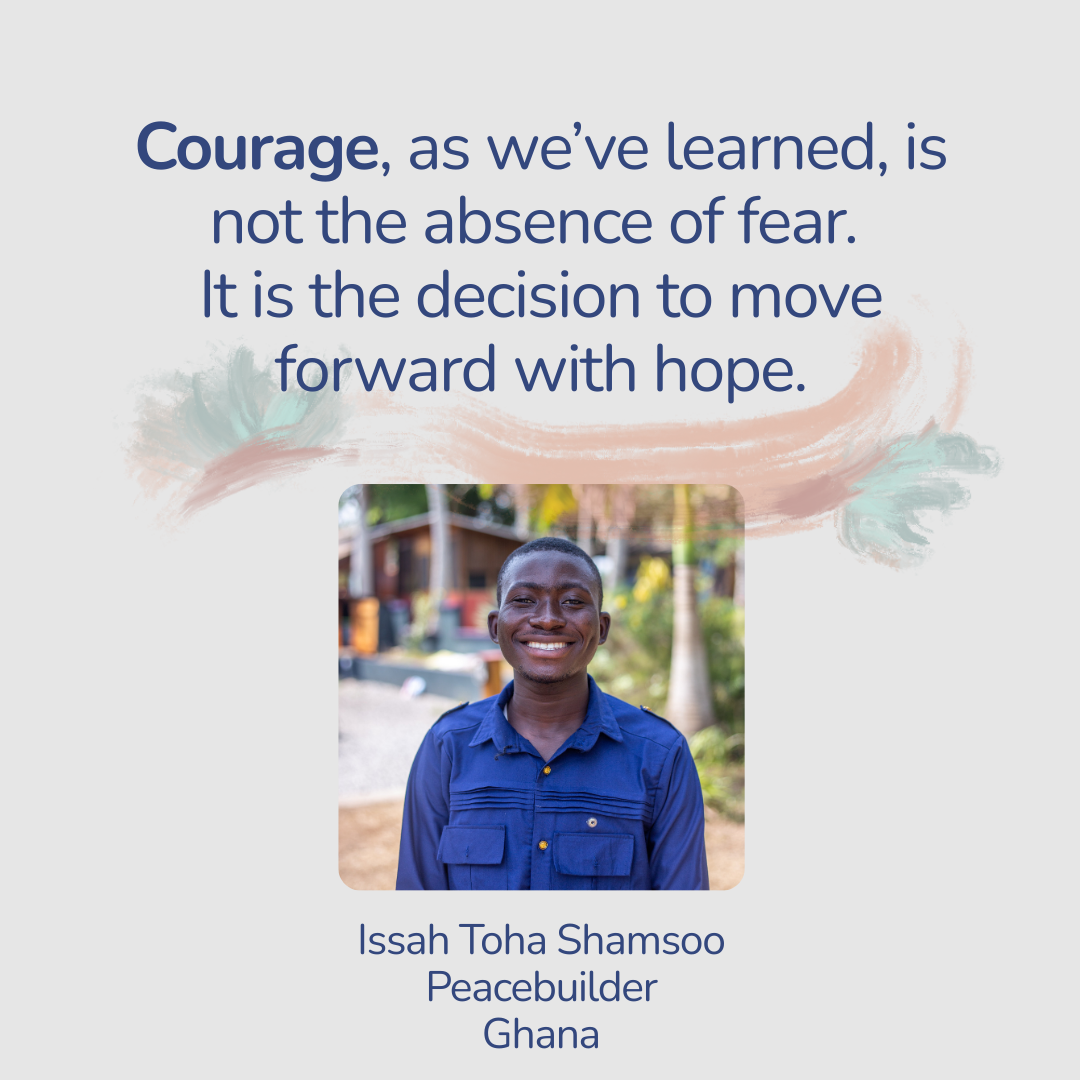
When one person — any of us here — chooses peace and courage, the world shifts quietly but surely. One kind word, one step toward understanding, and the ripples move outward… further and further. Courage, as we’ve learned, is not the absence of fear. It is the decision to move forward with hope.
I heard that phrase several times today — “keep on, keeping on.” And I heard Anna from Ukraine say that simply waking up and believing in tomorrow is an act of courage.
So as we end this call, I invite all of us to reflect together:
Where is courage calling you today?
And where is your courage taking you next?
Thank you for your presence, your comments, your gifts. Please stay in touch. Our calls will continue in 2026 — every first Tuesday of the month, at the same time, 4 PM UTC.
Hollister | Euphrates:
Thank you, Issah, and thank you, everyone. As Issa said, we look forward to gathering with you again in 2026 for our monthly public forums. You’re all invited — bring a friend. Let’s keep this choir growing strong. Thank you so much. You’re welcome to unmute, blow kisses, say goodbyes. We’re grateful to have spent this time with you, and we hope to see you again in 2026!