
Disrupting War at its Roots: A Call with Sami Awad
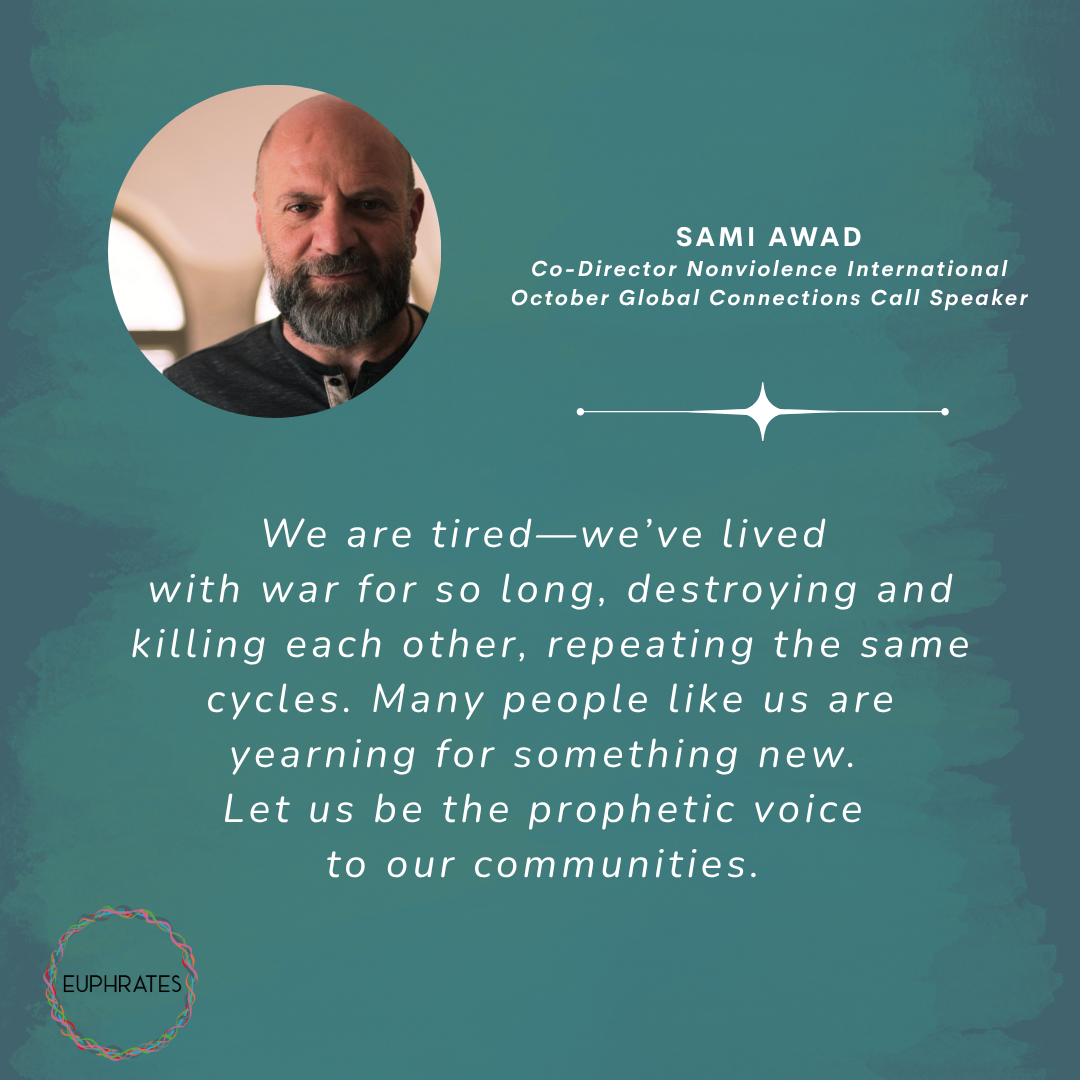
This October 7th, we gathered with peacebuilder Sami Awad to introduce a different energy to the horrific attacks by Hamas, the ongoing oppression of Palestinians, and the long cycles of violence and genocide that have scarred both peoples. Together, we explored how to disrupt these patterns and transform them from within. Sami’s new book, The Sacred Awakening: Reclaiming Christ Consciousness, embodies this call. The words disrupt and dismantle appear nearly ninety times, while peace appears about three hundred, revealing a vision that both challenges and heals. He invites us beyond reaction and ideology toward a deeper consciousness capable of breaking cycles of fear, control, and retribution.
In his message, Sami calls us back to the radical heart of Jesus’ teachings not as a religion to follow, but as a consciousness to embody. He reminds us that unhealed fear and power create destruction, and that peace is not merely the absence of violence but the active presence of love, justice, and humility. Through his reflections, he reframes meekness as strength harnessed for goodness, and courage as compassion in action. This “sacred activism,” he explains, unites inner transformation with courageous engagement. The world, he says, is hungry for something new and that renewal must begin within each of us. We invite you to read the full transcript below or click here to watch the 60 minute recording.
Some Call Nuggets:
Sami reminds us that the roots of violence lie not just in politics or ideology but in unhealed fear—and that reconciliation requires inner healing, not domination. When fear and trauma go unhealed, and when fear combines with power, the result is absolute disaster. True peace begins where fear is transformed, not suppressed.
True strength, for Sami, is not domination but disciplined compassion, courage guided by humility, using power in service of justice. “A meek person is not weak but has channeled their strength toward gentleness.”
Sami redefines peace work as sacred activism, a practice that unites spiritual depth with courageous public engagement, avoiding both passivity and burnout. “Jesus didn’t only meditate or only resist; he brought sacredness and activism together.”
Transformation begins within our families, our faiths, our nations. True prophets hold a mirror to their own communities before confronting the wider world. “Jesus first challenged the systems of his own people before those of others.”
Sami exposes the subtle spiritual danger of ego, fame, and moral certainty. Awakening, he says, is ongoing vigilance - a humility that renews our motives daily. “Power corrupts. The journey of awakening Christ consciousness means checking myself in every moment - deciding from awareness, not reaction.”
Discipleship, Sami says, is not about memorizing doctrines but embodying a consciousness - a lived transformation that mirrors Christ’s way of seeing and being in the world. “Rabbis didn’t teach students simply to learn something—they taught them to become something.”
His closing call is both hopeful and urgent: we are being invited to embody a new consciousness of love, courage, and unity to become the change we seek. “The world is hungry for something new. Let us be the prophetic voice to our communities.”
Full transcript

Janessa Wilder: Thank you again for joining. It feels important to gather on this day, October 7th, as a way of adding a different impulse to the field, to that which perpetrated the horrific attacks on October 7th, the attacks by Hamas. And also, that perpetrated the oppression of Palestinians that preceded that, and the genocide that has followed, or the genocide that preceded this one by 80 years against the Jewish people by the Nazi regime. And what we're talking about today with Sami is a disruption to that cycle and of that mindset. In fact, the words disrupt and dismantle show up 90 times in Sami's new book, The Sacred Awakening: Reclaiming Christ Consciousness. And it should be no surprise that peace shows up about 300 times.
So, to introduce Sami, to get into our conversation, he's the co-director of Nonviolence International and founder of Holy Land Trust, a peacebuilding organization in Bethlehem, which is where he lives and where he joins us from today. When I first met Sami, I was so stunned by his vision that I felt I had to do something to honor it and to honor him, and so it was in his name that I created the Visionary of the Year Award, which he was the first recipient of in 2011.
When I first met him, he has inspired me so much with his humility and his dogged commitment to peace, and also for his courage to voice what people often don't want to hear. And I would have to say, Sami, that this book is no different. It is an extraordinary and profound call. And I was honestly shocked. Because I was thinking about all the things you could have written about, Sami—the Israeli-Palestinian conflict, life under occupation, peace itself, your life, trauma, bridging divides—or you could have written about any peace leader in history: Gandhi, MLK Jr., Mandela, Tutu. But you took on Jesus. But not as a religious figure.
In fact, your book is a direct challenge to what some might see as traditional Christianity. But really, it's holding up Jesus as a radical, revolutionary, spiritual peace leader who challenges structures, systems of religion, governments, organization, or really any structure of control. And I… it's such a courageous act that you would even… were willing and… and felt that this was the time to write this book, so I wonder if we could start there. What compelled you to write this book right now?
Sami Awad: Well, first of all, it is such an honor to be with you. I always love our connection and when we reconnect. I also want to thank you for all the work you have done through decades of engaging in peace work—really challenging yourself and others to discover the essence of what it means to live in peace. It's not just about reaching agreements; it's not about conquering or quieting, but really about that essence of peace and justice you have been working on. I honor the partnership we've had for quite a few years now, and I’m thankful for it.
What pushed me to write the book is people. I never thought of writing a book—never had the intention to. But when I began to discover Jesus outside of Christianity—like I say in the opening line, I had to step out of Christianity to discover Jesus—I had to really let go. And letting go wasn’t just saying, “I’m not a Christian anymore.” There was deep emotional, spiritual, and communal attachment to Christianity itself.
Within Christianity, I was challenged by the notion of learning about a certain Jesus—how he behaved, engaged, taught, and healed—while at the same time encountering a counter-narrative in the church, one embedded in fear, belief, and the concept of salvation: that your sins will not be forgiven if you don’t… even though Jesus repeatedly taught about forgiveness. For me, it was a big challenge to live between those two narratives.
Like many people, I tried to fit them together—to reconcile the kind, loving, confrontational peacemaker Jesus with systems and structures of empire; to hold both love and hierarchy in the same hand. At one point, it became too much, and I had to make a decision. If it was a choice between Christianity and Jesus, I would choose Jesus. I wanted to learn him and follow him. To do that, I had to step out of what faith meant and really see him.
The way I’ve come to see and love him is as an amazing man who walked the very land where I live, proclaiming the kingdom of God—whatever that means. You don’t hear much talk about it, except as something that happens after death. But he was proclaiming it now—teaching, healing, and engaging people where they were. I think this is something largely missing in churches today. We focus on salvation, miracles, and sermons, but we overlook his actual teachings—what he taught his followers to become.
And my journey was to discover what he taught. At the end of the day, no matter what we think Jesus was, when he was here, he was a rabbi—a teacher. Rabbis at that time didn’t just teach students to learn something; they taught them to become something.
Today, we go to school or university to learn. Back then, it was about becoming. They didn’t have education like we do now—you didn’t study various subjects and then choose a career later. From the beginning of your life, you grew up apprenticed into the becoming of something—a carpenter, a fisherman, a rabbi, a soldier.
Jesus was inviting people to become what he was: a person who had attained a higher consciousness—what we might call Christ consciousness. It’s a higher awareness that allows us to engage with humanity differently, to see through a new lens beyond what we’ve been conditioned to see—beyond what we’re born into or shaped by.
And this is where your word “disrupted” fits perfectly. He was aiming to disrupt systems and structures of separation—structures of duality, hierarchy, and patriarchy. And not just patriarchy as male over female, but as any system that divides—top from bottom, those with access from those denied access.
This was his true aim: to manifest what I believe is the kingdom of God at hand—the dream we all carry within us. It’s not a fantasy. We can all envision peace on Earth, and that’s what he was inviting us to do: to turn that dream into reality.
Janessa Wilder: And I love that you bring up the becoming part. This wasn’t something to do, or something he did so we don’t have to. You know what I mean? That’s even a step beyond—like, he’s the doer, and we’re just there passively watching, I guess, or enjoying his sacrifice.
But you say at one point that this isn’t about doing peace; it’s about becoming peacemakers—not making peace, but becoming peace. And what really stands out are the qualities he talks about, and that you highlight in the book—how he lays out the roadmap for us.
Two qualities, in particular, really struck me beyond the disrupting and dismantling—which, over and over again, show him as this revolutionary, rebellious preacher, disrupting everywhere he goes. The other quality is humility. It stood out so clearly, maybe because it’s in such stark contrast to what we see—not just in leaders right now, but in our systems of dense power and domination.
The humility you draw out again and again—the humility he embodied—feels so countercultural. I want to get to the disruption piece in a bit, but can you comment on that seeming paradox? How can you be both so meek and humble, and at the same time, this disruptor—this force of strength?
And one thing—well, I’ll let you comment in a second—but on the humility part, one quote I love that you used is: “A meek person is not weak.” Because I think we often equate humility with weakness. A meek person is not weak, but has channeled their strength toward goodness. But sometimes we even think goodness is weak too. Anyway, I’d love for you to comment on that paradox—and what humility means to you.
Sami Awad: Yeah, yeah. When we say Jesus was a disruptor, he was a disruptor of everything. It's not just about the systems and the structures that are out there; it is also the systems and the structures that are within us—the things that we assume we cannot live without, even the concept of identity, which is so normalized in us, how we even define and identify ourselves immediately. “Sami is a Palestinian…”—blah, blah, blah—Christian immediately, and then we box people into these identities, and we relate to them based on how they identify themselves.
For an Israeli who looks at me as a Palestinian, he sees me differently; for a Palestinian who looks at me, maybe differently if I'm a Muslim Palestinian or a Christian Palestinian—we look at each other differently, and this way we gauge how we relate to them. So he was breaking every single structure. And the biggest structures that he was inviting us to break were the structures within us.
This is where the journey of the Beatitudes for me became the blueprint. Again, in my limited approach to theology and understanding Christianity—even though I grew up in a Christian family, my father was the president of the Bible college; I had church five times a week—many people do not do that. But never was there an explanation of the Beatitudes as more than, again, sermon material—bumper stickers to be used: “Blessed are the peacemakers,” “Blessed are the poor in spirit.” If you are this, then you will be blessed.
Sami Awad: I think the first invitation to begin to break things within us is actually in the first two or three Beatitudes. “Blessed are you when you become poor in spirit”—this was his invitation. He was inviting us into poverty. He was inviting us into letting go of attachment. He was inviting us to the first step of living love, which is to break fear. When we are attached—emotionally, physically, materially—to things, we're always afraid of losing the thing we're attached to. So the first step he invites us to is this step of poverty.
Then the second step is the step of mourning and grieving, of burying what is old so that we can open up the possibility of what is new. This is the story of the resurrection over and over again—how do we bury and bring to death and mourn and grieve what has passed, not to hold on to the illusions or the stories of it, so that we can open up to manifest the new? And then that's where the beauty of meekness comes in—the third Beatitude, where he says, “Blessed are the meek.” Many times, especially for people engaging in spiritual practices or enlightenment, the ego jumps in: Look at me, how great I am. Look at what I've let go of, look at what I've healed. I need to be honored, respected, identified with the things that I have done. And immediately he jumps in and says, oh—let us be humble in this; let us be meek in this.
For me, meekness is like working with a horse. Making a horse meek is not about dismantling its power; it’s about harnessing that power for the right time and the right conditions.
Goodness is one expression of that. Standing for righteousness and justice that comes out of meekness is another—when we stand for justice in the face of atrocities, genocide, or racism. We’re not just reacting; we’re channeling that inner power of righteousness through meekness and directing it toward goodness.
The profound thing about Jesus being so powerful was that he was meek—that he was humble. He engaged with people around him from that place of humility. He became a famous rabbi during his time—people followed him widely—and yet, he would look through the crowd, find the one who was most marginalized, go to them, ask them a question, and sit with them. We don’t hear many of those stories in the Bible, but you can imagine how he carried himself—with humility, gentleness, and deep presence.
It was in that humbleness that people followed him—not out of fear, as we often follow leaders today, but out of love and trust. They wanted to follow him because he was humble. And that is such a beautiful gift.
We’ve had other leaders in history who embodied this spirit; he was not unique in that sense. That’s part of the beauty of Jesus—he set the roadmap for us, and others have walked it too, whether or not they even knew him.
When I see a leader in our community who serves others with humility and meekness, I want to know that person. When I see a peacemaker—Palestinian or Israeli—who comes from that same place of humbleness, not ego, not “I want to make peace with you because I know better,” something in me connects with them.
At the essence of our humanity, we are drawn to leaders who embody that spirit. But sadly, the systems and structures we’ve lived under for so long make us follow leaders out of fear—fear of exclusion, fear of punishment, fear of rejection. And we see this growing today, even in times when we’d hope such authoritarian, dictatorial systems would have been dismantled. Instead, we see leaders leading through aggression, fear, lies, and manipulation. And people follow them—for reasons I can’t fully explain—but I know fear is a big part of it.
Janessa Wilder: And I think, too, they just take up so much space—whether it's that they were the ones who have attracted millions of followers. You talked about meekness not being a platform for our wisdom—not in the number of followers or in the roles they're ascribed to. It almost demands a humbling of ourselves to even have the intuition to recognize that meekness and humility—that there is strength—rather than being a doormat or insignificant. It takes the humbling in ourselves to recognize the humility and meekness in someone else. It's really interesting how even that's a two-way street.
Sami Awad: I have to admit that part of my hesitation in writing the book comes from this very reason. I did not want to become the reference—the one, the so-called knowledgeable authority on this subject. Even writing the book, or posting about it on social media, I hesitate every time. People keep encouraging me: You need to do this. You need to come on this webinar. You need to give this interview. But honestly, it holds me back.
Because I know there is something in power—and we all know this—power corrupts. It’s very important for me to keep checking in with myself deeply. I go back to that question: What do I bring into poverty? What do I let go of? What are those invitations that are so tempting?
I talk in the book about the temptations Jesus faced as ego temptations. Where does my ego show up in any setting that whispers, “Oh, Sam, you’re going to get credit for this. You’re going to become famous. You’re going to make money.” And then I have to take a breath and tell myself: Check yourself. Learn to say no. This is what Jesus was doing when he faced his temptations—they were the temptations of his own ego, challenging him in those moments. And he had to go through them. These temptations never really stop; they just keep coming and coming.
But this is the journey—the journey I see Jesus engaged in. It’s the journey of awakening Christ consciousness within us: the ability to stay aware of everything happening within and around me in every single moment—and to make each decision from that place of awareness and being, rather than from a place of reaction.
Janessa Wilder: Before we get into the peacemaking Beatitude, I want to touch on this a bit more, because I cannot imagine, Sami—taking on a subject as huge as this, and as directly challenging to every system you can imagine—what resistance came up in you? You talk so many times about the temptations that Jesus faced and the resistance, and then the courage that we each have to have as peacemakers, because this will—this does.
I'm sure everyone on this call experiences this kind of resistance and the need to cultivate that courage to push through to do anything in peacebuilding, 100%, but also anything that's good often inspires an equal amount of resistance. Do you want to give us a vignette or an example of resistance that came up for you in, or external to, this book? And how did you harness the courage?
Sami Awad: Yeah, thank you. I want to share one experience I had with my uncle Alex—he’s a pastor; I don’t know if you’ve met him before. He was the pastor of the East Jerusalem Baptist Church here. He’s retired now and lives in Oregon. He has always been such a dear and inspiring teacher to me throughout my life.
He received the book and read it, and then he told me, “We need to talk.” And I thought, Oh my goodness… what is he going to say now? When we got on the phone, he said, “Sami, I just want to say—I love your book. I love what you wrote. I’m learning so many things from it, things I never learned in seminary—things about Jesus that I never knew, never even thought of.”
Then he paused and asked, “But why? Why did you have to attack Christianity so much in it? Why couldn’t you just talk about the teachings and leave that part out?” That was one of the experiences I’ve had, and I’ve had a few people ask me that same question—why?
But I think, at my essence, it’s not coming from a place of anger. It’s coming from a place of love. Because I really…
Janessa Wilder: That's so clear. Oh my gosh.
Sami Awad: I know many people who leave religion—Christianity or others—and go immediately on the attack. But in the essence of Jesus’ teachings, that reaction shows that they never truly mourned; they never grieved their past or their experience.
I went through that myself. I had my anger, my frustration, my resentment toward Christianity and the church. But it’s not my intention to live in that energy. So I made myself go through the grieving process. I reflected deeply. I mourned that chapter of my life so that I could open up into a new one.
I understand those who are angry—especially people who’ve experienced real violence in the church. Many, many people have suffered unspeakable harm within religious institutions. But if we want to live fully and manifest something new, we have to learn to let go.
So when I write about what Peter and Paul did, what the early church fathers did, and what the church has become today, it’s not from anger. It’s from compassion and love. It’s a challenge, yes—but one rooted in love.
As I say in the book, if the church had truly commanded us to live just five or ten percent of Jesus’ teachings—if, alongside tithing or ritual observances like eating fish on Fridays, they had said: We need you to practice humility. We need you to engage in peace work in your community. You can’t come to church unless you live the Beatitudes—imagine what the world would look like.
I really believe the church has an opportunity now to reconnect to Jesus and his teachings. And I don’t say that only for the church—the invitation is for everyone. Jesus was a man who came first to his own people, but he soon realized his message was greater than any single group, and he opened it to the entire world.
If people everywhere truly began to follow the teachings of Jesus—not as someone “more special” than other great spiritual teachers who also attained higher consciousness—but as one who modeled that awakening—then our world would be a very different, much better place. But because Christianity adopted Jesus, the challenge is especially strong for Christianity to reflect honestly on what it has become. And sadly, sadly, sadly, it has become…
Sami Awad: …a version of what Jesus was rejecting and trying to dismantle in his times. And I don't say it was done intentionally. We live in a prevailing consciousness where structures and systems like this are probably meant for good, but they still fall into a consciousness of duality and separation and hierarchy and fear and abuse and control. If we begin to shift out of that consciousness into kingdom consciousness, what would these institutions look like? That's the question I invite us to be in.
Janessa Wilder: Right—and you invite us into that larger question, too. It's not just about dismantling a system of oppressive religion. It's all of it—politics, society, gender—any structure or organization that would separate or create hierarchy.
Sami Awad: It goes to the most basic level of how we love each other, how we are intimate with each other. When we say we love somebody unconditionally, what does that really mean? Where do our expectations come in? Our assumptions? Our control mechanisms? Our fear of losing them? This matters even in what we think of as dictatorship and control—it exists on every level of our lives, even in how we raise our children. Do we raise them from a place of fear—if we don't do this, they'll become that; if we don't teach this, they won't have jobs? There is so much fear embedded in our most intimate, daily relationships. Again, it's not about right or wrong—this is the consciousness; these are the systems we live in.
Janessa Wilder: Live and move and breathe and…
Sami Awad: Exactly—and we need to begin to think differently, become differently, and maybe even begin to create differently. What are systems that embody unity, love, community, trust, and respect with each other? This is a big calling. Some people might say this is utopia, dreamland. Well, this is what Jesus was about—dreaming the big dream and inviting us into it. So why don't we do it?
Janessa Wilder: And not some far-off dream, but present now—which I love how empowering that is.
Sami Awad: From the beginning, if I ask everybody to close their eyes for a minute in this session and just imagine the world in peace…I think we’ll all have the same image: how people relate and engage with each other; how we relate to nature; that there isn’t scarcity but abundance; love and compassion. We can all imagine that world. We know it is possible. So it's not engaging in something impossible. The question is: how do we make what we think is impossible become a possibility in our lives?
Janessa Wilder: It's helpful to remember that the invitation is there—and that consciousness is there, accessible to each one of us. The call is there; will we answer? Will we see through those eyes? Will we humble ourselves so that we have that vision? It's always available. I want to get to the heart of what matters to this audience: peacemaking. You spend a lot of time in the book on what peace is. Of course, it goes back to the Beatitudes—“Blessed are the peacemakers, for they shall be called the children of God.” There’s so much in that one. I love the notion of peace you start with as a challenge: not just singing kumbaya or a quiet, safe environment, but not merely the absence of external conflict—the presence of something deeper: justice, harmony, equality, purpose, abundance. If we can, let’s start with your definition of peace and what Jesus invited us into.
Sami Awad: When I first started writing the book, it was about how we become peacemakers.
Janessa Wilder: That was going to be the whole focus of the book?
Sami Awad: Yes—the last Beatitude, the journey of becoming a peacemaker. Then I discovered that Jesus was talking a lot about the kingdom and about becoming like me. As I explored that, the book expanded to include both kingdom consciousness and Christ consciousness.
I’m glad I didn’t write it five years ago; I would have missed that understanding. Back then, I was still thinking about peacemaking in a very dualistic way—mainly as the absence of violence, not the manifestation of righteousness and justice. I saw peacemaking as getting Palestinians and Israelis to sit together and reach some agreement—peace as the end of violence, a kind of coexistence where both communities could live side by side. That’s the prevailing consciousness: no wars would be great.


But I began to see that Jesus was inviting us to something much greater—the kingdom, the attainment of a higher consciousness, and the manifestation of that consciousness on Earth. He was calling us to become sacred in our peacemaking, not just political or ideological. I don’t think it’s either/or—it’s a way. What I find deeply comforting in Jesus’ life and teachings is that he didn’t do what many people try to do today: focus only on inner peace and avoid everything external. The “I’m too busy working on myself” mindset. Inner peace is beautiful, but it’s incomplete—it’s missing a vital component.
On the other side, we have the resisters—those who say, “Stop them. Attack them. End injustice.” These are the angry activists, filled with bitterness, hatred, and resentment—understandably so—but the anger overtakes them. They burn out. They fail. They give up.
Jesus invited us to bring both together—to hold sacredness and activism as one. That’s where the idea of sacred activism began for me. How do we engage our personal spiritual journey and, at the same time, test that journey through how we engage with our communities and the world’s tragedies? How do we stand, as Jesus did, strong against the systems and structures of power?
Interestingly, he first challenged the systems of his own people before he challenged those of others. He challenged the Jewish institution more than he challenged the Roman Empire. He understood that the Roman Empire had to be dealt with. But you cannot confront an empire if, as a Jew then—or any group now—you only claim victimhood or oppression. You also have to take responsibility.
He warned his people not to become obedient—or worse, compliant—with that system. Many of their leaders had aligned themselves with Rome, selling out their own people for allegiance and power. Jesus called them evil. He was a rebel. He challenged the system to its very core.
People often know the story of him turning over the tables in the temple, but they don’t always understand what that act meant. He knew exactly what he was doing and the sign he was giving. It wasn’t just about flipping a few merchants’ tables—it was about striking at the heart of the system of occupation and oppression over his people.
It’s similar to Gandhi’s salt march—weeks and months of study, scenario planning, and strategy before taking a single step to confront the British Empire. Or like the Montgomery bus boycotts—carefully planned, strategic, anticipating how power would react, practicing nonviolent discipline, and then engaging. In that sense, Jesus was the first strategic, nonviolent activist. When he turned the tables, he had studied it. He was deliberate. His disciples probably said, “This is too much, too early.” But he said, “No—this is the time.”
Janessa Wilder: But he also had the internal readiness—like Gandhi. His followers said, We’re ready; let’s act. He said, No, you’re not ready. It took years of internal emptying, humbling, dedication to righteousness before they could challenge. So it’s both: external strategy and internal work. How do we know when we’re ready?
Sami Awad: I think we will know—that’s the point. For me, I keep asking: What is the salt in the context of our occupation as Palestinians? What is the Montgomery bus boycott we need to do? And when will we be ready? These are deep questions for me, because I live under occupation; I live in times of genocide that break my heart. I never thought I would see what is happening to us. At the same time, I ask: What can I do?—not from hatred, resentment, or revenge, but from understanding, healing, love, compassion, and a resistance that leads to transformation. This is our call.
Janessa Wilder: And balancing the sense of urgency—people are dying; we must act—how do we navigate that? Is it a false urgency? External fear? A lack of trust in the bigger picture?
Sami Awad: We are called to act and to respond—absolutely.
I was on a call a few days ago, and someone asked, “If Jesus were here today, looking at what’s happening, what would he do?” Honestly—and not because I’m an activist—I believe he would be on one of the flotillas, on one of those boats, saying, “I need to go into Gaza. I need to help those who have been pushed to the margins in that land.”
And it wouldn’t be just against occupation or Israelis—it would come from compassion for the people living in that suffering. That’s what Jesus would do. And he would probably pay the price for it. I’m not saying this as a political ideologue; I’m saying it from kingdom consciousness—from asking what Jesus, carrying Christ consciousness, would do today.
He wouldn’t sit comfortably in a house in Jerusalem, Bethlehem, or Nazareth, just teaching more sermons or only praying—though I love prayer. He would do something. That’s why we return to that verse: Jesus engaged. He walked. He met. He taught. And he healed.
Healing is action—the sacred action he chose to engage in during his time.
Sami Awad: He would be challenging the authorities—Palestinian leadership, Israeli leadership—both of them. He would ask, What are you doing? What motivates you? Why are you doing these things? What’s behind it? And he would understand that at the core of it all is fear. Everything happening in this land is rooted in fear. And when fear combines with power, that’s when disaster arises. As I’ve said for many years: when absolute fear meets absolute power, you create absolute disaster. I never thought that disaster would become as immense as the one we face now.
This is what happens when fear and trauma go unhealed—when reconciliation doesn’t occur. It’s the failure of the peace process we’ve been in for years, manipulated by political players with economic and ideological interests, not by those truly seeking reconciliation among the people. What we’re witnessing today is the failure of a hundred years of war and peace in this land.
Janessa Wilder: Sami, I love how clear you are about the roadmap Jesus laid out—and how he commanded his followers to go and do likewise. You also write that each of us has diverse callings: some of us are teachers, some are musicians, each with our own way of living this out. That gives me hope. And I should ask—why aren’t you on the flotilla, following in Jesus’ footsteps? Why aren’t we all? Are we each meant to do different things? How do you square that?
Sami Awad: I think if we all begin to live the teachings of Jesus—especially the Beatitudes and the Sermon on the Mount—we will see change in our communities, and then in our nations. Jesus gave this message two thousand years ago; let us begin to live it now. We’re not going to end all wars. Genocide is happening not only in Gaza, but in Sudan, in Congo, in so many places around the world—in our homes, in our nations, in the gun violence in the U.S. It’s everywhere. So let us begin to live this now. Jesus called us to create communities—not churches—but communities where people come together and practice what he taught us.
And yes, I agree with you: some people need to get on the flotillas. But the teacher in a classroom can teach the Beatitudes to students—to help raise a generation that doesn’t repeat these cycles. We must understand that even if peace comes now, even if a Pax Romano–style agreement is reached between Palestinians and Israelis, it doesn’t prevent another disaster from happening ten, twenty, thirty years from now. To prevent future wars and genocides, we must begin now—stop what’s happening today as best we can, but not remain silent once it ends. We must mobilize ourselves to become peacemakers.
Janessa Wilder: That’s powerful. There are a billion questions we didn’t get to, but I want to open it up for others to engage. Even if you haven’t read the book yet, Sami’s always up for any question or reflection. Please keep them brief so we can hear from as many people as possible. Isabelle, I invite you to unmute and ask your question to kick us off—and if others would like to ask something, please raise your hand or use the chat.
Isobel Davis: Sami, thank you so much—and Janessa as well. This has been so rich and wonderful. I was writing my question in the chat and realized you were answering it as I wrote! But perhaps there’s still more to explore. I’ve come to understand that inner peace—personal peace—must involve relationship: in family, in community, even as we see in the news. But the disconnect for me—living on an island off Washington State—is that wars and conflicts feel so intellectual, distant. It’s hard to know what the next step is. Of course, I ask God, What am I being called to do?—hopefully with less fear, without narrowing what’s possible. Maybe that’s my question: what’s the next step of action? And maybe, too, more consistent prayer—so I don’t just throw a prayer into the wind and forget for a month. How do we stay engaged?
Sami Awad: Thank you, Isobel. To be quick—one of the things about the Beatitudes is that they’re not sequential steps you complete one by one; they’re an ongoing, evolving, rotating process. And I say this as a beginner myself. I wrote this book for me more than anyone else—as a study guide for my own learning. I’m reading it again and taking notes, reminding myself, This is what I need to do now.
What we’re invited to do, individually and collectively, is to attain a higher consciousness. Jesus said something we rarely hear sermons about: You can do greater things than what I have done. I’ve asked pastors to preach on it, and they usually avoid it. But my interpretation is this: Jesus was a man doing this work alone, having attained a higher consciousness. He invited others to learn what he had learned—to form a community. He knew that unity and oneness—a collective of people who have awakened to that consciousness—can create greater transformation in the world. That’s why he said, You can do greater things, because together we can.
So my invitation to you—even living on an island—is to ask who around you can begin this work with you. We now have the gift of connection through social media, the internet—we can join hearts globally. I see people here from many countries. Let our voices be heard. I truly believe people everywhere are thirsty for something new. They are tired of the systems we’ve been living in—even the powerful are tired. As you know, we must liberate both the oppressor and the oppressed from the oppression. There is fertile ground everywhere to plant new seeds.
Janessa Wilder: Thank you, Isobel. Jamie—would you like to share your reflection next?
Jamie Stock: I’m getting so much out of this, Sami. I already ordered the book and can’t wait to read it. I love that you said you had to let go of Christianity to discover Jesus. That resonated with me. When we step outside the institution—the religion, the structure—we can really find the essence. It becomes universal. I admire your bravery to take this on and focus on Jesus. It becomes non-denominational. Thank you, and I look forward to reading your book.
Sami Awad: Thank you. And I’ve created pages for the book on Instagram and Facebook where people can share questions, comments, and reflections. My hope—humbly—is to create a movement of people like you and me who are questioning, exploring, and finding answers beyond what we’ve inherited or been told by institutions.
Janessa Wilder: Tom is clapping! Thank you. Suzette and Tom, let’s go back to back since we only have a few minutes left. Please share your reflections, and then we’ll let Sami have the final word.
Suzette Perkins: Thank you so much. I love that you started intending to write one thing, but as you listened, you followed that inner guidance without fear. That, to me, is the perfect example of living what you’re teaching—listening. I’m reminded of Martin Luther King Jr. in Selma—I saw that film five times. I love the scene on the bridge, where he kneels, surrounded by people, seeing what’s ahead, and then finds the courage to turn back. And later, they cross. That moment of humility and timing—listening—that’s what you’re embodying here. Thank you for your example, and thank you to Euphrates for continuing this kind of work every day. Bless you all.
Sami Awad: Thank you, thank you for that.
Tom Kotlarek: Thank you, Sami. Your book is awesome. I know Yeshua deeply, and I’d love to network with you. I’m building a community with people across Africa—Wazieh Offuh, James Offuh—they’re part of it. I agree fully with your vision. We can do more than he did as a person. I practice the sweat lodge ceremony, and I’d love to connect.
Sami Awad: Wonderful. Please join the Facebook or Instagram community—we can continue there if I don’t get your contact here.
Tom Kotlarek: Facebook’s tricky unless it’s Messenger, but take my info—email, WhatsApp, whatever works.
Sami Awad: Perfect. Thank you. Love your energy—bless you.
Janessa Wilder: There’s a comment from Emmanuel—someone else truly walking in Jesus’ footsteps. He’s in Cameroon. Even when his family had to flee for safety, he stayed because he said, I have to be here for my community. He was sleeping in different churches, constantly in danger. There are so many people like him, Sami. I wish my last question could be this: how can we support you? How can we support this message? You’ve shared some ideas—joining the community, engaging with the reflections in the book—but is there anything more we can do to live into this?
Sami Awad: Thank you. I’m truly touched—moved to tears by the comments and words being shared. This moment, this connection, is the greatest gift I could receive right now.
I say this as someone living in Bethlehem—where the great one was born—and remembering what he taught us and the world. The invitation is for all of us to begin to follow him—truly follow his teachings. He is amazing—so full of love, light, compassion, and fun. He was also a joker. So let us come together as often as we can. I want to support you as much as I can, because I believe this is the new manifestation of Christ consciousness, and the world is ready for something new.
The world is hungry for something new. We are tired—we’ve lived with war for so long, destroying and killing each other, repeating the same cycles. Many people like us are yearning for something new. Let us be the prophetic voice to our communities.
Thank you, everyone, for the work you’re doing. Lots of love to all of you. Thank you.
Janessa Wilder: Let’s close with a moment of silence, as we began. Let this gathering of love—this message of profound love and compassion—go out to all who are not on this call and radiate outward. May this work be multiplied. Thank you all so much for joining. It means so much that you shared in this conversation and in this field. And what a day to do it—on this two-year anniversary of October 7th—so we don’t repeat the same cycles. Love to you all, and deep gratitude to you, Sami, for your courage.